


The customs figures behind “Iranian quality saffron is exported, its counterfeit imported” do not show Iran importing hundreds of thousands of tonnes of fake saffron. They refer to sunflower-seed and safflower oil under a vegetable-oil tariff heading. Safflower petals can be misrepresented as saffron in a different transaction, but edible oil imports are not evidence that this happened.
What the 2019 customs report recorded
The original article said that, during the first five months of the stated year, Iran imported 321,447 tonnes in a category translated as “sunflower oil, safflower oil or false saffron.” It gave the value as $275.981 million and described the category as eighth among the country’s imports.
It also reported year-on-year growth of 218.41% by weight and 186.98% by value. According to the article, the category represented 2.26% of total imported weight and 1.42% of total import value during the period.
Those numbers are preserved as the article’s five-month customs report. The conclusion drawn from them was wrong because the product description was misunderstood.
The tariff heading is for vegetable oil
The United Nations Statistics Division’s HS classification detail for heading 1512 identifies the goods as sunflower-seed, safflower or cotton-seed oil and their fractions, whether or not refined but not chemically modified. Its subheadings distinguish crude from other sunflower-seed or safflower oil.
Nothing in that heading describes dried safflower petals sold as a spice, and nothing calls the oil counterfeit saffron. “Safflower” and “false saffron” became conflated when the plant’s colloquial name was inserted into a customs description.
The scale is consistent with bulk oil. The WITS presentation of UN Comtrade data records Iran importing about 695.97 million kg of crude sunflower-seed and safflower oil in full-year 2019, valued at about $549.49 million. That annual total is separate from the article’s first-five-month figure, but it confirms the kind of commodity involved.
What safflower actually is
Safflower, Carthamus tinctorius, is a real oilseed crop. Its seeds are used to produce edible oil. Its flower heads carry yellow, orange or reddish florets that have also been used as colour material. It is not lily of the valley, as the old translation claimed, and it is not the saffron crocus.
Saffron is made from the dried stigmas of Crocus sativus. The two plants differ botanically, physically and in the compounds responsible for aroma, taste and colour. A legitimate bottle labelled safflower oil and a legitimate packet labelled dried safflower petals are not counterfeits. The problem begins when one product is represented and priced as another.
Why safflower is sometimes called false saffron
Dried safflower florets can add a yellow-orange colour to food. In some languages and markets, that visual use has produced names such as false saffron or poor man’s saffron. The nickname does not make safflower illegal or unsafe when it is accurately labelled.
It does make substitution easier to explain. Petal fragments may be mixed with saffron threads to increase apparent volume, or coloured plant material may be sold entirely as saffron. That is misrepresentation. It should be demonstrated from the sampled product, seller and test result—not inferred from national oil-import totals.
Iran can export saffron and import oil without contradiction
Countries regularly export products in which they have a strong production base while importing unrelated foods or inputs. Iranian saffron exports and Iranian vegetable-oil imports serve different supply chains, customers and uses. One does not cancel out the other.
The headline creates a dramatic exchange—quality goes out, counterfeit comes in—but the data never established that exchange. At most, it placed two facts beside each other: Iran was a major saffron exporter, and Iran imported a large volume in a sunflower/safflower-oil code.
How a buyer can distinguish the products
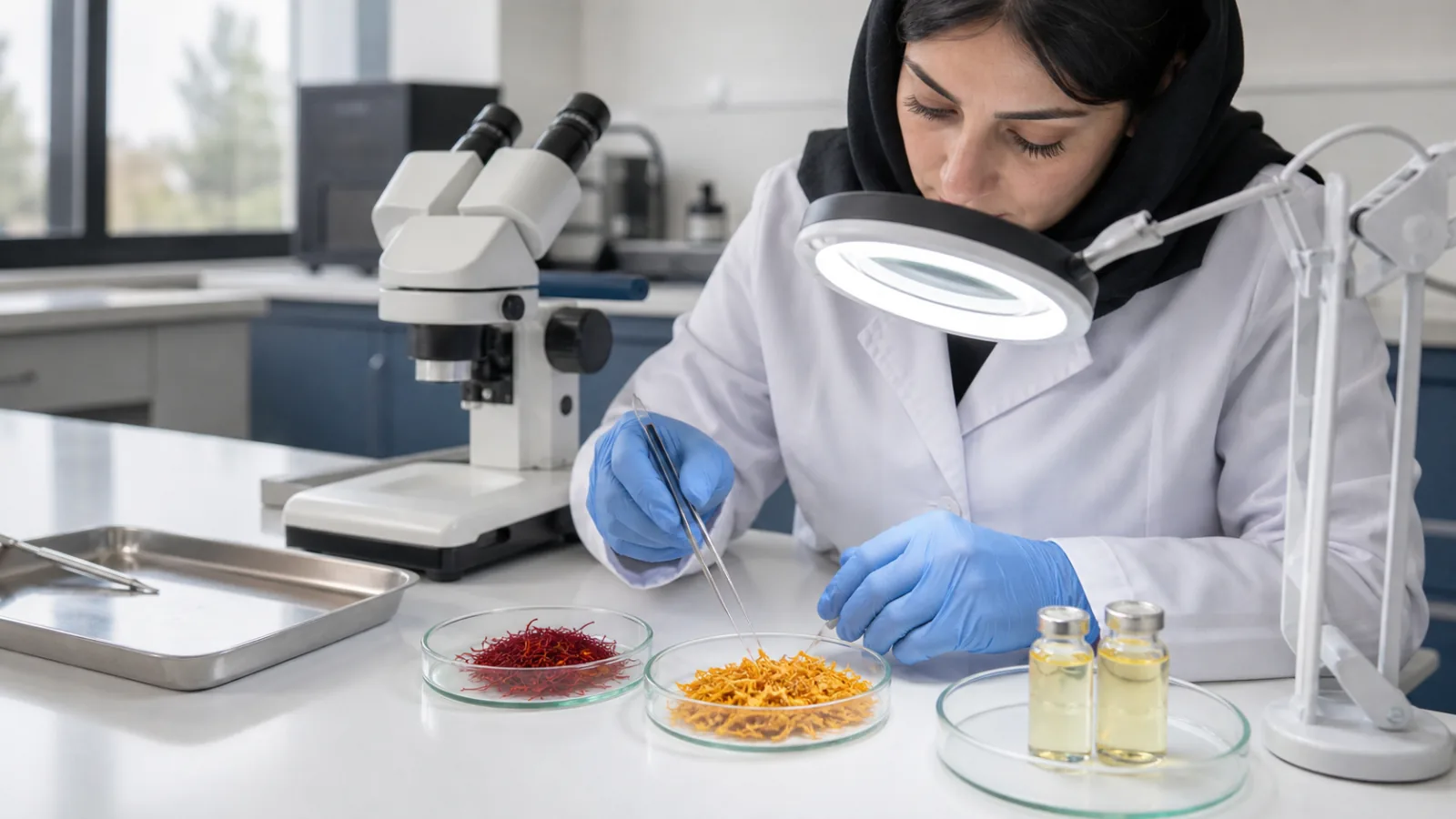
Whole saffron threads are usually easier to inspect than powder. A genuine thread is a stigma: narrow through much of its length and broader or trumpet-like at one end. Colour can vary with the cut and handling, but strong lots are predominantly red. Safflower material tends to look flatter and more petal-like, without the same thread structure or characteristic saffron aroma.
Visual inspection is useful for finding obvious foreign matter. It cannot establish purity by itself. Dyed fibres, mixed plant material and powdered substitutes can defeat a quick look, and colour release in water is affected by particle size, drying and the test conditions.
Our practical guide to identifying counterfeit saffron explains what a consumer can check and where home observations stop.
What representative testing should cover
A commercial decision should start with a sample that represents the lot. Sampling only the top of one container can miss material distributed unevenly through a shipment. The chain of custody, lot number, container count and sampling method should be recorded before results are interpreted.
ISO publishes standards specifically for saffron. ISO 3632-2:2010 sets out test methods for dried saffron in filaments, cut filaments and powder; the specification part was updated as ISO 3632-1:2025. A laboratory may combine the applicable standard methods with microscopy or other validated identity tests when substitution is suspected.
A result should state what was tested. Colouring strength or moisture alone cannot prove botanical identity, and a pass on one measure does not guarantee that every fraud route has been excluded.
How to report a suspected counterfeit responsibly
Keep the product, package, receipt and lot information. Photograph the item before opening it further, separate it from stock still for sale, and avoid accusing a named business publicly on the strength of a home test. A competent food authority or accredited laboratory can advise on sampling and evidence.
For an importer or distributor, the supplier specification should define Crocus sativus, physical form, crop and origin information, allowed foreign matter, test basis and the remedy for a failed lot. Repeatability across deliveries is more protective than a decorative certificate with no link to the supplied batch.
The corrected conclusion
Safflower can be used honestly as an oilseed, a food colour ingredient or a named botanical product. It can also be used dishonestly if petals or other material are passed off as saffron. Those are separate facts.
The 2019 import statistics concerned vegetable oil and cannot support the claim that counterfeit saffron was being imported at that volume. Protecting Iranian quality saffron requires accurate tariff reading, representative product testing and traceable lots—the same discipline needed before making a fraud allegation.

![Exporting Saffron to Turkey + Price Guide [Complete 0 to 100]](https://img.rowhanisaffron.com/20260827003933/saffron-export-turkey-quality-inspection.webp)



