Pure saffron ways to identify counterfeit begins with an important limit: no kitchen trick can certify a saffron lot. Appearance, smell, texture and a simple paper or water check may reveal an obvious problem, but sophisticated adulteration requires appropriate sampling and laboratory analysis.
A 2016 Iranian Students News Agency (ISNA) report described several suspected fraud methods: adding fat, honey, salt or sugar to increase weight; introducing artificial colour; mixing in other plant material; and colouring pale parts of the saffron plant itself. Some of its warnings remain useful, but the original also contains a corrupted price and overstates what a consumer can prove at home.
What pure saffron should contain
Saffron is the dried stigma of Crocus sativus. Whole-thread saffron should therefore consist of characteristic stigma pieces rather than an unexplained mixture of fibres, powder, crystals or glossy clumps. Natural variation is normal; absolute uniformity is not proof of purity.
The International Organization for Standardization explains that ISO 3632 methods assess saffron’s colour, flavour and aroma and look for foreign matter. ISO also notes that powdered saffron is more vulnerable to adulteration because its structure is no longer visible. A claim that a product “meets ISO 3632” should be supported by batch-specific evidence, not merely printed on a page.
Method one: adding substances to increase weight
The ISNA report says fraudsters may coat saffron with fat, honey, sugar or salt, allow it to dry and sell the added weight as saffron. An unusually sticky, crystalline, damp or greasy lot deserves scrutiny. Threads that adhere in unnatural clumps or leave an obvious oily patch on plain paper may also warrant investigation.
The paper test is a screening observation, not a verdict. Handling, moisture, packaging and natural compounds can affect how a sample behaves. Crushing valuable saffron between fingers also damages the product and does not identify the added substance. If the purchase matters commercially, retain the lot and package, document the concern and send a representative sample to a competent laboratory.
The original price claim is corrupted
The source says saffron was worth more than $5,000 per gram. That would mean more than $5 million per kilogram and is plainly not a credible market statement. The translation may have lost a kilogram unit, currency or comparison, but the intended figure cannot be recovered safely.
The commercial motive for adding weight does not depend on that number: saffron is valuable relative to most dry ingredients. Still, an inaccurate price should never be used to dramatise the risk. Use a dated quotation for a named grade, quantity and pack rather than an old article’s damaged unit.
Method two: artificial dyes and coloured substitutes
The report warns about artificial colour applied to saffron or substitute plant material. It also refers to a product translated as “flower of Mecca,” often supplied as powder, but the English name is too uncertain to identify the plant reliably. It should not be converted into a definite botanical accusation.
The US Food and Drug Administration’s food-fraud guidance uses expensive saffron as an example of a product that may be bulked with other plant material. It also explains that dyes can be added to spices to alter their apparent quality and that some unauthorised industrial dyes present health concerns. This does not mean every added colour has the same hazard or that every vividly coloured sample is fraudulent.
Method three: colouring pale saffron tissue
Another method described in the source uses saffron’s own natural colour to stain pale or white plant parts before mixing them into the saleable threads. A seller might then claim that nothing except the saffron plant was added. That claim avoids the real question: whether the pack contains the part and grade stated.
The report calls this technique common but provides no survey or prevalence data. Consumers may find it difficult to recognise once the pieces are coloured. Laboratory microscopy and chemical profiling are more reliable than a seller’s oath or a visual glance.
What genuine saffron threads look like
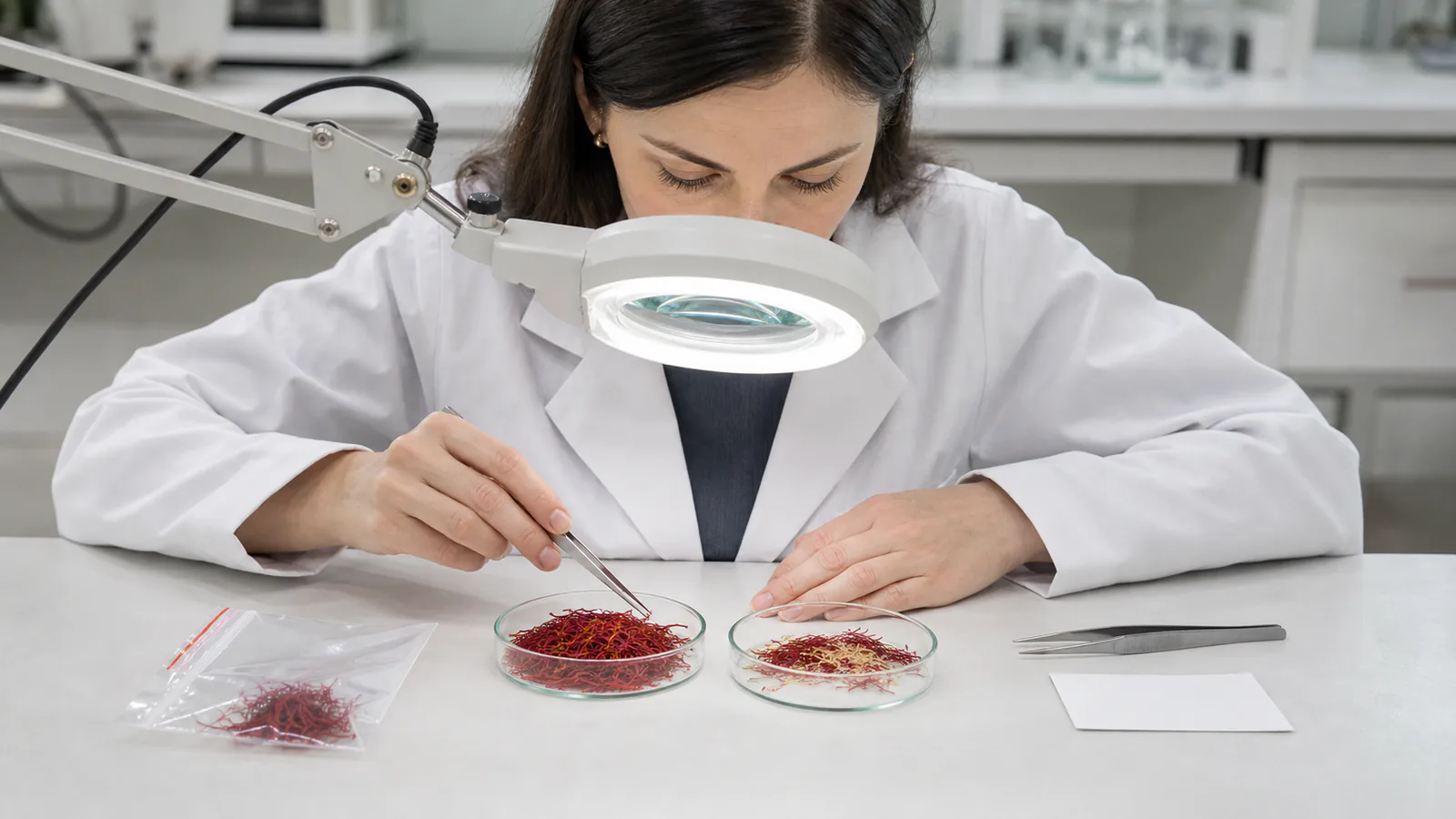
The original compares saffron with a clove and describes a narrow lower part and a flattened, wider end. In practical terms, many intact stigma pieces widen or flare toward one end rather than remaining like uniformly cut red fibres. Shape can help distinguish obvious imitations, especially under magnification.
Colour should generally be deep red, but colour alone is a weak test. Grade and the amount of yellow style tissue can vary. Excessive surface shine, identical fibres, visible sugar or salt crystals, an oily coating, or many unrelated plant fragments are reasons to ask more questions. None of them proves the exact adulterant without analysis.
What a simple water check can and cannot show
A few threads placed in cool or lukewarm water should release colour gradually while retaining recognisable fibrous structure for a time. A sample that instantly sheds a strong surface dye or leaves pale unrelated fibres may be suspicious. Water temperature, thread size, crushing and natural quality all affect the result.
This check cannot certify purity, grade or safety. Genuine saffron can colour water strongly, while a carefully chosen substitute can behave plausibly. Do not taste an unknown or suspect sample as a fraud test, and do not use household chemicals on something that may later be consumed.
Why laboratory testing is stronger
A laboratory can combine methods rather than depend on one sign. Depending on the question, analysts may examine morphology and foreign matter, measure moisture, assess the compounds associated with colour, aroma and flavour, or screen for undeclared dyes and other materials.
The US FDA publishes a macroanalytical method collection for spices that includes saffron. In Iran, the Food and Agriculture Organization and Mashhad University of Medical Sciences announced work in 2025 on stronger saffron-authenticity methods, including high-resolution chemical fingerprinting and practical guidance. The project also notes limits in relying on routine methods alone for sophisticated fraud.
Sampling matters as much as the test
A laboratory result only describes the material that reached the laboratory. A single clean thread chosen from the top of a large pack cannot represent a mixed lot. Commercial buyers should agree how units are selected, combined, sealed and identified before analysis.
Keep the original package and lot information. Record the supplier, purchase date, weight and condition. If a result may lead to a complaint or legal action, use a chain-of-custody process and an accredited laboratory capable of answering the specific question.
Safer buying reduces counterfeit risk
Buy whole threads when practical, because their structure is easier to inspect than powder. Choose a seller who identifies the product and lot, states the net weight, explains available test information and can respond to a quality concern. A sealed pack is useful for traceability, though attractive packaging alone proves nothing.
Be cautious when a price is far below comparable offers, but do not treat high price as proof of authenticity. Ask what grade, origin, testing, pack and delivery terms explain the difference. For bulk purchases, specify acceptance criteria before payment and retain an agreed reference sample.
Historical production context
The 2016 ISNA article closes by saying world saffron production was nearly 300 tonnes, Iran produced more than 250 tonnes and held more than 90% of output. Those are historical, rounded claims and should not be used as current statistics. Their relevance here is economic: a large, valuable trade creates incentives for both quality assurance and fraud.
Identifying pure saffron is therefore a process, not a trick. Start with the supplier and lot record, inspect whole threads for obvious anomalies, use home observations only as warnings, and turn to representative laboratory testing when certainty matters. That approach is less dramatic than a viral “instant test,” but much more dependable.