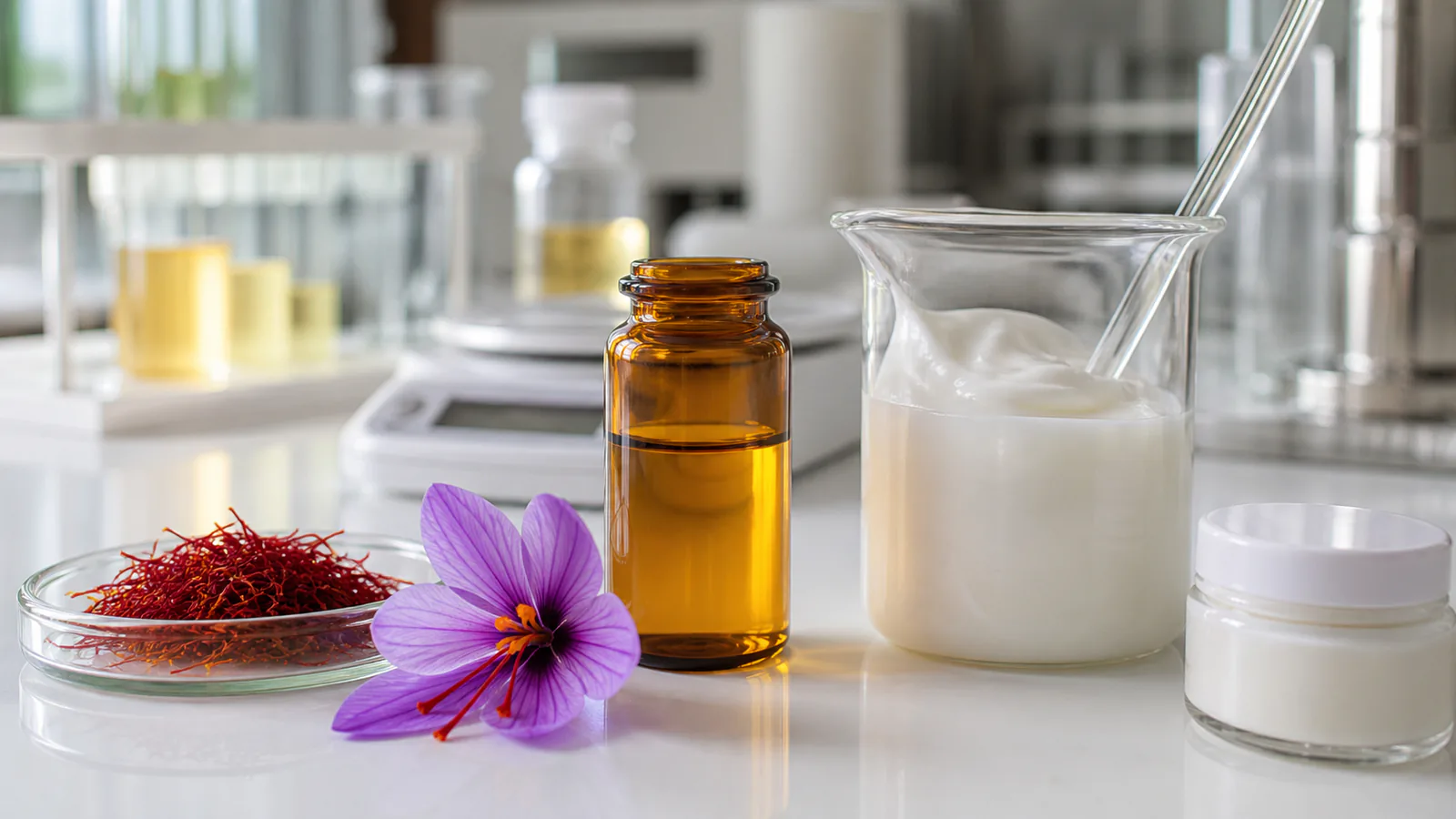
Saffron and its aromatic compound safranal can absorb ultraviolet light in laboratory formulations, but saffron is not a tested substitute for commercial sunscreen. The research behind the “sunscreen properties of saffron” claim used prepared lotions and nanoliposomes, then estimated sun protection factor with in-vitro methods. It did not show that kitchen saffron rubbed on skin prevents sunburn or skin cancer.
This is a promising formulation question, not a home skin-care instruction.
Where the claim came from
Researchers associated with Mashhad University of Medical Sciences published two related studies. The names in the original news translation were distorted; the researchers were Shiva Golmohammadzadeh, Fatemeh Imani, Hossein Hosseinzadeh and Mahmoud Reza Jaafari.
A 2010 study of saffron lotions tested formulations containing 2%, 4% and 8% saffron against an 8% homosalate reference lotion. A 2011 study of safranal nanoliposomes tested several concentrations of the aromatic compound in a lipid delivery system.
The old report appears to combine details from these related experiments. Keeping them separate makes the conclusion easier to judge.
What the saffron-lotion study found
The 2010 experiment used dried saffron floral material from Ghaen in lotion bases. Researchers measured ultraviolet absorption from 290 to 320 nanometres with a spectrophotometer and calculated an estimated SPF using the Mansur equation.
The 4% saffron lotion produced an in-vitro SPF estimate similar to the 8% homosalate reference. The 8% saffron lotion produced a significantly higher estimate than that reference under the same laboratory method.
Six volunteers were involved only in a skin-hydration assessment. The saffron lotion did not moisturise better than the lotion base over seven hours. The volunteers were not exposed to sunlight to establish real-world sunburn protection.
What the safranal nanoliposome study found
The 2011 paper prepared liposomes containing safranal at concentrations from 0.25% to 8%, along with empty liposomes and an 8% homosalate reference. SPF was estimated by two in-vitro methods. The researchers also examined penetration across mouse skin in diffusion cells and measured short-term skin moisture in human volunteers.
The 8% safranal liposome formulation had a higher measured SPF than the 8% homosalate reference under the laboratory test. The 1% formulation showed low penetration in the mouse-skin model. The tested 1% and 4% formulations did not show a moisturising advantage over empty liposomes.
Nanoliposomes matter because a delivery system can alter stability, distribution and how much of a compound remains near the skin surface. The result describes that complete experimental formulation, not plain saffron threads, saffron water or safranal on its own.
Why an in-vitro SPF result is not enough
Laboratory UV absorption is useful for screening ingredients. A product intended to protect people still needs much more evidence:
- validated SPF testing on the finished formulation;
- broad-spectrum UVA as well as UVB performance;
- photostability during sun exposure;
- uniform film formation at the labelled application amount;
- water-resistance testing when that claim is made;
- skin irritation, sensitisation and safety assessment; and
- stable manufacturing and packaging throughout shelf life.
The 2010 spectrophotometry range focused on UVB wavelengths linked closely to sunburn. It did not establish complete UVA protection. Calling an experimental saffron lotion “broad spectrum” would therefore go beyond the evidence.
Why the homosalate comparison can be misunderstood
The studies compared equal ingredient concentrations in specific laboratory bases. That does not mean saffron is generally “twice as strong” as homosalate or superior to a finished commercial sunscreen.
A modern sunscreen usually combines an approved formulation, labelled SPF, broad-spectrum testing, directions and safety controls. The performance of one ingredient cannot be separated from its vehicle, concentration, film and other active ingredients.
Do not make saffron sunscreen at home
Grinding saffron into oil, cream or water does not reproduce either study. A homemade mixture has no verified SPF, may spread unevenly and may stain or irritate skin. The colour it leaves behind is not evidence of UV protection.
Safranal is a concentrated volatile compound, and nanoliposomes require controlled formulation. Neither should be improvised for sun protection. “Natural” does not mean tested, non-irritating or effective at an unknown dose.
What to use for sun protection now
The American Academy of Dermatology recommends a sunscreen that is broad spectrum, water resistant and SPF 30 or higher. Apply it generously to exposed skin and follow the label for reapplication, especially after swimming or sweating.
Sunscreen works best as part of a wider routine:
- seek shade when ultraviolet exposure is strong;
- wear protective clothing, a broad-brimmed hat and UV-protective sunglasses;
- avoid tanning beds; and
- do not rely on a botanical oil, food extract or cosmetic without a tested sunscreen label.
What the saffron research is useful for
The studies give cosmetic scientists a reason to investigate saffron-derived UV absorbers in properly engineered products. Later research has explored solid-lipid nanoparticles and multi-ingredient creams, but much of it remains formulation or laboratory work rather than proof of clinical protection in everyday use.
A useful next step would compare a stable finished formula with established controls using current SPF and UVA methods, then assess irritation, photostability, water resistance and real application conditions. Independent replication would matter too.
The accurate conclusion
Saffron has measurable UV-absorbing properties in experimental lotions, and safranal nanoliposomes produced encouraging in-vitro SPF results. That supports further sunscreen-formulation research. It does not support replacing a labelled sunscreen with saffron, a saffron mask or a homemade extract.
Until a finished saffron-derived product has the required testing and regulatory status, use proven broad-spectrum sun protection and treat the saffron result as an interesting laboratory finding.