


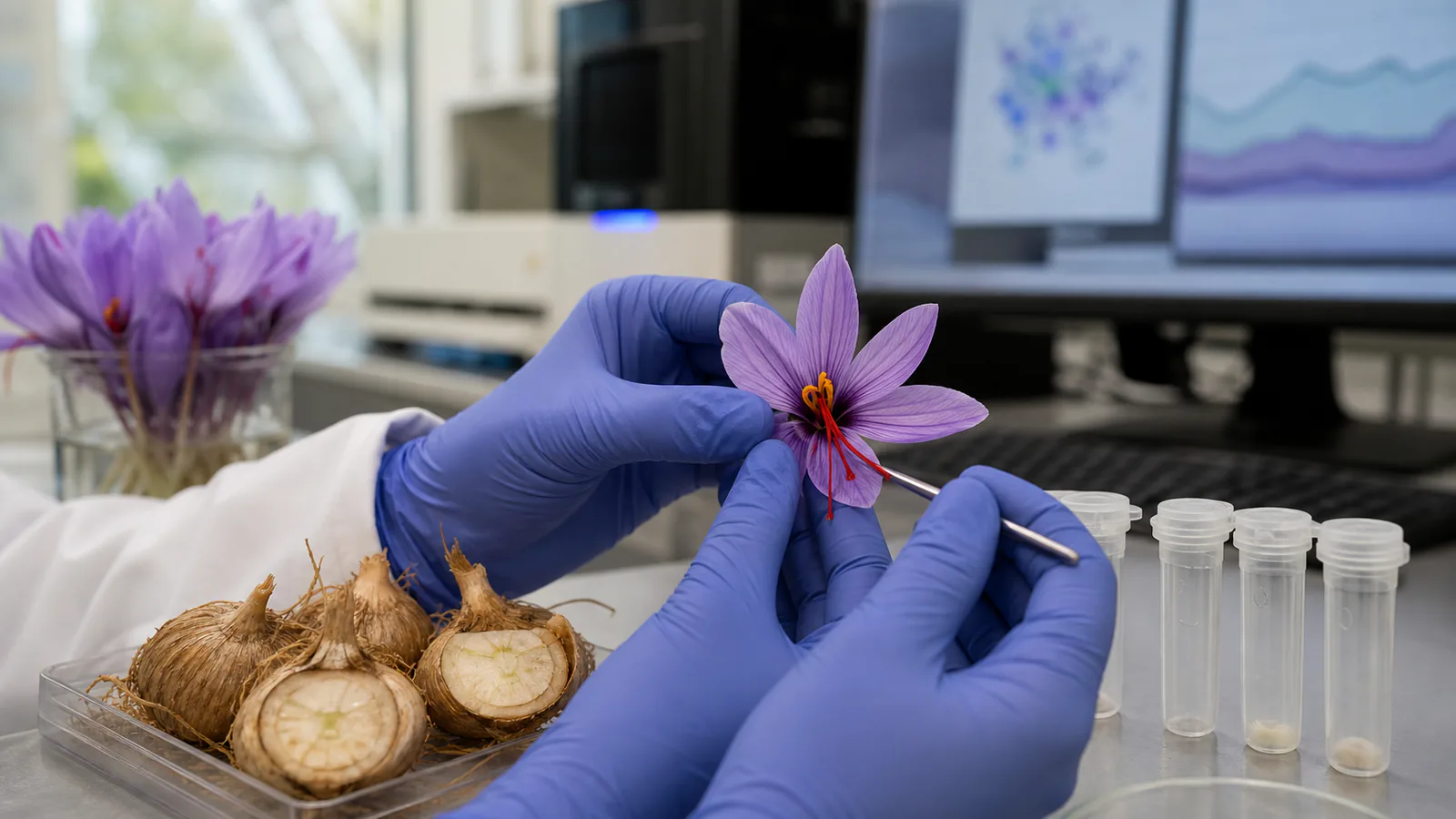
A 2016 investment briefing in Khorasan Razavi reported that 118,000 saffron “genes” had been identified in Iran. That wording should be treated cautiously. In plant transcriptomics, researchers often assemble large numbers of reads, transcripts or “unigenes”; these are not automatically 118,000 distinct, experimentally confirmed genes.
The briefing’s wider point remains useful: saffron research can support crop improvement, quality control and the study of valuable compounds. It does not mean that identifying plant sequences directly produces a medicine for Alzheimer’s disease or any other condition.
Who made the announcement
The original ISNA report covered a press meeting about foreign-investment opportunities in Khorasan Razavi agriculture. The speaker was Gholam Hossein Sarban, then deputy for plant-production improvement at the provincial Agricultural Jihad Organisation.
His surname was machine-translated as “camel driver” in the old English text. Restoring the person’s name matters because readers should be able to distinguish an attributed policy statement from a peer-reviewed scientific result.
What “118 thousand genes” may mean
Saffron is a sterile triploid plant with a complex genome. It is usually propagated through corms, so genetic improvement is more difficult than it is in a seed crop with straightforward breeding. Before a complete reference genome is available, researchers can study the transcriptome: RNA sequences showing which parts of the genetic information are expressed in sampled tissue.
A typical workflow generates millions of short sequence reads. Software assembles overlapping reads into transcripts and may cluster them into “unigenes.” The count changes with tissue, sequencing technology, filtering and assembly method. Alternative transcripts from one gene and assembly fragments can inflate the total.
For example, a 2015 saffron flower and stigma transcriptome study assembled 64,438 transcripts and classified them into 32,204 unigenes. A later full-length transcriptome study reported 31,755 high-confidence protein-coding gene predictions. These figures are not corrections to the 2016 speech; they show why the underlying dataset and definition must accompany any large gene count.
What scientists can learn from saffron sequences
Genomic and transcriptomic work can help researchers:
- identify candidate genes involved in crocin, picrocrocin and safranal production;
- compare expression in stigmas, flowers, corms and different growth stages;
- study flowering, corm development and responses to environmental stress;
- investigate markers linked to disease resistance or planting-material identity;
- build better reference resources for breeding and germplasm research; and
- select specific enzymes or pathways for laboratory validation.
Sequence identification is a map of candidates. Functional studies still have to show what a candidate does, where it acts and whether changing it produces a useful and safe trait.
Why the Alzheimer’s claim goes too far
The 2016 report said the genetic work could help produce medicines for conditions such as Alzheimer’s disease. That is a possible long-term research aspiration, not an outcome of finding plant transcripts.
Drug development would require researchers to identify a relevant saffron compound or biological target, characterise it, establish a reproducible preparation, test toxicity and pharmacology, and then complete phased human clinical trials. A plant gene involved in making crocin or safranal is not itself an Alzheimer’s medicine.
Saffron extracts have been studied in small cognition trials, but the evidence does not justify a prevention or cure claim. Patients and families should rely on qualified clinical care rather than a genomic headline.
Saffron within Khorasan Razavi’s investment brief
Saffron was one part of a broader provincial presentation. Sarban described it as a potential raw material for pharmaceutical manufacturing and also referred to roughly 13,000 hectares of other medicinal plants. The surviving translation is unclear on the unit, so that figure should remain attributed to the briefing rather than presented as a current audited total.
The investment argument connected agricultural research with processing. For saffron, that could mean validated planting material, clean drying, compound extraction, analytical laboratories and responsibly developed food, cosmetic or pharmaceutical ingredients. Each requires a market, quality system and evidence appropriate to the product.
Pomegranate, pistachio and grape opportunities
The briefing said a severe freeze in the Iranian year 1386 had damaged pomegranate trade with Central Asian markets, but conditions had recovered by 2016. It also cited 53,000 hectares of pistachios in Khorasan Razavi and described the province as second in Iran for pistachio area.
For grapes and raisins, the report referred to about 3,000 hectares and the potential to process more of the crop. Its reference to a beverage project described a non-alcoholic or “Islamic” drink, not wine production.
These are historical investment claims. Acreage, ranking, exchange rates and export access change, so a current project would need current ministry and customs data before using them in a business plan.
Greenhouses, cotton and agricultural inputs
Khorasan Razavi’s sunshine, climate and pool of agricultural graduates were presented as advantages for greenhouse investment. The report also attributed more than 42,000 hectares of cotton and 70 percent of national production to the province at that time.
Input manufacturing formed another part of the proposal. Sarban pointed to dependence on imported phosphate fertiliser, sulphur resources around Sarakhs and potential investment in phosphate fertiliser and compost. He also discussed sesame oil as one route to reduce dependence on imported edible oil.
These ideas require environmental and economic checks. Local feedstock does not make a fertiliser plant safe or profitable by itself, and compost quality depends on controlled inputs, pathogen management and contaminant testing.
Mechanisation and local manufacturing
The original article said around 20 types of agricultural machinery had been produced through reverse engineering. It highlighted rice combines as a response to labour costs and suggested capacity could rise to 100 units a year.
Mechanisation can improve timing and reduce repetitive labour, but equipment must fit local crop systems, field size, repair capacity and safety requirements. For saffron, the delicate harvest and stigma separation steps pose very different engineering problems from grain combining.
How to report saffron genomics responsibly
- Name the project, institution and sequence repository.
- Say whether the number refers to reads, contigs, transcripts, unigenes or predicted genes.
- Describe the tissues and cultivars sampled.
- Report assembly quality and how many sequences received functional annotation.
- Separate candidate-gene discovery from laboratory validation.
- Keep crop applications separate from medical efficacy claims.
A valuable direction, not 118,000 medicines
The headline captures the excitement around Iranian saffron research in 2016, but its gene count cannot be interpreted confidently without the original technical record. Modern transcriptome studies show that large sequence assemblies are real and useful, while also showing why “transcripts,” “unigenes” and “genes” cannot be swapped freely.
Saffron genomics can contribute to better crops and a deeper understanding of its compounds. Turning that knowledge into a safe agricultural technology or medicine is a separate, evidence-heavy process.

![Exporting Saffron to Turkey + Price Guide [Complete 0 to 100]](https://img.rowhanisaffron.com/20260827003933/saffron-export-turkey-quality-inspection.webp)



