


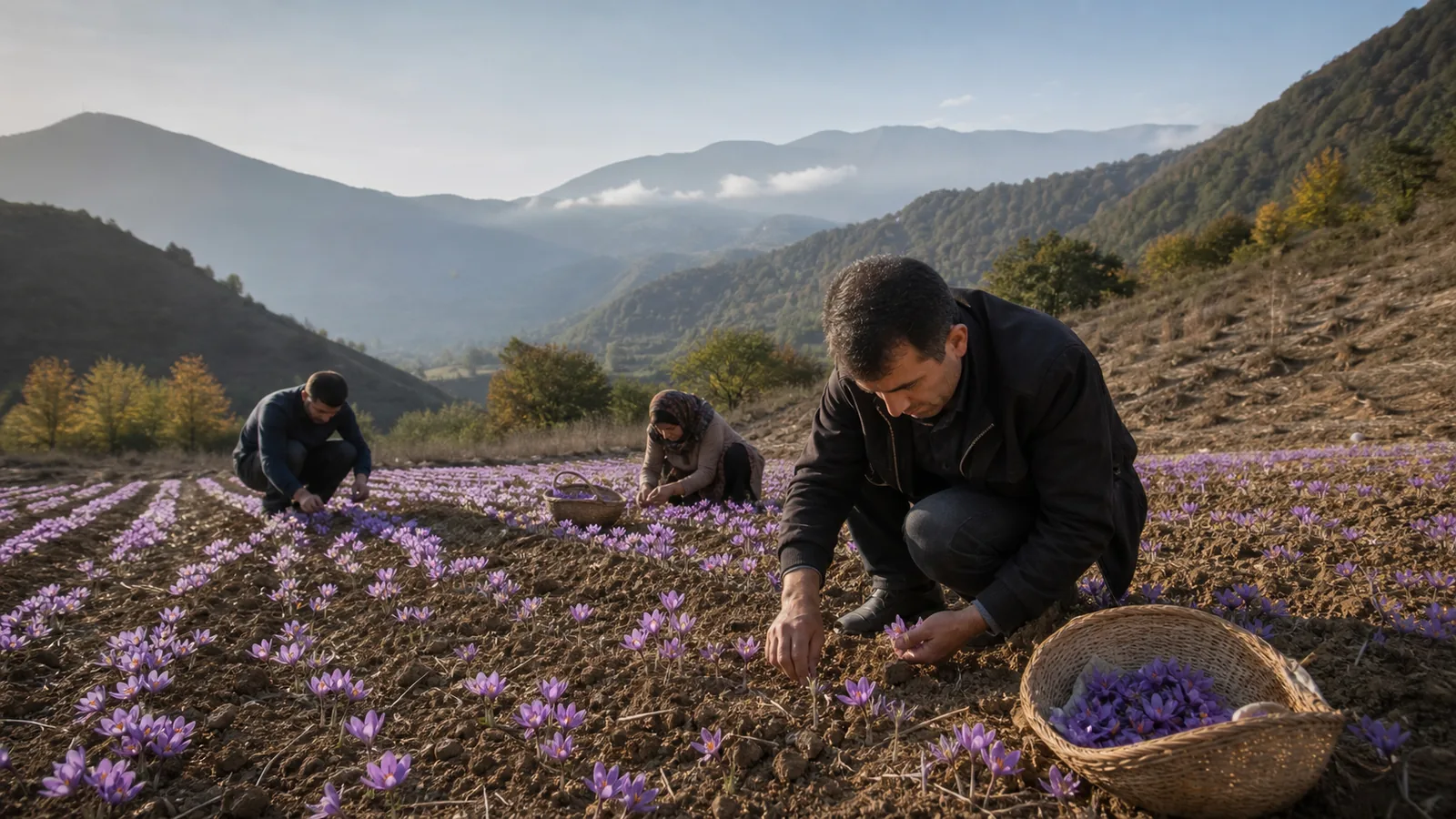
Production of 1100 kg of saffron in Golestan was reported as the province expanded a young crop beyond Iran’s traditional Khorasan heartland, especially in the mountain villages of Azadshahr.
The figures below come from a historical interview with Morteza Sadeghi, then identified as Golestan Agricultural Jihad’s horticulture director. The report compared 1,100 kg in one season with 980 kg in 2016. Because it did not provide a publication year, survey method or newer provincial series, its numbers should be read as a dated production snapshot rather than today’s output.
What the 1,100 kg figure represented
The increase from 980 kg to 1,100 kg was 120 kg, or a little over 12%. That comparison showed a growing local sector, but it did not mean every planted hectare was already producing at full capacity.
Sadeghi placed Golestan’s cultivated area at about 235 hectares. He said 65–70% of those fields were three or four years old, while the remainder were in their first or second year and had not yet reached normal production. Saffron fields develop over several seasons, so planted area and harvestable area should not be treated as the same measure.
The report also carried a target of expanding provincial cultivation to 400 hectares by the end of Iran’s Sixth Development Plan. That was a policy goal, not a confirmed final result. Without a later official acreage report, it would be misleading to present 400 hectares as an area that Golestan necessarily achieved.
Golestan saffron centered on Azadshahr’s mountain villages
The supported commercial area described in the report was concentrated in mountain villages of Azadshahr County. It named Wamnan, also transliterated as Vamenan, together with Kashidar, Sibchal and Narab.
Experimental plots had also been established in Shahkuh, Chaharbagh and Maraveh Tappeh. Sadeghi said expansion into those or other parts of Golestan would depend on suitable results and coordination with the Ministry of Agriculture Jihad.
That cautious approach matters because a crop that succeeds in one mountain village may not perform the same way elsewhere in a diverse province. Cold exposure, summer dormancy, drainage, soil texture, humidity and field history all affect the result.
What research says about saffron suitability in Azadshahr
A later climate-suitability study indexed by FAO AGRIS examined Azadshahr using annual and seasonal rainfall, temperatures, relative humidity, sunshine and frost days. Its field checks placed the sampled saffron farms in suitable or very suitable zones and concluded that southern Azadshahr has scope for saffron development.
That finding supports the location described in the old production report, but it is not a blanket recommendation for every parcel. Site maps identify broad climatic potential; growers still need local soil, water, drainage and disease assessments.
Another study indexed by FAO AGRIS compared saffron fields in Vamenan and Ghaen during 2015–2017. It sampled 30 farms in each region and examined how soil texture related to yield. The Vamenan–Ghaen research record is useful evidence that Golestan’s newer growing area has been studied directly rather than assumed to behave exactly like Khorasan.
The reported yield was unusually strong
Sadeghi gave Golestan an average yield of 8 kg per hectare, about 2 kg above the national average he cited at the time. He also said individual farms had reached 20 kg per hectare.
Those numbers need their original boundaries. The 8 kg figure was an official’s provincial estimate, while 20 kg described exceptional fields, not the expected result for a new grower. Field age, corm density, irrigation, flower picking, disease pressure and how dried saffron is weighed can all affect reported yield.
The broader lesson is that average and maximum yield answer different questions. A farm business plan should use repeatable multi-year results, not the best plot in a favorable season.
Quality claims and what they do—and do not—show
The historical report described Golestan saffron as a “healthy product” grown without toxins, an awkward translation of a claim that pesticides were not used in the fields. It also said samples had performed well against quality indicators in reputable Khorasan Razavi laboratories.
No laboratory name, certificate, sample count or test result was included in the article. The claim is therefore preserved as Sadeghi’s reported statement, not converted into an independent guarantee that every lot from Golestan is pesticide-free or among Iran’s best.
For buyers, province alone cannot establish quality. A specific batch needs suitable documentation and, where the sale requires it, testing for identity, purity, moisture and the relevant chemical characteristics. The same principle applies to saffron grown in Khorasan or any newer production area.
Employment and local processing in Wamnan
Sadeghi estimated that each hectare of saffron supported four direct jobs. This was a local employment estimate rather than a year-round full-time count, but it reflected how much hand labor the crop needs during flower picking and stigma separation.
The report traced organized processing and drying in Golestan to a saffron-growers’ cooperative established in Wamnan in the Iranian year 1392, corresponding broadly to 2013–2014. Local drying and a provincial brand were intended to keep more post-harvest work and value in the region.
Processing close to the field can shorten the time between flower picking and stigma drying. It can also make training and batch handling more consistent, provided the cooperative has reliable hygiene, moisture control, storage and traceability procedures.
Why the report focused on healthy saffron corms
Saffron is propagated through corms, often called bulbs in everyday trade. Diseased planting material can introduce fungi or soil-borne problems into a clean field and reduce the productive life of the crop.
Sadeghi urged applicants to buy corms from inspected Golestan farms that showed no fungal infection. He also warned against bringing separate loads from North Khorasan, Khorasan Razavi and other provinces because he believed contamination pressure was higher in some established fields.
That warning should not be turned into a claim that corms from an entire province are unsafe. Geographic origin is not a plant-health certificate. The practical rule is to use traceable planting stock, inspect the source field, reject damaged or suspect corms, and follow local agricultural guidance before moving soil or plant material.
How to read Golestan’s saffron expansion today
Golestan’s 1,100 kg report documented a real stage in the spread of Iranian saffron cultivation: a relatively young 235-hectare sector, a core around Azadshahr’s mountain villages, experimental work elsewhere and ambitions for further growth.
It also shows why expansion should be evidence-led. Climate suitability, soil, healthy corms, field age, drying capacity and access to buyers have to develop together. Our wider review of saffron cultivation beyond Khorasan explains those trade-offs in more detail.
The headline production number remains useful as a historical benchmark. A current estimate would require a newer Golestan source using clearly dated acreage, mature-field area, dried-saffron output and sampling methods.

![Exporting Saffron to Turkey + Price Guide [Complete 0 to 100]](https://img.rowhanisaffron.com/20260827003933/saffron-export-turkey-quality-inspection.webp)



