


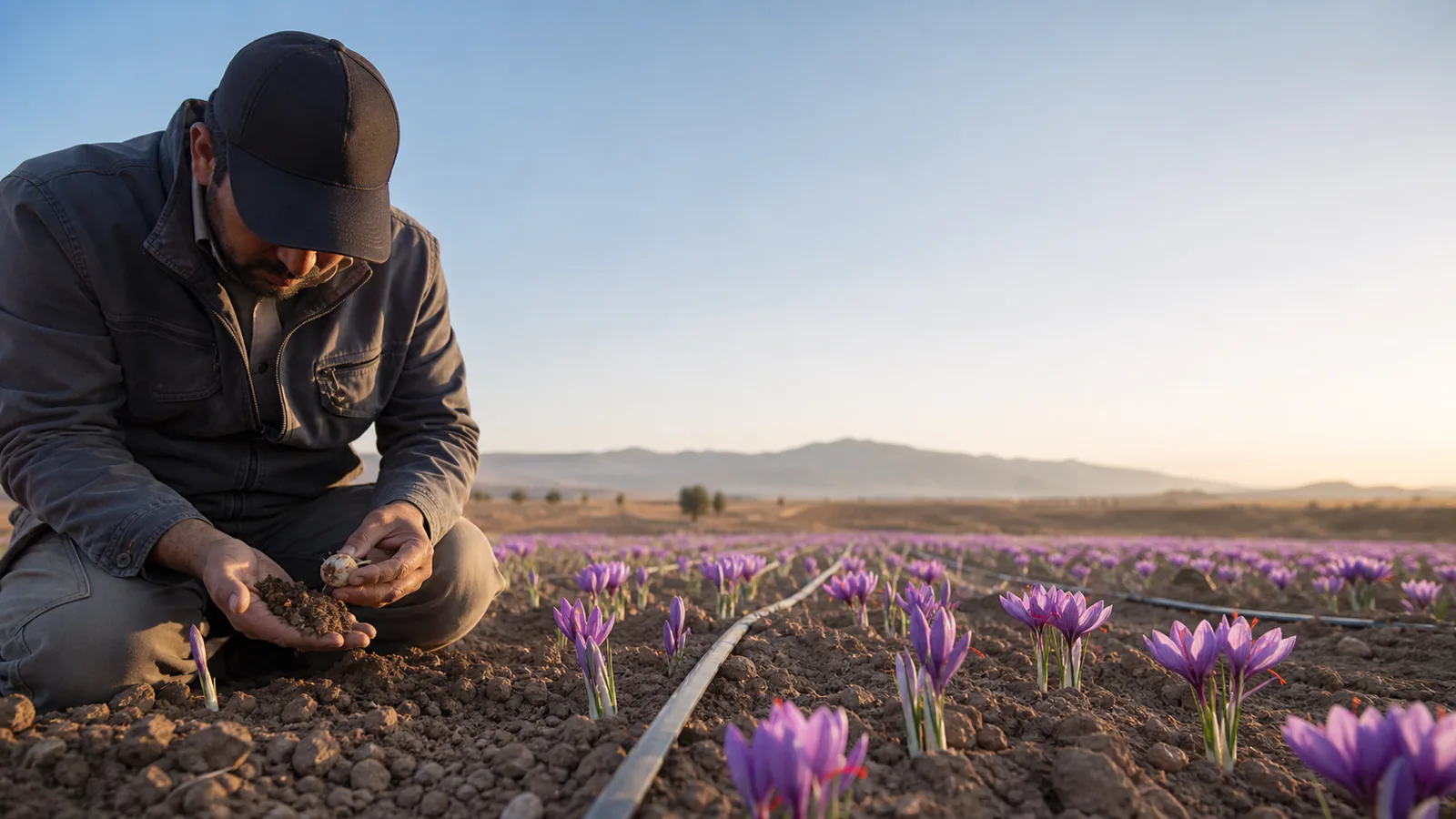
Saffron cultivation beyond Khorasan is agronomically possible, but a suitable field is not the same as a sound regional strategy. Before growers commit land and capital, they need to test the climate, soil, water, planting material, labour supply and likely market. Expansion driven only by saffron’s high selling price can leave farmers with weak yields or a crop that is difficult to sell at the expected grade.
That was the concern behind a 2015 statement from Gholamreza Miri, then head of the Khorasan Razavi Saffron Exporters Association. He warned that rapid planting in provinces with other viable crops could put pressure on prices and on the many households whose livelihoods depended on Khorasan saffron. The concern was real, although the better response is careful planning rather than assuming saffron can only succeed in its historic centre.
Why Khorasan became Iran’s saffron centre
Khorasan’s position reflects more than a familiar place name. Generations of growers developed practical knowledge of corm selection, irrigation timing, flower picking, stigma separation and drying. The crop also fits parts of the region where water is limited and farmers have fewer profitable alternatives.
The FAO description of Iran’s qanat-based saffron system explains how saffron became part of an agricultural landscape adapted to dry conditions and carefully managed underground water. This does not mean the plant requires no water. It means its seasonal pattern can suit an arid region when irrigation is timed well and the wider water system is sustainable.
A dated 2014–2015 provincial table submitted to Codex shows how concentrated production was when the original article appeared. Razavi Khorasan was reported at about 218 tonnes and South Khorasan at 48 tonnes. North Khorasan, Isfahan, Kerman, Fars and Yazd also reported production, but at much smaller volumes. Those figures are a historical baseline, not a current forecast.
What the 2015 warning actually said
Miri argued that some provinces had more water and could grow other crops, yet were turning to saffron because of its income potential. He estimated that roughly 120,000 households across Khorasan’s saffron economy relied on the crop. If production expanded faster than demand and the market was poorly managed, he feared lower prices, lost employment and damage to Iran’s position as the leading producer.
The same report placed annual Iranian output at approximately 250–300 tonnes. It described export capacity at around 150 tonnes, domestic consumption at 25–30% and formal exports at roughly 70%, with a small additional amount carried informally by travellers. These are attributed claims from 2015. They should not be used as today’s production, consumption or trade statistics.
The underlying economic point still deserves attention. A high-value crop can attract many new growers at once. Because saffron is perennial and the initial corm purchase is substantial, farmers may continue producing even when market conditions weaken. A planting decision therefore needs a multi-year budget rather than one season’s retail price.
Can saffron grow outside Khorasan?
Yes. Research samples saffron from several Iranian provinces, and saffron is grown in other countries as well. Geographic origin does not by itself decide whether a lot is genuine or high quality. Site conditions, corm health, field management and post-harvest handling all influence the result.
A study of Iranian saffron from different locations found that environmental and cultivation conditions, as well as viral infection, can significantly affect quality. Another 2024 origin-authentication study analysed samples from Azerbaijan, Golestan, Khorasan, Fars and Isfahan. Its purpose was traceable geographic classification, but the sample range also makes clear that commercial cultivation is not confined to one province.
The useful question is not simply whether a corm can flower. It is whether a particular site can produce a consistent crop without creating a poor trade-off for water, soil or the farmer’s other opportunities.
Checks to make before planting in a new region
A field trial should come before large-scale expansion. Growers and local advisers need evidence for the actual site, not a general claim that saffron is “low water” or highly profitable.
- Seasonal climate: assess winter cold, flowering-period temperatures, summer dormancy and the risk of unseasonal rain or heat.
- Soil and drainage: test texture, salinity, pH, fertility and whether water can drain away from corms.
- Water: calculate the source, quality and timing of irrigation within the local basin—not only the volume applied to one field.
- Planting material: use healthy, correctly identified corms and a plan that limits the movement of pests and viruses between regions.
- Labour: confirm that flowers can be picked and stigmas separated quickly during the short harvest window.
- Post-harvest control: arrange hygienic separation, measured drying, sealed storage and lot traceability before flowers appear.
- Market access: identify the likely grade, buyer, testing requirements, packaging form and realistic farm-gate price.
Location-suitability modelling can help narrow the search, but it cannot replace local trials. A published saffron suitability study combines environmental variables to identify promising areas; the method is useful precisely because suitability depends on several conditions working together.
Low water use needs local context
Saffron is often described as an answer to water scarcity. Its autumn flowering and summer dormancy can make it attractive in dry regions, yet “low water” is not a licence to plant it everywhere. The relevant comparison is the crop’s full water demand, timing and economic return against realistic alternatives in that district.
In Khorasan, Miri’s argument was that water constraints and limited alternatives helped explain saffron’s importance. A province with different rainfall, soils, employment patterns or established crops may reach another conclusion. Replacing a well-adapted crop with saffron solely because a small retail pack commands a high price can be a costly mistake; growers are paid for a raw lot, not for the final shelf price.
Expansion also creates quality and biosecurity risks
Moving corms between regions can spread pathogens and mix planting material of uncertain health. Research on corm origin and climatic adaptation also suggests that source material and growing environment affect crop response. New projects should document where corms came from, inspect them before planting and avoid presenting unknown material as a guaranteed local selection.
Quality can also be lost after harvest. Flowers held too long, unhygienic separation, uncontrolled heat and exposure to moisture can weaken colour, aroma and stability. A province may have suitable land yet lack the seasonal labour, dryers, laboratories or buyer relationships needed to deliver a reliable product. Those services belong in the expansion plan from the start.
Protecting Khorasan without blocking responsible growth
Khorasan’s growers should not have to compete only on volume. Their accumulated skill, recognised origin and established supply network can be protected through accurate provenance, consistent grading, testing, clean processing and contracts that reward dependable quality.
At the same time, a suitable project elsewhere in Iran is not automatically a threat. It may serve a local market, test a different production system or create a traceable regional product. Modern analytical work can distinguish origins, which makes honest labelling more useful than treating every non-Khorasan crop as interchangeable.
The market risk appears when expansion has no credible buyer, when production claims outrun evidence, or when saffron from different origins is mixed and sold under a better-known name. Traceability protects both the historic producing region and responsible new growers.
A better decision than expansion for its own sake
The 2015 warning about saffron cultivation in other provinces should be read as a call for crop-pattern and market planning, not as proof that cultivation outside Khorasan cannot work. Its household, production and trade figures are useful historical context, while current projects need current local evidence.
A strong proposal begins with a small field trial, a multi-year cost model and a buyer who can explain the required grade. It includes water and soil evidence, healthy corms, harvest labour, post-harvest controls and honest origin labelling. If those pieces do not fit, the high price associated with saffron will not make the project economical. If they do fit, expansion can be evaluated on its own merits without weakening the value of Khorasan saffron.

![Exporting Saffron to Turkey + Price Guide [Complete 0 to 100]](https://img.rowhanisaffron.com/20260827003933/saffron-export-turkey-quality-inspection.webp)



