


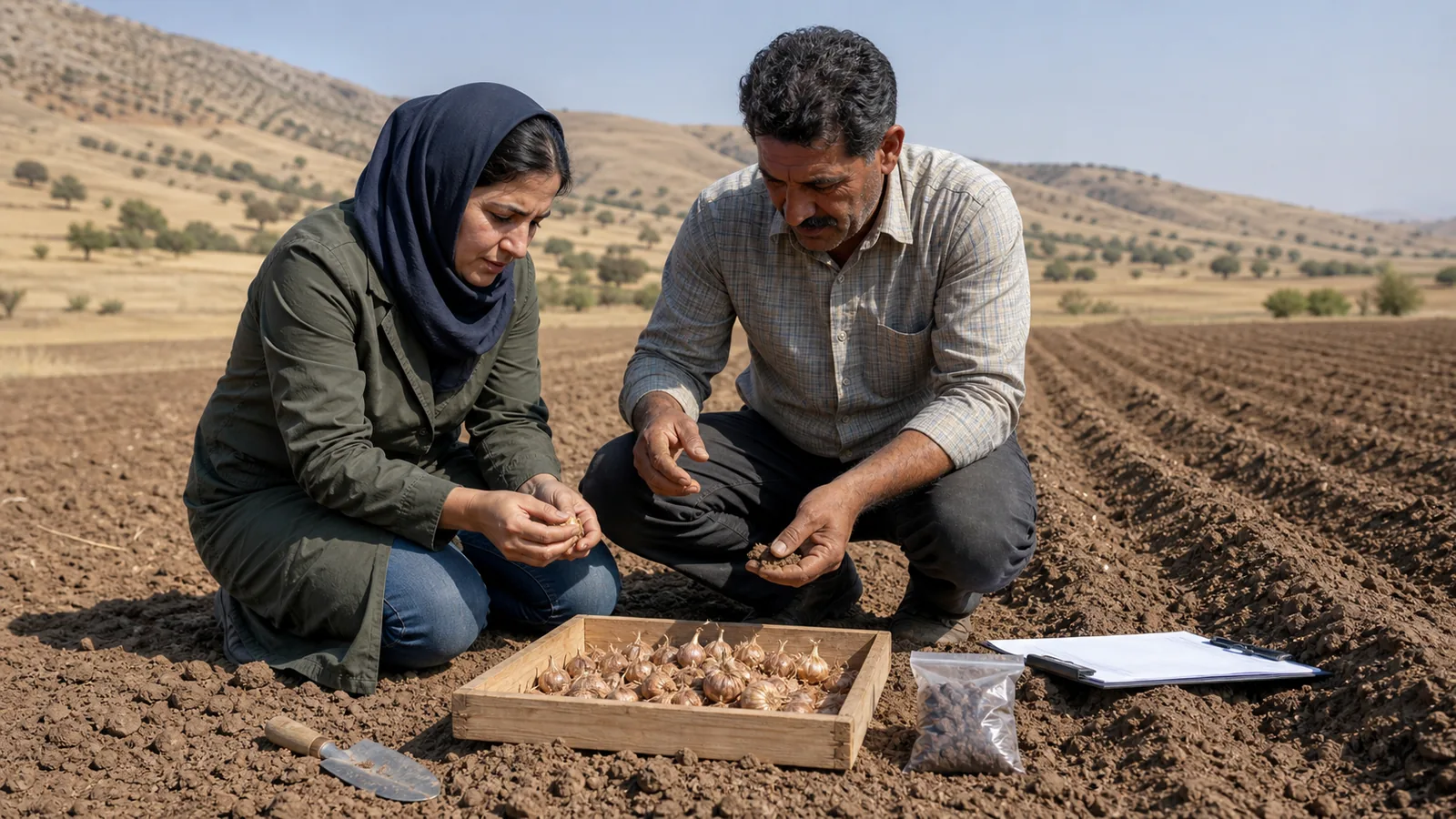
Kermanshah province supported the saffron farmers through a programme reported in 2015. The announcement described non-repayable assistance of four million tomans for each hectare planted with saffron. It also put the contemporary cost of buying corms and establishing one hectare at 13 to 14 million tomans. Both figures belong to that year and programme; they are not current prices, loans or standing entitlements.
The report was broader than its title. Alongside the saffron support, it discussed field age, expected yield, irrigation and harvest timing. It then moved to two separate provincial initiatives: mass production of the parasitoid wasp Habrobracon hebetor for biological pest control, and registration of agricultural tractors. Keeping those topics separate makes the original briefing much easier to understand.
What the 2015 support announcement said
ISNA’s Kermanshah bureau attributed the information to Dr Seyed Afshin Safavi, then described as deputy head for plant-production improvement at Kermanshah Province’s Agricultural Jihad Organization. Safavi said expansion of saffron cultivation was one of the organization’s priorities and that saffron farmers in the province would receive support.
The Persian source used toman, not US dollars. The old English version mistranslated both amounts as “USD.” It also called the planting material onions. Saffron is established from corms, so the corrected historical budget is:
- four million tomans in non-repayable support per planted hectare; and
- 13 to 14 million tomans as the stated cost of corm purchase and hectare establishment.
On those figures, the assistance represented roughly 29 to 31 percent of the stated establishment cost. That ratio helps explain the scale of the programme, but it does not show what each farmer actually received or whether all applicants qualified. The article gives no application rules, budget ceiling, payment date or number of supported hectares.
The grant was useful only if it arrived at the right time
Corms, land preparation, irrigation arrangements and planting labour are early costs. A support payment made after planting may help cash flow, but it cannot correct poor corm selection or a field prepared in haste. A useful farm programme therefore needs more than a headline amount.
For a hectare-level payment to improve the planting rather than simply expand area, the process should establish:
- who is eligible and whether the land and water source are verified;
- which corm-health, size and traceability checks apply;
- what costs the assistance may cover;
- whether payment comes before the agronomic deadline;
- how planted area is measured and inspected; and
- what records are required after establishment.
The 2015 report does not tell us whether those controls existed. It records an announced level of support, not an audit of programme delivery. Anyone looking for assistance now should contact the responsible provincial authority and lender directly; this article does not confirm a current scheme.
Field age and the seven-kilogram claim
Safavi said saffron corms could remain in the field for up to seven years. He placed first-year production between half a kilogram and one kilogram per hectare, rising to seven kilograms per hectare in the seventh year. The first part reflects saffron’s perennial nature. The precise yield path is a historical local claim, not a biological schedule that every field will follow.
Each mother corm produces daughter corms, so the underground population changes from season to season. A field may yield more as the stand matures, but crowding, small daughter corms, soil fertility, disease, weeds, water and weather can change the result. Research in Iran has found strong interactions between field age, corm size and planting conditions rather than an automatic annual increase. The field-age evidence is discussed in Industrial Crops and Products.
Yield also needs a clear definition. A half kilogram, one kilogram or seven kilograms per hectare should refer to accepted dry saffron from a mapped productive hectare, not fresh flowers or an estimate taken from the best-looking rows. Our article on measuring saffron production per hectare explains the recordkeeping needed to compare one season with another.
“Two irrigations” was a local statement, not a universal rule
The briefing described saffron as a low-water crop and said it needed only two irrigations during the year. That sentence should not be copied into a farm plan without its context. Irrigation requirement depends on soil water-holding capacity, rain, field age, rooting depth, temperature, irrigation method and the timing of crop development.
Low demand compared with some local crops does not mean no water between two fixed dates. A poorly timed irrigation can delay field work or keep heavy soil wet, while insufficient water can restrict flowering and daughter-corm growth. Semi-arid field research has shown that irrigation and soil texture affect both flower and corm performance. The relevant experiment is available in Scientia Horticulturae.
Safavi placed harvest in the second ten-day period of Aban, the Iranian calendar month that spans late October and much of November. That points broadly to early November, but emergence should be watched in the field. Weather can move the peak, and crews need to be ready before the first large flush rather than waiting for a calendar date.
What support should protect after planting
Paying part of the establishment cost can encourage cultivation. Long-term value depends on what happens next. Farmers need a practical route from healthy corms to saleable dry saffron, including:
- soil and irrigation-water testing before the field is committed;
- a field map, planting record and lot identity;
- seasonal advice based on local soil and weather;
- trained harvest labour and clean flower handling;
- controlled separation and drying capacity;
- quality testing and realistic buyer specifications; and
- cost and yield records that distinguish cash flow from profit.
A programme that rewards hectares but ignores corm quality, water, labour and market readiness can increase planted area without creating a reliable crop. The separate regional article on saffron production in Kermanshah examines how area, forecast yield and local conditions should be read together.
The biological-control section was not about treating saffron
The second half of the 2015 briefing changed subject. Safavi described mass production of Habrobracon hebetor, a small parasitoid wasp used against the larvae of certain moth pests. The machine translation repeatedly called the insect a bee. It is a wasp, and releasing it is an integrated pest-management technique that depends on the target pest and crop system.
The provincial figures were substantial. Ten biological-agent production units were said to have produced about 40 million wasps that year. Releases reportedly covered 22,000 hectares and were associated with an 80-tonne reduction in chemical pesticide use across maize, tomato and chickpea fields in Kermanshah. Some of the agents were also sent to Khuzestan.
These were attributed programme claims, not a controlled comparison supplied in the article. They should not be read as evidence that the wasp controls saffron pests or that one released insect replaces a fixed amount of pesticide. Peer-reviewed work identifies H. hebetor as a parasitoid biological-control agent and shows that its performance and compatibility with insecticides require specific evaluation. One Iranian study of storage and efficiency is available in the Archives of Phytopathology and Plant Protection.
The tractor-numbering project was another separate initiative
Safavi also announced a provincial registration or numbering programme for agricultural machinery. The survey behind it identified about 10,000 tractors in Kermanshah Province, and the numbering operation was said to have begun in Sarpol-e Zahab County.
This administrative project appeared in the same briefing but was not described as a saffron grant condition. It should not be folded into the cultivation advice or presented as if 10,000 tractors were used for saffron. The number referred to tractors across the province’s agricultural sector.
How to read Kermanshah’s support record today
The article documents a 2015 attempt to lower the entry cost for saffron farmers: four million tomans of non-repayable assistance against a stated 13-to-14-million-toman establishment budget per hectare. It also preserves the official’s expectations for field life, yield, water and harvest timing.
None of those monetary figures should be converted into a current offer. Inflation, corm prices, labour, irrigation, eligibility rules and provincial policy have changed. The safe present-day approach is to obtain the written programme terms, test the field, price the full crop cycle and check when funds would actually be available.
The wider biological-control and tractor sections belong to the historical record too. Read separately, they show that the announcement formed part of a broader provincial agricultural briefing rather than a single promise about saffron.

![Exporting Saffron to Turkey + Price Guide [Complete 0 to 100]](https://img.rowhanisaffron.com/20260827003933/saffron-export-turkey-quality-inspection.webp)



