


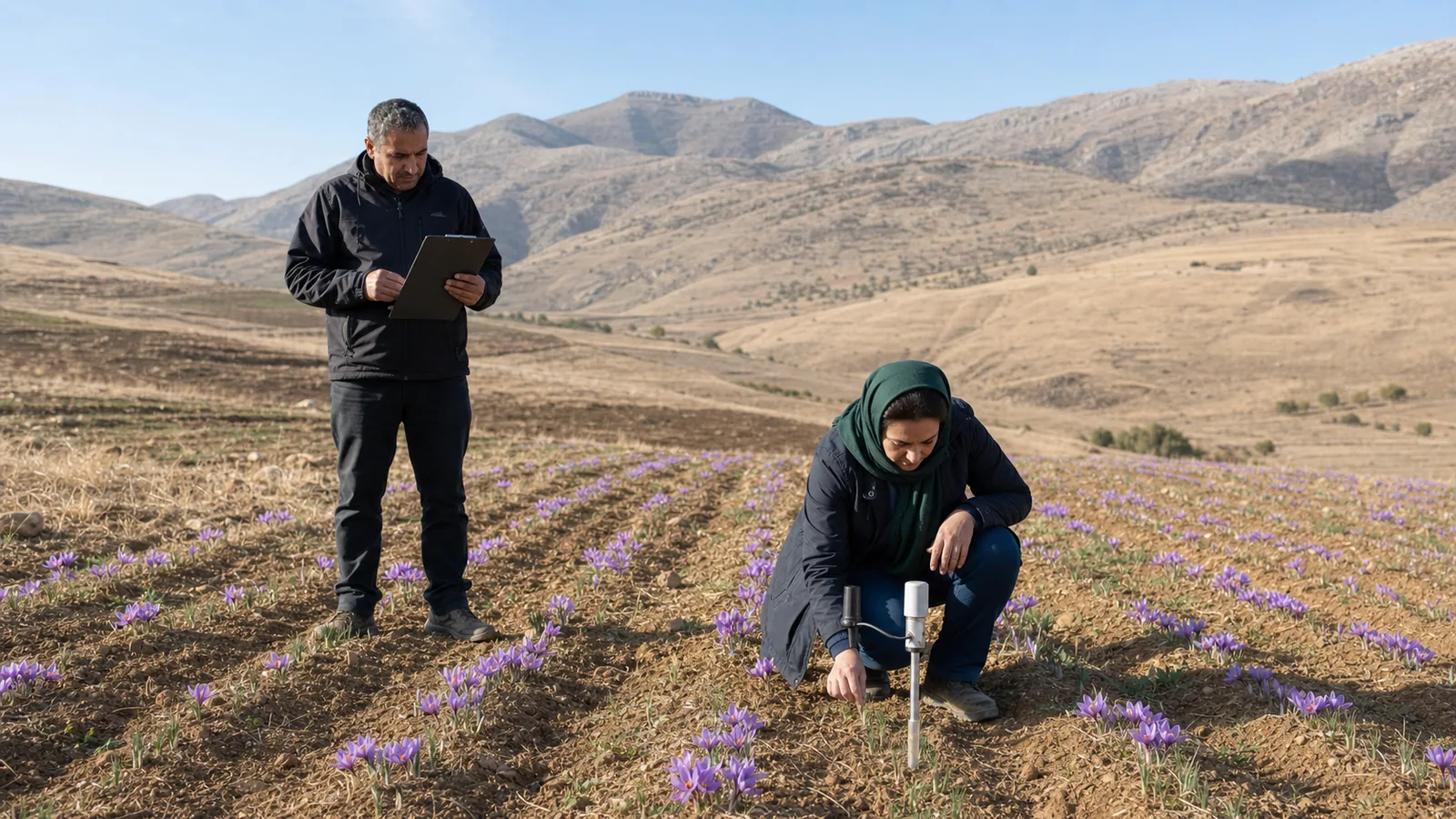
Saffron production in Kermanshah was still a small, expanding activity when this page first reported on it in 2015. The provincial forecast was more than 200 kilograms from an area expected to reach 70 hectares, following a reported harvest of 176 kilograms the year before. Those figures are a historical checkpoint, not a current forecast.
The more durable lesson is that Kermanshah cannot be treated as one uniform saffron zone. Cooler districts were carrying most of the early acreage, while several warmer western areas were excluded or only partly considered suitable. Production depends on the field’s climate, soil, corms, water and age—not the province name alone.
What the 2015 Kermanshah report said
The original report was attributed to Fars News Agency and quoted Hamidreza Jahangiri, then identified as director of horticulture at the Kermanshah Province Agricultural Jihad organisation. He said saffron farming in the province had a six-year history at that point.
Jahangiri put the area under saffron at 55 hectares and expected it to reach 70 hectares during the year. He said 176 kilograms had been harvested in the previous year and forecast more than 200 kilograms for the current one. The report also referred to four kilograms per hectare, immediately warning that this figure could not be generalised to every field.
Sahneh County and Kermanshah County were named as the main cultivation areas. The Persian source text indicated that Qasr-e Shirin, Sarpol-e Zahab and part of Gilan-e Gharb were exceptions to the broader provincial potential, not the leading production districts. That is an important correction to the old machine translation.
The forecast and area values should remain tied to 2015. A later provincial report documented far larger totals, but it does not make the older numbers false; it shows that the industry changed. Our separate record of the 1,700-kilogram Kermanshah harvest reported for 2020 preserves that later checkpoint. Neither article should be mistaken for a live 2026 statistical bulletin.
Why the totals do not produce a reliable yield estimate
It is tempting to divide 200 kilograms by 70 hectares and call the result the provincial yield. That would mix a forecast with an expected area. Some of the 70 hectares may have been newly planted, some may not yet have flowered fully, and the reported production could have come from a smaller mature area.
The same problem affects the previous year’s 176-kilogram total. Unless the productive area, field age and measurement method are known, the ratio is not a clean yield comparison. Jahangiri’s caution about the four-kilogram figure was therefore justified.
A broad scientific review found saffron stigma yields ranging from about 2 to 28 kilograms per hectare across very different locations and studies. That span does not provide a target for Kermanshah. It demonstrates how strongly corm size and density, field age, climate, water, fertility, disease and harvest management affect the result.
Where saffron can fit in Kermanshah
The early concentration in Sahneh and Kermanshah County was not accidental. Saffron needs a seasonal sequence: replacement corms develop through the cool growing period, flower initiation takes place during the warm resting phase, and falling temperatures help bring on autumn emergence. Excessively warm autumn conditions, unsuitable summer soil temperatures or waterlogged corms can upset that sequence.
Elevation and local topography matter. A sheltered lowland, a cold basin and a well-drained slope within the same county can have different nightly temperatures and frost exposure. Rainfall alone does not show what the corm experiences. Soil texture, drainage and the temperature at planting depth are part of the site.
A controlled study found that flower formation and emergence responded to different temperature phases, while field research in cold climates has shown that insufficient summer warmth and rapidly falling autumn temperatures can limit flowering. Those studies explain the physiology; they do not certify every field in a named district.
Use the guide to weather and climate for planting saffron to compare a candidate site. For a new part of Kermanshah, a small trial with temperature and field records is more useful than a province-wide statement of suitability.
“One irrigation a year” needs context
The 2015 report described saffron as an economic crop whose fields needed watering only once a year. Read literally, that is unsafe advice. A field may receive an important pre-flowering irrigation and then rely heavily on well-timed rain, but its total water supply includes rainfall and stored soil moisture. The active leaves and developing daughter corms still need suitable moisture through winter and spring.
Water requirements differ with rainfall distribution, soil depth, texture, field age and evaporative demand. Too much summer moisture may increase rot risk during dormancy; too little moisture before emergence or during vegetative growth can restrict performance. The right schedule follows soil and weather, not a fixed count.
Research on Iranian saffron has measured substantial differences in applied water and water productivity among farms. Another multi-year irrigation study found that irrigation method affected dry stigma yield, quality and water-use efficiency. Saffron may fit a water-constrained rotation, but it is not a no-water crop.
What a Kermanshah field trial should record
Begin with healthy, traceable corms and a plot small enough to manage closely. Before planting, record the soil test, drainage, slope, previous crop and any history of corm disease. Mark the planting density and depth rather than relying on memory.
During the first seasons, keep a short field record:
- planting date, corm source, size range and planted count;
- irrigation dates and amounts, useful rainfall and unusual heat or frost;
- emergence, first flower, peak harvest and the length of the flowering window;
- whole flowers collected and final dry saffron from fixed sample plots;
- labour used for picking, separation and drying;
- symptoms of rot, rodents, weeds or uneven growth;
- the grade, accepted saleable weight and price actually received.
A first-year plot should not be judged as though it were a mature field. Daughter corm development influences later crops, while crowding and disease can eventually reduce performance. Keep results by field age so a temporary rise is not presented as a permanent average.
Production means more than growing flowers
Jahangiri linked suitable production with a good economic return. That qualification matters. The farm needs enough labour to collect flowers promptly and enough clean workspace to separate stigmas without delay. Drying has to be controlled and consistent, then the lot needs protection from moisture, light, odours and contamination.
A provincial production target does not show how much saleable saffron reached each grade or what farmers were paid. Calculate income from accepted dry weight and the actual sales channel. Subtract corms, land preparation, irrigation, field care, harvest labour, drying, testing, packaging, finance and marketing before describing the crop as profitable.
Quality cannot be inferred from province or colour alone. The current ISO 3632-1:2025 specification applies to dried saffron filaments, cut filaments and powder. Buyers may also require traceability and contaminant testing under the rules of the destination market.
The support programme was historical
The report said farmers interested in saffron and model plantings could receive an eight-million-toman subsidy. The old English version mistranslated that currency as US dollars. It also said the provincial organisation had supported model cultivation over 25 hectares, with farmers contributing their own share, as a way to establish fields and improve income.
Neither statement proves that the same programme, amount or eligibility exists today. A grower should obtain current written terms from the responsible provincial authority before including support in a budget. An announced subsidy is not income until the applicant qualifies, the payment conditions are met and the money is received.
The reference to “onions” in the old translation comes from the Persian word used for bulbs or corm-like planting material in context. It should not be read as a promise to subsidise an unrelated onion crop. The report does not provide enough programme documentation to define the eligible input more narrowly.
A separate Golab apple note in the same interview
The original source ended with another subject: Jahangiri discussed Golab apple production in Dalahu, Sahneh and Kermanshah counties. He said that harvest had begun in the second half of Khordad and entered the consumer market in early Tir. This was not a claim about saffron timing; it was a separate horticultural update carried in the same interview.
Reading the Kermanshah production story correctly
Saffron production in Kermanshah had grown beyond an experiment by 2015, but it was still being described through forecasts, model fields and a short provincial history. The 55-to-70-hectare expansion, 176-kilogram harvest and 200-kilogram forecast belong to that moment.
For a present-day planting decision, keep the history and replace the assumptions. Verify the field’s climate and drainage, test healthy corms on a manageable area, plan water from local soil and rainfall, and measure saleable dry yield over more than one season. That is safer than applying an old provincial average—or a one-irrigation slogan—to every farm.
Hamidreza Jahangiri’s role, Fars attribution, six-year history, 55- and 70-hectare areas, four-kilogram caution, Sahneh/Kermanshah concentration, Qasr-e Shirin/Sarpol-e Zahab/Gilan-e Gharb exceptions, one-irrigation claim, 176- and 200-kilogram figures, eight-million-toman support, 25-hectare model programme and Golab apple dates are retained as details of the 2015 report. No current programme or provincial total is inferred. Sources were reviewed on 29 August 2026.

![Exporting Saffron to Turkey + Price Guide [Complete 0 to 100]](https://img.rowhanisaffron.com/20260827003933/saffron-export-turkey-quality-inspection.webp)



