


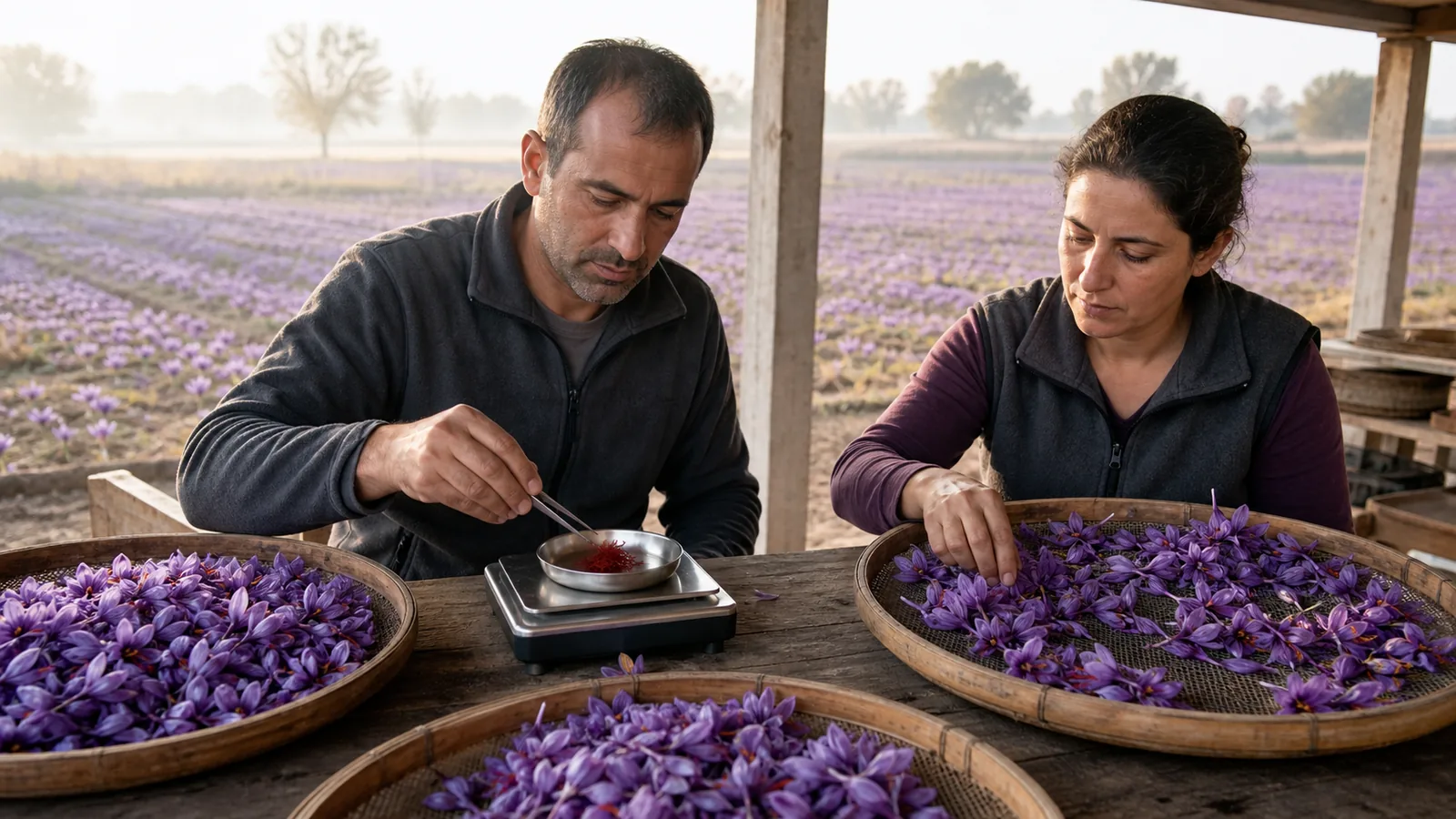
Saffron is the most expensive crop when the comparison is the value of its dried product by weight. That does not make every saffron field the most profitable use of an acre. The spice is costly because each flower produces only three stigmas, the saleable dry yield is small, and harvesting, separation, drying and grading demand careful work in a short period.
For a farmer, the useful question is not the retail price of one gram. It is how many grams the field can sell, at which grade and channel, after every production and marketing cost. A high-priced crop can still lose money when yield is weak, labour is unavailable or the harvest is sold in bulk at a much lower price than a packaged retail product.
The East Azerbaijan report behind the claim
The original article on this page reported comments by Mousa Izadkhah, identified as the acting deputy responsible for improving plant production in the East Azerbaijan Agricultural Jihad organisation. According to Asr-e Emrooz, he described saffron as the most expensive crop despite the very small weight harvested from a field.
Izadkhah said saffron enters dormancy in summer and does not need water during that stage. He gave five kilograms of dry saffron per hectare as an average, said planting through processing did not require complex machinery, and described the crop as suitable for water-scarce regions. He linked its high price to the low dry output per hectare and the cost of production.
He also named colour, aroma and flavour as three signs of good saffron. The report attributed possible uses to the rest of the plant: small corms and leaves in livestock systems, tepals in dyeing, and stamens in beekeeping. Those details are retained as historical statements, but they are not complete production or safety instructions. Each needs a defined process, a buyer and appropriate feed, food or environmental checks before it becomes income.
Why so little finished saffron comes from so many flowers
The commercial spice is made from the dried red stigmas of Crocus sativus. There are three in each flower. Flowers must be collected promptly, then the stigmas have to be separated without filling the lot with yellow style, stamens, tepals or soil. Drying removes much of their fresh weight and must preserve the compounds responsible for colour, aroma and flavour.
An FAO production guide notes that about 450,000 stigmas are needed for one kilogram of saffron. The exact flower count varies with stigma size and final moisture, but the scale explains the price better than the phrase “red gold.” A kilogram represents repeated field visits, hundreds of thousands of delicate plant parts, separation, controlled drying and a very small final mass.
The work is concentrated. Flowers can appear quickly, and a delay may expose them to sun, rain, contamination or physical damage. Separation and drying capacity have to keep pace with collection. Simple hand tools may be enough, but the operation is not effortless.
How much is an acre of saffron worth?
There is no responsible universal cash figure. The value of an acre begins with a short calculation:
Gross crop revenue = saleable dry saffron yield × the price actually received.
Izadkhah’s historical figure of 5 kilograms per hectare converts to about 2.02 kilograms, or 2,023 grams, per acre. If a farm genuinely produces that amount, its gross revenue is 2,023 multiplied by the farm’s weighted average selling price per gram. Use the price received after discounts and rejected lots, not the price of a premium one-gram jar seen in a shop.
The arithmetic protects the query “how much is an acre of saffron worth” from becoming a sales promise. The five-kilogram figure came from an old regional statement; it is not a yield guarantee for East Azerbaijan or anywhere else. A 2020 scientific review found reported stigma yields spanning roughly 2 to 28 kilograms per hectare across very different studies and production settings. Field age, corm size and density, climate, water, soil, disease and management all change the result.
A University of Vermont agrivoltaic trial illustrates another trap in acre-value headlines. Its one-acre estimates assumed a retail saffron price of $35 per gram, included a separate corm-sales scenario and itemised substantial costs. Those assumptions describe that project, market and period. They should not be copied into a wholesale field budget in another country.
Gross value is not farm profit
Subtract all the costs needed to earn the sale price. For a new planting, these may include corms, soil preparation, planting labour, irrigation infrastructure, weed and disease control, harvest labour, separation, drying equipment, testing, packaging, storage, finance and marketing. Existing perennial fields have a different cost pattern, but they still need labour and maintenance.
Separate farm-gate, wholesale and retail volumes. A producer may package some grams directly and sell the rest in bulk. Retail sales carry higher prices but also require small packs, labels, order handling, delivery, customer acquisition and time. Unsold inventory is not revenue.
Quality losses belong in the budget. Damaged flowers, excessive yellow style, poor drying, moisture gain, contamination or a lot that fails a buyer’s specification reduce the saleable weight or price. A realistic budget uses the final accepted weight rather than the fresh flowers collected.
Our review of saffron price and production costs explains why a higher quoted market price may not reach the grower or cover a rise in inputs. The distinction is especially important when a “per acre” estimate mixes retail revenue with farm-level costs.
Five kilograms per hectare is context, not a standard
The original five-kilogram average is plausible as a historical regional figure, but saffron yield changes over the life of a field. The first harvest may be light. Productive years can improve as replacement corms develop, then crowding, disease, depleted soil structure or poor management may reduce performance.
Published data also differ by place and method. A study of Iran’s national water footprint reported an average dry yield of 4.14 kilograms per hectare for its 2008–2014 dataset. A later field-measurement study in Khorasan Razavi found averages of 5 kilograms per hectare in Gonabad and 7.3 in Zaveh and Torbat Heydarieh. These numbers are evidence of variation, not a league table.
Before valuing a new acre, use conservative local results from fields with comparable soil, climate, corm material, age and management. Build a low, expected and high yield case. If the project works only in the high case, the crop is not yet a safe investment.
Summer dormancy does not mean the crop never needs water
Izadkhah’s summer statement describes a familiar feature of saffron. Leaves normally die back as replacement corms enter their warm-season resting period, and established fields are often not irrigated then. Unnecessary summer water can be harmful where warm, wet soil encourages corm rot.
It would be wrong to extend that into “saffron needs no water.” Moisture before flowering and during active leaf and daughter-corm growth can affect emergence, yield and the following season. Rainfall, soil water-holding capacity and climate determine how much irrigation is needed and when.
Recent field research continues to test irrigation depth, timing, salinity and planting method because water productivity is a management problem rather than a zero-water property. The practical guide to saffron in water-scarce regions sets out that distinction in more detail.
Simple equipment, demanding execution
Saffron does not necessarily require a combine or complex processing line. Corms can be planted with ordinary field tools, flowers can be picked by hand, stigmas can be separated at a clean table, and small lots can be dried with controlled equipment. That is the useful part of the historical “simple” claim.
Yet each stage has consequences. Planting depth and density affect corm development. Flower collection competes for labour during a narrow peak. Separation must exclude foreign material. Drying time and temperature alter the finished spice. Packaging must protect it from moisture, light, odours and contamination. A process can be mechanically simple and still require discipline.
Scale changes the equipment decision. A household plot and a commercial hectare do not have the same daily flower volume. Plan backwards from the largest plausible harvest day: how many people can collect, how many kilograms of flowers can be separated, and how much saffron can be dried uniformly before quality declines?
Colour, aroma and flavour need objective quality control
Colour, aroma and flavour are central to saffron, as Izadkhah said. They arise largely from crocins, safranal and picrocrocin, but sensory strength alone cannot confirm purity or grade. Added plant material, artificial colour, excessive moisture or poor storage can mislead a visual inspection.
The current ISO 3632-1:2025 specification applies to dried saffron in filaments, cut filaments and powder. ISO’s explanation of saffron testing notes that laboratory methods evaluate colouring strength, aroma, flavour, purity and moisture-related concerns. A buyer may also set limits for microbial, pesticide or other contaminants under the rules of the destination market.
For farm economics, record dry weight only after the lot reaches its intended moisture condition. Keep batches traceable to field and drying run. A stronger, cleaner lot may earn a better price, but quality should be demonstrated rather than inferred from a dark red appearance.
Can the rest of the saffron plant add value?
Most flower mass remains after the three stigmas are removed, so by-product research is worthwhile. Petals and other floral parts contain pigments and compounds that have been investigated for food, cosmetic and other applications. A scientific review of saffron agronomy describes possible value from tepals, stamens, styles, leaves and corms.
Research potential is not the same as a ready market. The 2015 report’s references to livestock, dyeing and beekeeping did not specify species, inclusion rates, processing, safety results or commercial buyers. Do not feed corms, leaves or floral residues merely because they are plant material. A livestock ration requires qualified advice and analysis; a food colour or extract requires appropriate processing and regulatory compliance.
Small daughter corms may also have more value as future planting stock than as residue if they are healthy and large enough to establish. Compare the cost and delay of growing them on with any alternative use. Keep diseased corms out of propagation and do not create a disposal route that spreads pathogens.
When saffron can be a valuable crop
Saffron’s high price per unit weight is real, but its business case is local. A suitable field, healthy corms, enough harvest labour, controlled drying, verified quality and a realistic route to market must come together. Weakness in one can erase the advantage of the spice’s price.
Start with a trial area and measured costs. Record saleable grams rather than fresh flower weight. Confirm the price with actual buyers in the grade and pack size the farm can supply. Then calculate gross revenue, subtract labour and every other cost, and compare the result with the best alternative use of the land.
That is the honest meaning of “saffron is the most expensive crop.” A small amount of dried spice can carry high value because it embodies a great deal of biological scarcity and careful work. The title describes value by weight; the field budget decides whether that value becomes profit.
Mousa Izadkhah’s role, East Azerbaijan and Asr-e Emrooz attribution, summer dormancy, five-kilogram-per-hectare average, low-output and production-cost explanation, water-scarcity claim, non-complex equipment statement, colour/aroma/flavour criteria and proposed by-product uses are retained as details from the report published here in 2015. They are not presented as current provincial statistics or universal instructions. Sources were reviewed on 29 August 2026.

![Exporting Saffron to Turkey + Price Guide [Complete 0 to 100]](https://img.rowhanisaffron.com/20260827003933/saffron-export-turkey-quality-inspection.webp)



