


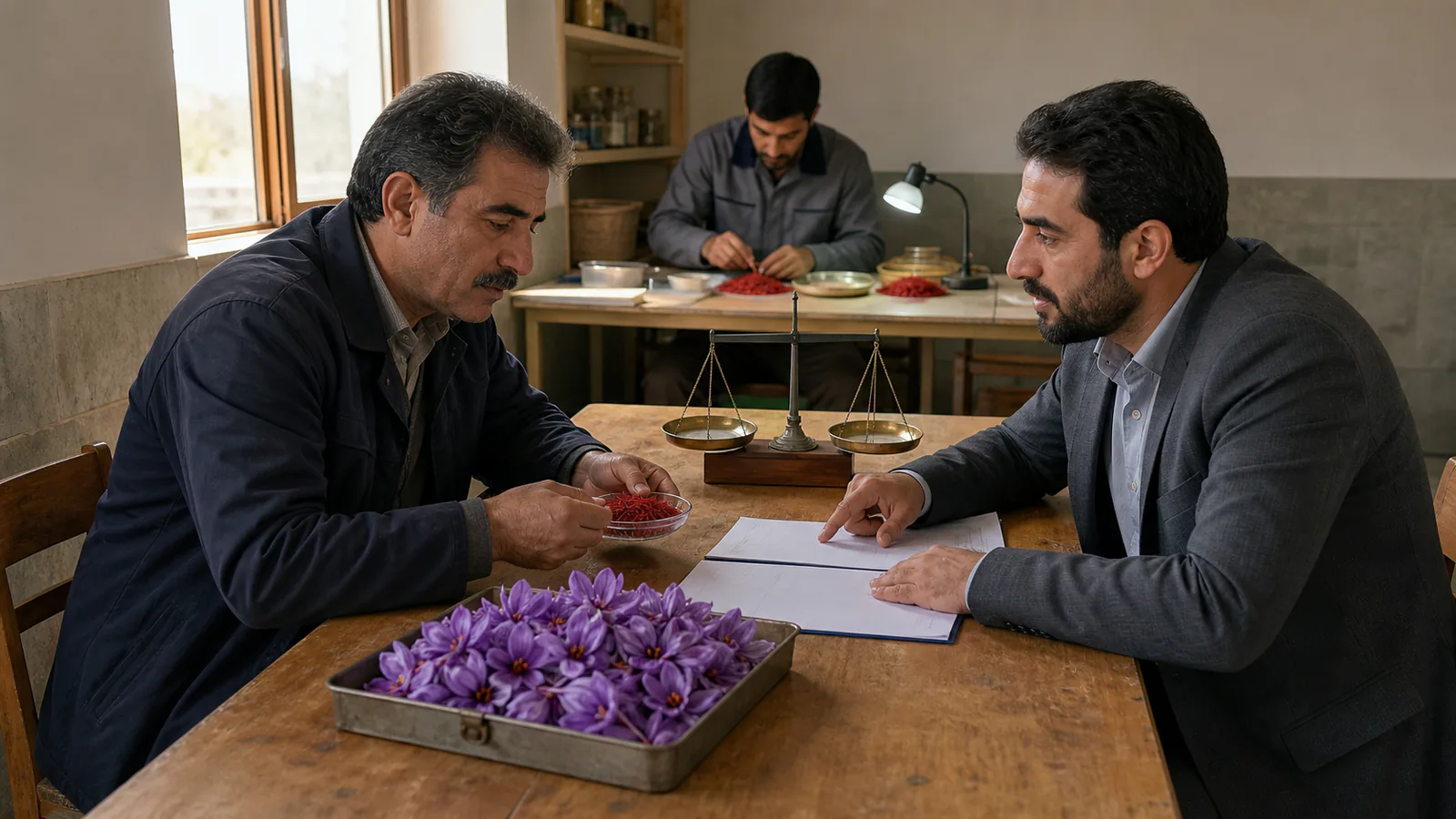
Iranian saffron dealers benefited when growers needed cash before harvest and when more processing, packaging and overseas distribution happened after the product left Iran. That is the central argument running through three historical market reports. Together they recorded 116 tonnes exported for about $166.49 million in one ten-month period, 133 tonnes worth $190 million in a separate eleven-month period, and a pre-harvest flower market in which brokers offered less than the reported farm price.
These are dated snapshots, not today’s saffron price or export total. They also cover different stages of the supply chain: fresh flowers, dried saffron, customs value and downstream re-export are not interchangeable measures. Read carefully, the numbers explain the reported bargaining problem without suggesting that every intermediary made the same margin.
The ten-month export record was $166.49 million
National Saffron Council member Ali Hosseini reported that Iran exported more than 116 tonnes of saffron from Farvardin through Dey, roughly April to December in the Iranian calendar. The declared value was $166,491,133. Compared with the same ten months a year earlier, he reported growth of 15.38% by weight and 14.4% by value.
Dividing declared value by reported weight gives an average of about $1,435 per kilogram. That calculation is useful for checking the internal scale of the report, but it is not a universal product price. Export consignments can differ by grade, format, destination, contract terms and reporting basis; the total also does not reveal what farmers, processors or distributors received.
Hosseini linked the export rise to regulatory stability. That was his market interpretation rather than a controlled analysis. The report did not isolate exchange rates, crop size, destination demand or changes in product mix, so stable rules should be treated as one proposed explanation, not the sole proven cause.
A separate eleven-month period reached $190 million
Another historical report, attributed to Gholamreza Miri, recorded 133 tonnes of saffron exported through Mashhad over eleven months for about $190 million. It compared that with approximately 104.143 tonnes and $151 million in the corresponding earlier period. The reported volume increase of about 27.6% is consistent with those rounded weights.
The second period implies roughly $1,429 in declared value per exported kilogram, close to the ten-month report’s $1,435. The similarity is interesting, but it does not prove that the reports cover the same year, grades or customs methodology. One spans ten months and the other eleven, and the original English text is damaged. Their figures should remain separate rather than being combined into one annual series.
Mashhad reportedly handled 90% to 95% of exports
Miri said that 90% to 95% of the country’s saffron exports were connected with Mashhad. The wording most reasonably describes the city’s role as a trade and export hub, not the physical origin of every flower. Saffron grown elsewhere can pass through Mashhad for sorting, sale, documentation or shipment.
The same account placed local purchasing at about 4.15 to 4.2 million tomans per kilogram and described that year’s price as relatively stable. The report does not name the grade, transaction date or whether every quotation used the same unit and quality. The range must remain a historical local quotation, never a current offer or a benchmark for today’s customer.
The “three times” dealer-benefit claim was an estimate
Hosseini argued that weak domestic processing, packaging, targeted export and international distribution allowed foreign intermediaries to capture more value than Iranian traders. To illustrate the scale, he proposed about $500 million in annual Iranian saffron turnover and about $1.5 billion accruing to brokers and overseas intermediaries.
That three-to-one relationship is an attributed scenario, not audited profit. Turnover is revenue moving through a market; profit is what remains after product, labour, finance, transport, storage, compliance, marketing, tax and loss. The source supplies no ledgers, country breakdown or common accounting definition. Repeating “three times the profit” without that boundary would make the historical statement stronger than its evidence.
Where downstream value can arise
The report’s broader point is easier to understand when the chain is separated. Value can be added through cleaning, grading, testing, loss control, branded packaging, regulatory documentation, customer acquisition, warehousing and delivery in the destination market. A reseller may also assume inventory, currency and payment risk.
Those activities have real costs; they are not automatically excessive margin. The policy concern was that too little of the processing and market access happened close to Iranian producers. Hosseini proposed better collection, lower production waste, cooperation with established overseas networks and, over time, a stronger direct distribution network. He also acknowledged that such a network could not be built quickly or simply.
Our article on Iranian saffron production and export-value challenges examines that wider quality and market problem. Product testing and truthful packaging also matter because downstream value is sustainable only when buyers can verify what they receive.
The pre-harvest flower market exposed a cash gap
A South Khorasan report described brokers pre-purchasing fresh saffron flowers at about 45,000 tomans per kilogram before harvest. The contemporary farm quotation was said to be around 60,000 tomans. The 15,000-toman difference placed the pre-purchase offer 25% below the stated farm price.
The report also said the previous year’s flower price had been about 30,000 tomans and described the move to 45,000 as a 50% rise. Both statements can be true: one compares years, while the other compares an advance sale with a contemporaneous farm quotation. They do not show the broker’s final profit because storage losses, payment timing, flower quality, stigma recovery and sale price are missing.
Fresh flowers and dried saffron are different markets
The same account said dried saffron had moved from roughly three million to five million tomans per kilogram, an increase of about 66.7%. That percentage is not the same as the reported 50% move in fresh flowers. A kilogram of flowers contains petals, stamens, moisture and only a small amount of marketable stigma, whereas a kilogram of dried saffron represents processed stigma.
Flower-to-spice conversion depends on flower condition, separation and drying. A peer-reviewed review of saffron’s commercial quality and main compounds describes the labour-intensive separation process and the effect of harvesting, drying and storage on quality. That is why a flower quotation cannot be divided directly into a dried-spice quotation to claim a margin.
Why growers accepted a lower pre-purchase price
Hosseini said some farmers lacked the liquidity to pay near-term harvest costs and therefore sold flowers forward to brokers. An early buyer offers cash and accepts later price or crop risk; the grower gives up some potential upside in exchange for certainty. The bargaining problem becomes sharper when urgent labour and household expenses leave only one realistic buyer.
His proposed remedy was seasonal finance through specialist banks or funds, allowing growers to reach harvest without a forced early sale. That was a proposal, not a documented programme result. Whether it would help depends on eligibility, timing, interest, collateral, repayment terms and access in the producing villages.
A larger forecast harvest did not guarantee lower prices
The flower-market report expected a favourable crop and suggested that both flower and dried-saffron prices might fall as supply arrived, potentially hurting traders who bought earlier. This was a forecast. Real prices also respond to grade, exchange rates, export demand, inventories, payment restrictions and how quickly flowers can be processed.
The comment is best preserved as evidence of the risk each side faced. A grower selling before harvest risked missing a later rise. A broker buying in advance risked a larger harvest and falling market. Neither outcome is known from the report, so the article does not declare who ultimately gained.
What a reliable value-chain record should include
To evaluate how much value remains with growers, later reporting should connect the same crop across each transaction stage:
- fresh-flower weight, price, payment date and location;
- dry-stigma recovery, grade, moisture and laboratory result;
- labour, drying, packaging, finance, transport and compliance costs;
- domestic wholesale and declared export value by format;
- destination-market selling price and reseller costs; and
- revenue, gross margin and net profit under consistent definitions.
Without those links, export totals describe trade scale and local quotations describe moments in a season, but neither proves the final distribution of profit. Readers assessing a package can consult our guide to saffron authenticity, labels and quality checks; those controls are part of the value a responsible supply chain must provide.
The historical lesson is bargaining power, not a current price
The three reports support a restrained conclusion. Iran shipped substantial saffron value, Mashhad was described as the main export hub, and officials believed weak processing and international distribution left too much downstream opportunity elsewhere. At farm level, urgent cash needs could push growers toward discounted pre-harvest flower sales.
They do not prove a universal threefold dealer profit, and none of their toman quotations should be used today. Their lasting value is the structure they reveal: transparent grades, timely finance, careful processing and credible access to buyers determine who can negotiate—and who must accept the first offer.

![Exporting Saffron to Turkey + Price Guide [Complete 0 to 100]](https://img.rowhanisaffron.com/20260827003933/saffron-export-turkey-quality-inspection.webp)



