


The figures in this article are historical snapshots of Iranian saffron prices on world markets, not a live price list. They come from several National Saffron Council interviews published between 2015 and 2020. Read together, they show how crop size, weather, quality, stored inventory, buyer demand and trading behaviour can move the market in different directions.
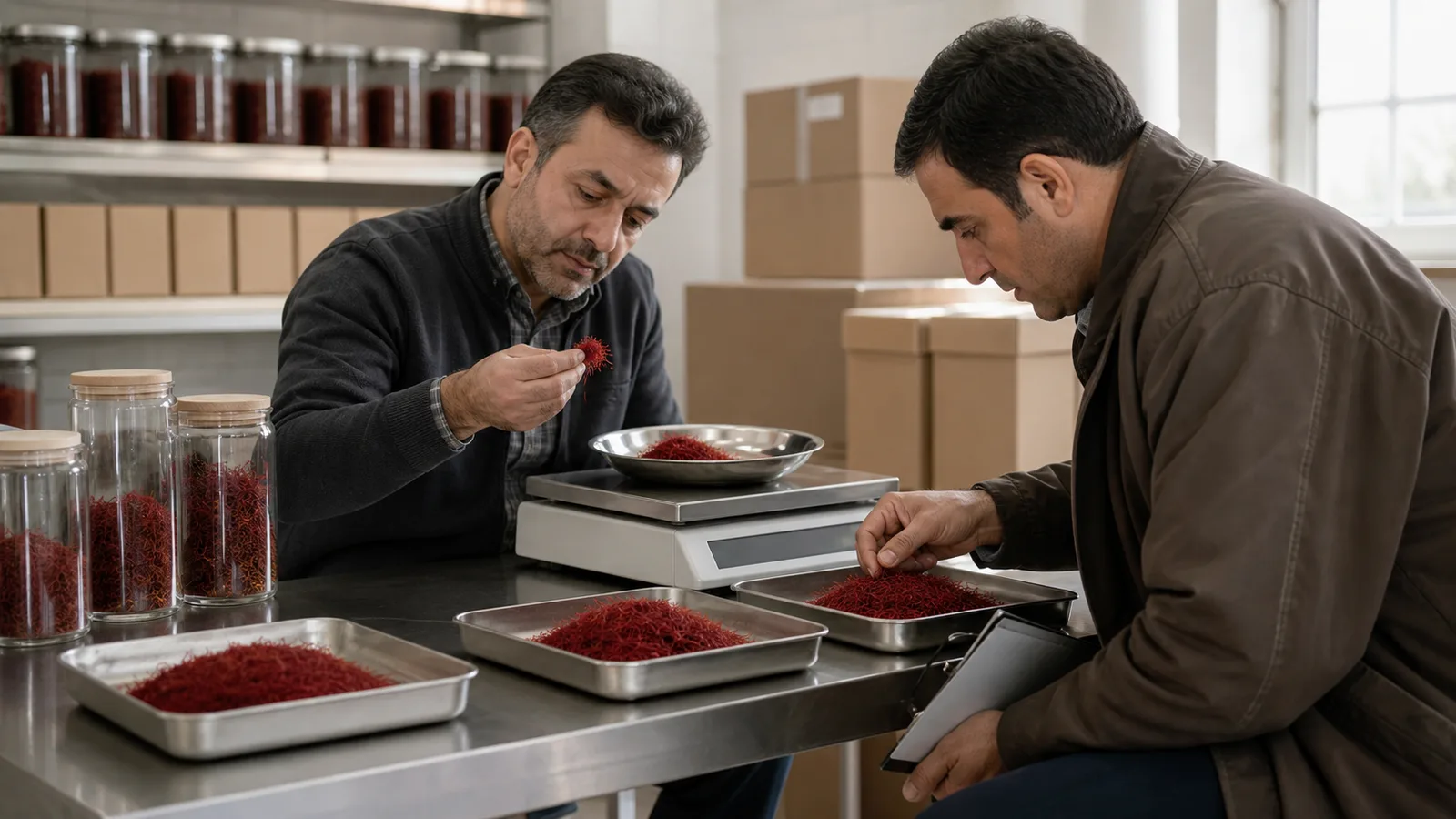
The original report quoted domestic prices of roughly 4–5.8 million tomans per kilogram and an international price of $1,800–$2,000 per kilogram. Later reports described a cold-reduced crop, a two-million-toman price jump, large stocks held outside the market and then a fall to what one council member called a world-market minimum. None of those numbers is a current Rowhani Saffron quotation.
The 210-tonne production estimate and average yield
In the destination interview, council member Ali Hosseini said Iran had produced about 210 tonnes of saffron in the preceding year, approximately 30% below the earlier comparison. He cited more than 80,000 hectares in Razavi and South Khorasan and calculated an average yield of about 2.6 kg per hectare.
That arithmetic is internally consistent: 80,000 hectares at 2.6 kg per hectare is about 208 tonnes. Hosseini argued that raising average yield towards 4 kg per hectare could lift production above 320 tonnes without simply expanding acreage. The important unit is kilograms, not tonnes per hectare; one assigned source mistranslated the yield unit.
Average yield does not describe every farm. Irrigation, corm health and density, soil, weather, field age, harvest timing and measurement methods all matter. A national or regional average should not be used as a promise for an individual field.
The historical domestic and world price figures
Hosseini placed Iranian domestic prices at about 4–5.8 million tomans per kilogram, varying by quality and market conditions. The translated article repeatedly rendered those figures as dollars or pounds; the coherent unit is tomans. It also quoted $1,800–$2,000 per kilogram in world trade and an approximate converted average of 6.5 million tomans.
These were interview figures, not a published exchange settlement or a grade-specific offer. Customs data gives another perspective. World Bank WITS records Iranian saffron exports in 2014 at about $227.6 million for 158,794 kg, an average declared value near $1,434 per kg. In 2015, the reported $165.3 million over 113,588 kg works out near $1,455 per kg.
A customs unit value is not a market quote. It combines shipments with different grades, contract dates, destinations, pack formats and commercial terms. The difference from the interview’s $1,800–$2,000 range illustrates why every price needs a definition.
Cold weather changed a later crop forecast
A subsequent Hosseini interview said saffron was grown in 24 Iranian provinces, while about 96% of production remained concentrated in Razavi and South Khorasan on more than 90,000 hectares. Before harvest, an average of roughly 3.5–4 kg per hectare had supported a forecast above 360 tonnes.
A late cold wave then hit the two Khorasan provinces during the harvest period. Hosseini estimated that production still exceeded 300 tonnes but said the Ministry of Agriculture had not yet released a definitive figure. He asked for prompt official statistics so growers, buyers and exporters could plan.
The 360-plus forecast and 300-plus post-cold estimate belong to that particular season. They should not be combined with the older 210-tonne figure as if one source had contradicted itself; acreage, year and weather had changed. Nor should the estimated loss be turned into a current supply warning.
The 100-village quality and identity programme
The cold-weather report also described a four-year saffron quality and identity programme implemented from Iranian years 1390 to 1393, roughly spanning 2011–2015. According to Hosseini, the National Saffron Council and public partners selected 100 villages, created local stations, supplied drying equipment and trained farmers from harvest through processing.
He said participating saffron earned about 30% more. Before the programme, growers reportedly received around 3 million tomans per kilogram; later, ordinary qualifying product was around 4.6 million and some lots reached 5.8 million tomans. Those are attributed historical prices, not an experimental evaluation that isolates the programme from inflation or wider market movement.
The mechanism is nevertheless credible. Faster, cleaner separation and controlled drying can make lots more consistent. Village stations can create a defined point for training, sampling and aggregation. A premium lasts only when the buyer can verify why one lot differs from another.
The estimate that half the crop was being held
Another 2017 article presented a more contentious estimate. Hosseini said roughly 300 tonnes had been produced and about 150 tonnes exported, leaving approximately 150 tonnes in homes and warehouses. At an assumed 5 million tomans per kilogram, he valued that inventory near 750 billion tomans.
The multiplication is consistent, but the underlying stock figure was not an audited inventory. The article said final customs data had not been released and attributed the balance to speculators hoping for higher prices. Some unsold material can also be normal working stock held by growers, traders or processors. Without lot-level evidence, not every stored kilogram should be labelled hoarding.
What matters is market impact. If a large volume is withheld and later offered at once, price and buyer confidence can change quickly. If the estimate is wrong, repeating it can create the very uncertainty the interview criticised.
The four-to-six-million-toman swing
The same report said prices moved between 4 and 6 million tomans per kilogram and jumped by about 2 million tomans around November. Hosseini linked the abrupt move to inventory changing hands and said exporters and foreign customers became uncertain. He also estimated that exports fell about 30% in the closing months of the period.
These statements lacked a grade-by-grade price series and final customs table. They should remain an account of market sentiment, not proof that a single price applied to all saffron. A sudden quote can reflect a particular lot, location or delivery term.
The concern about delayed stock returning to market was the reverse of the earlier price rise: a large release could push prices down. That is why stable specifications and transparent transaction data matter more than rumours about a universal daily rate.
The 2020 claim that world prices hit a minimum
In October 2020, Hosseini said the price of saffron in world markets had fallen to a minimum and argued that the decline was not caused by the dollar exchange rate. He pointed instead to lower purchasing power among foreign traders, changing world economic conditions and speculative activity.
“Minimum” was not tied to a time series, currency, grade or destination, so it cannot be measured from the article alone. Exchange rates still affect how an Iranian producer, exporter and overseas buyer experience the same transaction. Hosseini’s narrower point was that currency movement did not fully explain weak demand or the traded price at that time.
The broader chronology of Iranian saffron export increases and disruptions likewise shows that percentages from different intervals can coexist. Period, baseline and measure must travel with every number.
Why the Commodity Exchange was criticised
The 2020 source said offering saffron on the Commodity Exchange had not protected farmers because speculation and broker activity captured the benefit. Hosseini called official support through the exchange a slogan rather than a result.
This was the view of an industry representative, not an evaluation of every contract or farmer. An exchange can provide published trades, standard contracts and settlement rules, but it cannot guarantee a high price. Farmers benefit only if grades are accessible, lot sizes and delivery rules are workable, fees are proportionate, payment is timely and competition is genuine.
Off-exchange trade has similar trade-offs. A direct buyer may offer flexibility and finance but less public price information. The relevant comparison is the net result for a defined lot after testing, transport, storage, commission, financing and payment risk.
What actually determines a saffron quote
A useful current quotation needs more than “price per kilogram.” At minimum, buyer and seller should agree on:
- the physical grade and permitted floral material;
- moisture, aroma/colour specifications and supporting test method;
- harvest period, origin and lot identity;
- quantity and whether it is bulk or retail packed;
- currency, quotation time and payment terms;
- delivery location, transport, insurance and customs responsibility.
Two offers can differ substantially while both are honest because one includes testing, small packs, freight or longer credit. A very low price can also signal an old crop, weak grade, excess moisture, adulteration or simply a seller with urgent inventory. It should trigger verification, not an automatic conclusion.
How to use these historical price reports
The four articles document recurring forces in Iranian saffron markets: yield, weather, post-harvest quality, delayed statistics, inventory, buyer confidence, exchange design and global purchasing power. Their numerical details are valuable when kept with their dates and attributions.
They should not be used to answer “What does saffron cost today?” A current buyer needs a dated, specification-based offer. A grower evaluating a historical programme needs the crop year, grade and inflation context. Preserving those distinctions makes old market reporting useful without turning it into misleading live pricing.

![Exporting Saffron to Turkey + Price Guide [Complete 0 to 100]](https://img.rowhanisaffron.com/20260827003933/saffron-export-turkey-quality-inspection.webp)



