


Iranian saffron exports increased by 15%, according to the interview behind this headline, but the surviving article does not identify the comparison period, export weight or customs table. That missing denominator matters. The same collection of reports records an earlier 6% rise after JCPOA implementation and a sharp fall when COVID-19 interrupted flights and domestic travel. These are different snapshots, not a single trend.
Read together, the interviews with National Saffron Council figures Mohsen Ehtesham and Ali Hosseini show why one percentage cannot explain the market. Export results depended on air cargo, harvest labour, price policy, access to buyers, food-import compliance, branding and the gap between expanding cultivation and demand.
What the 15% headline can—and cannot—tell us
The destination article preserved “increased by 15%” in its title but began mid-interview and never supplied the period or baseline. It also did not say whether the percentage referred to physical weight, customs value or another measure. The figure should therefore remain an attributed historical headline, not be presented as a verified current growth rate.
Ehtesham’s surrounding comments appear to describe a pandemic-era harvest and its aftermath. He said a lower base export price, COVID-19 disruption and labour shortages had put downward pressure on saffron prices. Once harvest ended, he described the market as stabilising and advised growers not to rush their sales. Without the original customs series, the safest interpretation is that exports could rise over one chosen comparison while producers still faced weak prices and serious operational problems.
The earlier 6% rise after JCPOA implementation
Ali Hosseini supplied an earlier point in the timeline. He said customs statistics showed saffron exports rising 6% after JCPOA implementation and linked part of the opportunity to firms adapting their products for the American market. The old article does not provide the dates, weight, value or customs release behind that percentage, so it too should be treated as an attributed period result.
The policy context is documented: a narrow 2016 authorisation briefly allowed Iranian-origin foodstuffs into the United States. Our account of Iranian saffron exports to America explains that opening and its 2018 reversal. Meeting food rules did not remove sanctions restrictions, and sanctions permission did not make a food shipment automatically admissible.
What “adapted to FDA rules” means in practice
The source’s wording can sound as though the US Food and Drug Administration approved particular Iranian saffron exporters. FDA says it does not pre-approve or certify individual food importers, products, labels or shipments. Its official food-import guidance says imported foods must be safe, sanitary and properly labelled; applicable facilities must be registered, prior notice is required, and products can be inspected or detained at entry.
Depending on the transaction, an importer may also need a Foreign Supplier Verification Program, accurate English labelling, appropriate food-contact packaging and records supporting ingredient and hazard controls. This is a continuing system of responsibility, not a one-time badge. Hosseini’s useful point was that market access requires adapting the entire product and documentation to the destination’s rules.
How COVID-19 interrupted exports
In the second source interview, Ehtesham described the first pandemic shock. Saffron commonly travelled by air, so cancelled or heavily restricted flights in March and April reduced cargo capacity. He named Italy, the United States, Germany, Sweden, France, China, the United Arab Emirates and India among affected markets. The list mixed countries with a broader reference to Europe, but its meaning was clear: closures occurred across several important buying and transit markets at once.
The translated source contains garbled years for those March–April dates and does not provide an export tonnage. It is safer to identify the initial COVID-19 period than to repair the dates by guesswork. A later interview could report recovery or growth from a depressed base while the first shock still represented an exceptional decline.
Mashhad pilgrims and the domestic demand shock
The pandemic affected more than overseas cargo. Ehtesham said Mashhad typically received five to six million pilgrims in March and April, many of whom bought saffron as a souvenir. Travel restrictions removed that seasonal customer flow.
The English source says domestic “supply” fell 80%, although the surrounding explanation is about demand and purchases. It does not name a survey or dataset. The coherent reading is that the interviewee reported an approximately 80% disruption to that domestic market channel; it is not safe to relabel it as a verified nationwide fall in supply or sales. What can be retained is the mechanism: when visitors disappear, local retailers and the producers supplying them lose a concentrated period of demand.
Harvest labour, flower separation and historical prices
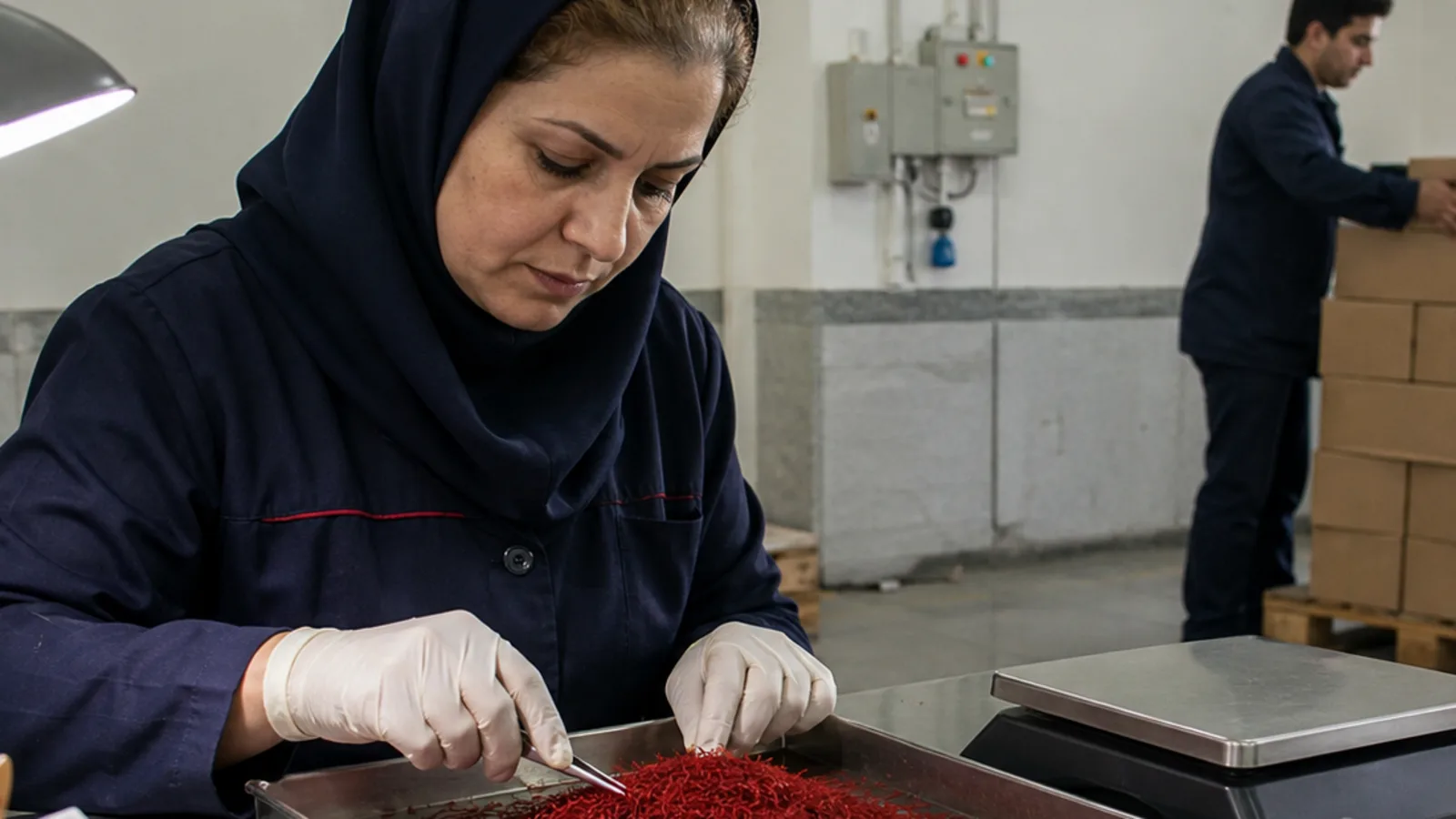
Export performance begins in the field. The destination says COVID-19 health protocols and worker shortages pushed harvest labour costs to about three times a normal year. Saffron flowers must be picked and the stigmas separated quickly, so a shortage can affect cost, timing and quality.
Ehtesham referred to a flower-opening device developed by students at Sharif University of Technology as a possible response. The post did not provide test results, capacity or commercial availability, so it should be described as a prototype or development effort rather than a proven industry solution. Mechanisation has to protect the threads and remain economical at farm scale.
The same interview placed “Super Negin” saffron at 21–24 million tomans per kilogram after exporters reportedly bought above an approved price. This is a dated wholesale snapshot with no precise month, laboratory grade or exchange-rate basis. It belongs in the historical account but is not a current quotation.
When cultivation grows faster than demand
Both interviews return to the same structural problem: more hectares do not guarantee a larger or better-paid market. Ehtesham said cultivation had expanded without a proportional increase in demand. He also criticised planting beyond local capacity to harvest and open flowers, particularly in Khorasan Razavi.
The former article claimed Iran produced 95% of the world’s saffron yet could not set the global price. The percentage was not sourced or tied to a year, and production share does not confer pricing power by itself. Buyers can switch suppliers, negotiate around quality and delivery risk, or purchase Iranian saffron through intermediaries. Currency policy, fragmented selling and inconsistent specifications can weaken the position of even a large producer.
Two different funding ideas in the interviews
The sources describe two proposals that should not be confused. First, Ehtesham said the council had long sought a saffron protection fund financed by 1% of export value. Under private-sector supervision, it would support market development, branding and consumer education. The interview presents this as a proposal that had not succeeded, not an operating levy or fund.
Second, the destination says 1,000 billion tomans was meant to be available for saffron purchases in Razavi, South and North Khorasan through Agricultural Bank, Mellat Bank and Export Development Bank, at 15% interest for one year. Ehtesham said this facility was not realised. It was purchase finance, not the proposed 1% marketing fund, and the National Saffron Council itself was described as a policy body rather than a buyer.
Branding, geographical identity and target markets
Hosseini argued that Iran needed to manage target markets and build an authentic national brand. Ehtesham made the same point from South Khorasan, noting the geographical-indication registration associated with Ghaenat saffron and barberry. The practical value is not a slogan on a box; it is a traceable connection among origin, consistent grading, test results, packing and the claims made to the buyer.
The destination also said Chinese buyers sometimes re-exported saffron under their own names. That claim was not documented at shipment level and should not be turned into an accusation against all Chinese buyers. The broader, supportable issue is loss of origin visibility when product is sold in bulk and branded later by an intermediary.
Foreign-exchange return and border trade
Ehtesham identified the return of export proceeds as another constraint, using Afghanistan as an example. He said some South Khorasan businesses could not exchange or return currency even through an exchange office and proposed facilities at border points.
This is a separate problem from customer demand. An order may exist and the goods may move, yet the exporter can still struggle to receive and document the proceeds through permitted channels. A sound export strategy therefore has to test the payment path before accepting the order, rather than treating finance as an afterthought.
Crocin, picrocrocin and safranal are not a COVID claim
The pandemic source proposed marketing saffron through traditional Chinese medicine and called it an immune-boosting or “anti-corona” product. It named crocin, picrocrocin and safranal, but these compounds are principally discussed in saffron chemistry for colour, bitterness and aroma, alongside continuing biomedical research. Their presence does not establish prevention or treatment of an infectious disease.
During the pandemic, the World Health Organization said no single food prevents COVID-19 and that there was no evidence for herbal teas or supplements as prevention or cure. The source’s marketing suggestion is therefore not carried forward as a health benefit. Product development can discuss saffron’s documented composition without turning laboratory hypotheses or traditional use into a medical promise.
What the rise-and-fall timeline really shows
The 6% and 15% growth headlines, the initial COVID decline and the later market stabilisation can all describe different intervals. None should be used without its comparison period, measure and source. The better conclusion is structural: Iranian saffron exports are strongest when logistics, destination compliance, harvest capacity, traceable branding, buyer development and payment channels work together.
Percentages attract attention, but resilience comes from the less dramatic work behind them. That means protecting quality at harvest, verifying the rules of each destination, matching cultivation to real demand, funding sustained market development and ensuring exporters can complete the financial side of a lawful sale.

![Exporting Saffron to Turkey + Price Guide [Complete 0 to 100]](https://img.rowhanisaffron.com/20260827003933/saffron-export-turkey-quality-inspection.webp)



