


Saffron production in Abarkooh city increased by 15% in the historical harvest reported here. Hassan Zare, then head of crop production at Abarkooh Agricultural Jihad, said farmers collected 400 kilograms of dried saffron from 100 hectares.
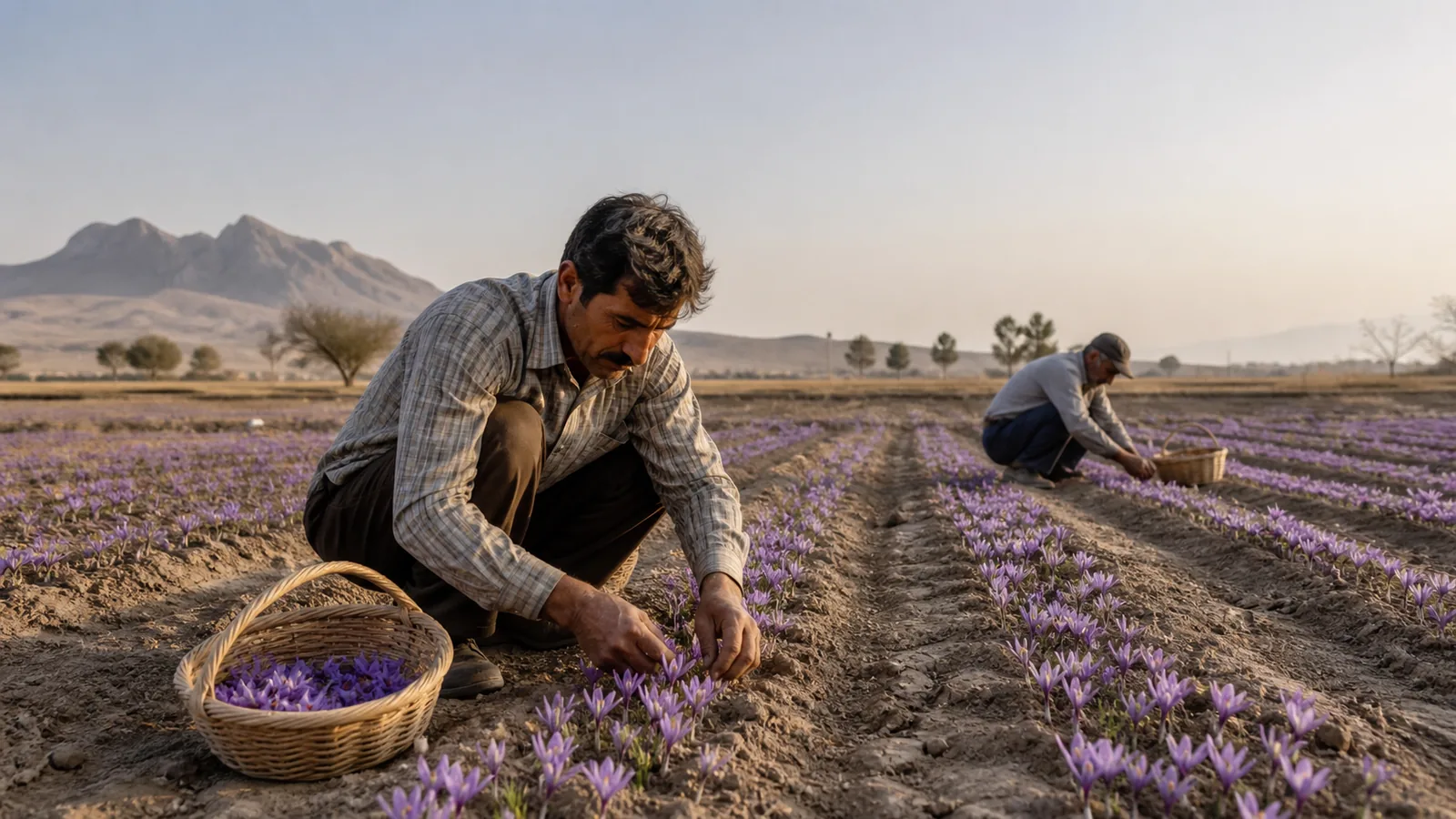
Four hundred kilograms came from 100 hectares
The reported totals give a city-wide average of 4 kilograms per hectare, matching the figure quoted by Zare. Some Abarkooh farms performed better, producing between 5.5 and 6 kilograms per hectare.
Those higher farm yields were examples, not the result across the whole cultivated area. The report did not identify the farms, their field age or their cultivation methods, so it does not support a promise that every grower could achieve the same output.
The 15 percent increase describes that season
The growth figure compared the completed harvest with the previous year’s production. If 400 kilograms represented an exact 15 percent rise, the earlier crop would have been about 348 kilograms. Because the report did not publish the underlying previous-year total, that calculation is only an approximation.
It is also a historical comparison, not Abarkooh’s current growth rate. Weather, irrigation, flowering conditions, the productive age of the fields and post-harvest handling can all change the result from one season to another.
Faragheh held the largest cultivated area
Zare identified Faragheh district in Abarkooh’s central area as the main centre of saffron cultivation. He said 200 farmers in the agricultural sector were involved in growing and producing the crop.
An earlier official Agricultural Information Network report recorded 50 hectares and a forecast of 180 kilograms of dried saffron in 2018. It also named Faragheh, along with the central and Bahman districts, among Abarkooh’s main growing areas. That earlier snapshot helps show the expansion that preceded the 100-hectare harvest.
Planting and harvest followed an autumn calendar
The local account placed saffron corm planting in September. It described harvesting as running from mid-November until late December, though the precise start and finish naturally depend on flowering in a particular year.
The old English translation called the planting material “saffron onions.” Corms is the accurate term for the underground structures planted to establish a saffron field.
The planned area was 120 hectares, not a 120 percent rise
Officials expected the cultivated area to reach 120 hectares in Iranian year 1400. Moving from the reported 100 hectares to 120 hectares would be a 20 percent increase.
The original wording said the area would “increase by 120% to 120 hectares,” but those two statements cannot both be correct. The defensible reading is that 120 hectares was the target total. The article did not later confirm whether that target was achieved.
Climate, water use and value encouraged expansion
Abarkooh’s agricultural office linked the crop’s expansion to its compatibility with the region’s climate and its added value. One sentence in the old translation referred to a “lack of demand” for crops including saffron, which conflicts with the rest of the passage and is too unclear to treat as a reliable reason.
In a dry region, saffron may be considered alongside crops with relatively modest seasonal water needs, but it is not water-free. Field suitability still depends on drainage, irrigation timing, temperature, healthy corms and local soil conditions.
A historical loan programme supported growers
The report said farmers establishing or enlarging saffron fields could apply for financing of 700 million rials per hectare, with repayment over five years. Applicants were directed to Abarkooh’s Agricultural Jihad management.
That was a programme described at the time of the report. It should not be read as a loan offer that is still open, nor as a guarantee of approval, without confirmation from the local authority.
Reading Abarkooh’s harvest record accurately
The useful picture is specific to its period: 400 kilograms of dried saffron from 100 hectares, a reported 15 percent annual increase, an average yield of 4 kilograms per hectare and 200 participating farmers. Faragheh was the main cultivation area, while officials planned a 120-hectare total and described financial support for expansion.
Keeping the dates, estimates and programme terms attached to that historical setting makes the account more useful. It records how saffron cultivation was developing in Abarkooh without turning an old harvest or loan scheme into a present-day claim.

![Exporting Saffron to Turkey + Price Guide [Complete 0 to 100]](https://img.rowhanisaffron.com/20260827003933/saffron-export-turkey-quality-inspection.webp)



