


Iranian saffron exports to America briefly gained a more direct legal route in 2016. A contemporary Iranian report said exporters shipped 41 kilograms to the United States during a 53-day period after a narrow JCPOA-era authorization allowed Iranian-origin foodstuffs to enter the country. That window later closed, so this article is a historical account rather than a statement that the same trade is authorised today.
The original news story mixed saffron with reports about carpets, caviar and pistachios, repeated one carpet paragraph and treated sanctions relief as much broader than it was. Read carefully, the important story is smaller and more useful: a short-lived regulatory change opened a direct route for a food product, while banking, counterparty and compliance restrictions still shaped every transaction.
What the 41-kilogram saffron report said
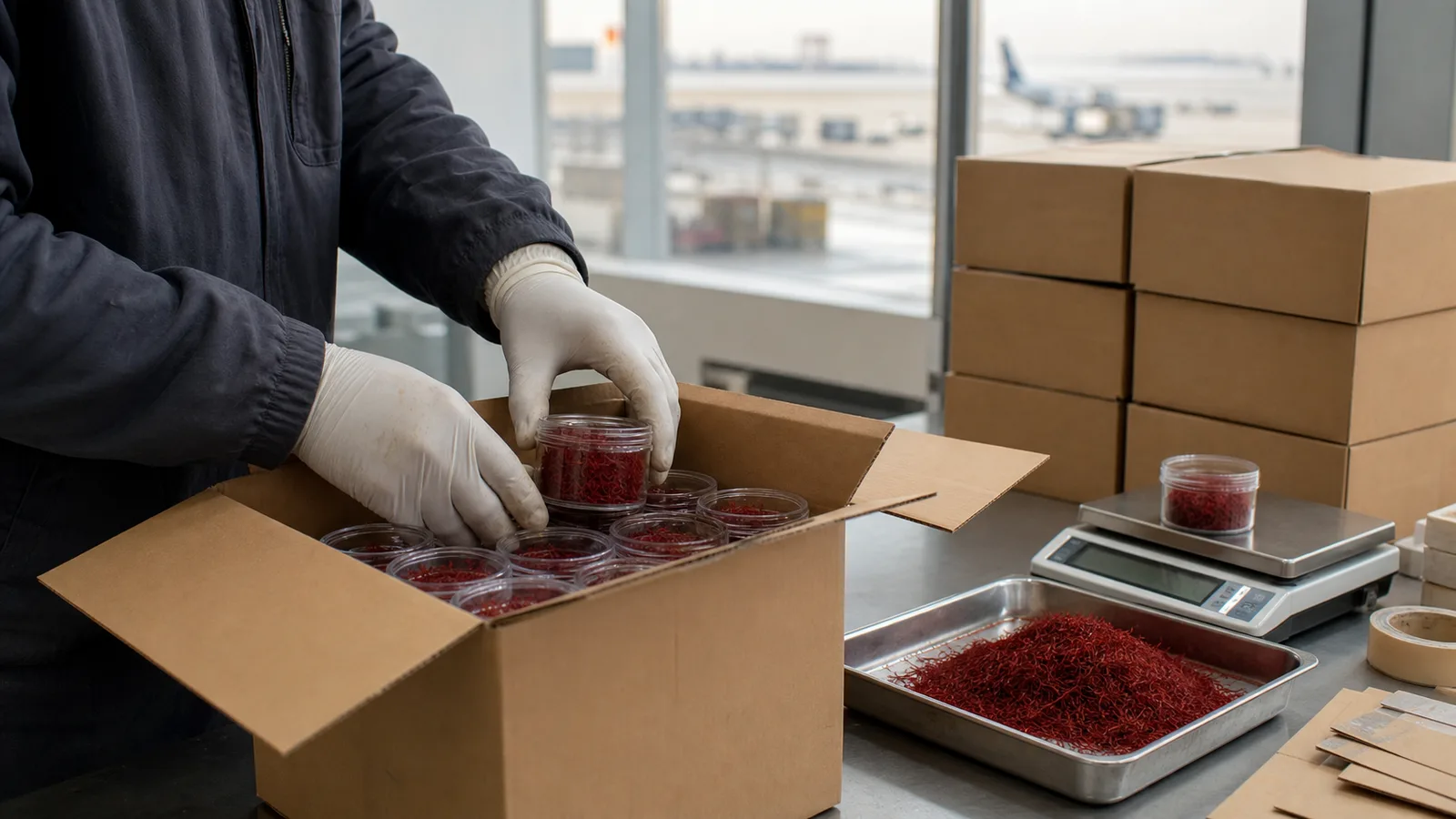
The destination article reported that Iranian businesses sent 41 kilograms of saffron to the United States during the final 53 days of the Iranian year then under discussion. It valued those shipments at more than US$68,000 and said the consignments included packages below 10 grams, packages from 10 to 30 grams and packages above 30 grams.
Those figures are preserved as claims from the contemporary report. The post did not identify a customs table, date range in the Gregorian calendar or whether its value was free on board, customs value or another measure. Dividing US$68,000 by 41 kilograms gives a rough reported average above US$1,650 per kilogram, but that calculation cannot reveal grade, package mix, insurance, freight or retail price. It should not be used as a present saffron quotation.
Why direct exports became possible in 2016
On 16 January 2016, JCPOA Implementation Day, the US Treasury’s Office of Foreign Assets Control (OFAC) issued a general licence for imports of Iranian-origin carpets and foodstuffs. Treasury testimony from February 2016 confirms that foodstuffs, including examples such as pistachios and caviar, were one of three narrow authorised categories.
Saffron is a foodstuff, which explains the opportunity described by the post. Importers no longer needed to treat a shipment of Iranian saffron exactly like goods that remained under the primary embargo. This was the regulatory change behind the reported direct consignments; it was not a general removal of US sanctions on Iran.
What sanctions relief did not do
US officials repeatedly stressed the limits. In 2016, the Treasury said that the primary embargo otherwise remained and that Iran was not being granted access to the US financial system. US persons were still generally prohibited from investing in Iran or dealing with most Iranian people, companies and financial institutions outside the narrow authorisations.
That distinction corrects a key weakness in the assigned source. The source suggested that Iranian exporters could simply receive money through letters of credit, Western Union or PayPal and deal directly with American buyers. The foodstuff authorisation did include certain related letters of credit and brokering services, but it did not make every bank, payment provider, Iranian counterparty or payment route available. A commercial service could impose its own restrictions, and dealings involving blocked people or institutions remained a serious issue.
Therefore, the practical benefit was an authorised category and a more direct commercial possibility—not guaranteed access to any named payment platform. An exporter still needed a willing importer, compliant financial institutions, screening of all parties and a transaction structured within the rule.
Why indirect routes had mattered before
The destination article said American buyers had previously obtained Iranian saffron through intermediary markets such as the United Arab Emirates. In that model, bulk saffron could be purchased, repacked and exported under a different commercial brand. The precise route would vary by business, but the underlying problem is plausible: when origin-country producers cannot reach the final market directly, more of the packaging, customer relationship and margin may sit with intermediaries.
The 2016 opening mattered because direct contact could make provenance easier to communicate and give Iranian suppliers a better chance to sell finished, traceable packs. It did not automatically solve quality assurance, labelling, customs classification, food-import requirements or payment risk.
Ghaen saffron and the unsupported 98% claim
The source singled out Ghaen saffron and said Iran produced almost 98% of the world’s saffron. Ghaen and the wider South Khorasan region are historically important saffron-growing areas, so their prominence belongs in the story. The 98% figure, however, was not sourced or tied to a particular production year. Global shares change, and production, export quantity and re-export origin are different measures.
For that reason, the merged article does not repeat 98% as a verified fact or imply that every US-bound consignment came from Ghaen. A reliable origin claim should follow the actual batch through farm or cooperative records, exporter documentation and packaging—not a national statistic attached to the product after the fact.
How the 41-kilogram story fit Iran’s wider exports
The original destination also reported a national annual total of 113 tonnes and 579 kilograms of saffron worth more than US$165.3 million, shipped in 42 packaging categories. It said quantity was down 28.5% and value down 27.4% from Iranian year 1393. These numbers provide useful scale, but the post did not name the customs release behind them, and its English translation leaves the reporting year unclear.
The careful conclusion is that the 41-kilogram US movement was symbolically important but very small beside Iran’s overall saffron trade. It demonstrated a new route; it was not evidence that America had become a major destination or that the broader export decline had reversed.
Why carpets, pistachios and caviar appeared in the story
Carpets and foodstuffs were discussed together because they were covered by related JCPOA-era exceptions. News reports about the first carpet shipment to Los Angeles and the return of Iranian pistachios or caviar created the political backdrop for saffron’s arrival. They do not need to dominate a saffron article, and the duplicated carpet passage has been removed.
The relevant connection is regulatory: these products illustrated how a narrow import authorisation could reopen familiar categories without lifting the wider embargo. Saffron followed the foodstuff route, while carpets followed their own named category.
The 2018 reversal changed the answer
The 2016 window did not remain in place. On 27 June 2018, OFAC announced that it had narrowed the foodstuff and carpet licences to wind-down activity through 6 August 2018. Its wind-down guidance said activity continuing after that date in violation of the Iranian Transactions and Sanctions Regulations could face enforcement.
This later action is essential context for anyone who finds an old headline saying saffron exports to America were “released.” The article describes what happened during the 2016 authorisation; it does not confirm that a direct shipment, payment channel or counterparty is lawful now.
What an exporter or importer must verify today
Iran-related rules and designations can change. Before arranging a shipment, parties need current legal advice and should check the official OFAC Iran sanctions page, the current regulations, licences, blocked-party lists and any guidance specific to the transaction. They also need to confirm customs origin, food admissibility, labelling, transport and the policies of every bank and service provider involved.
Do not assume that an exception for selling food to Iran is an exception for importing Iranian food from Iran. OFAC’s present humanitarian guidance often concerns agricultural commodities, food, medicine and medical devices supplied to Iran. Direction of trade matters.
What this historical episode still teaches
Iranian saffron exports to America in 2016 show how regulation affects much more than whether a parcel can cross a border. It affects who can contract, which bank will handle payment, whether origin remains visible, where packaging happens and who owns the customer relationship.
The assigned source was right that direct dealing and payment access were central obstacles. It was too confident in naming specific channels as if they were automatically open. The lasting lesson is to separate product demand from legal permission and operational capacity. A market may want Iranian saffron, yet a safe sale still depends on the exact rules, parties and payment path in force on the transaction date.

![Exporting Saffron to Turkey + Price Guide [Complete 0 to 100]](https://img.rowhanisaffron.com/20260827003933/saffron-export-turkey-quality-inspection.webp)



