


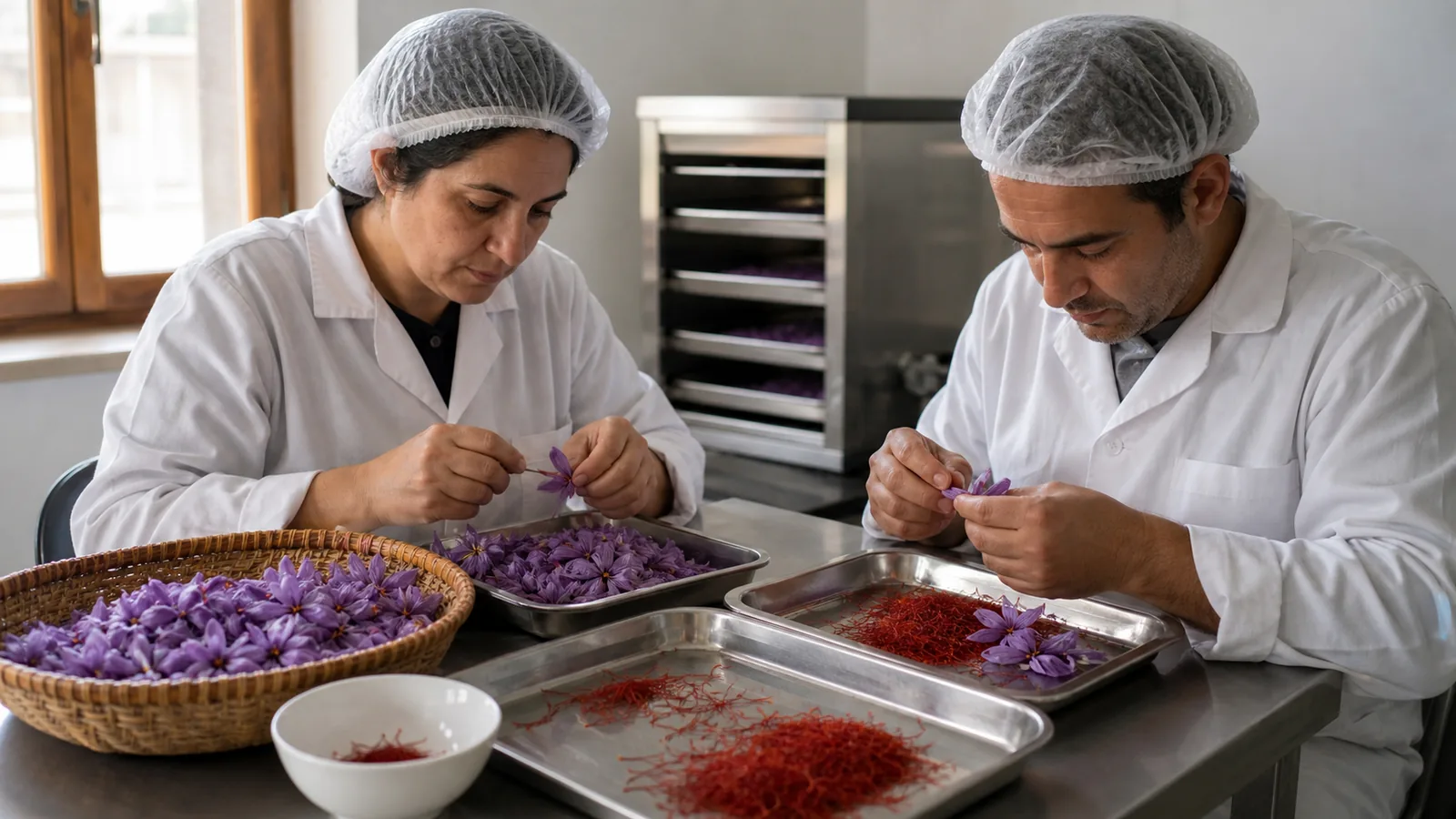
Workshop saffron is an old translated article about a small enterprise that receives fresh flowers, separates the red stigmas, dries them and prepares the finished spice for sale. The business idea is real, especially near producing areas such as Khorasan, where a short harvest can deliver more flowers than individual farms have time to process. The money figures in the source, however, are corrupted and must not be read as a current investment plan.
The surviving header presents it as a Hamshahri 2 skills report from Yazd and credits a name rendered as “Mojan Erdan.” Because the English spelling is machine-translated and cannot be verified from the backup, it is recorded here rather than silently corrected to a different person.
A viable saffron processing workshop starts with food hygiene and process control, not a room and a heater. Flowers deteriorate quickly. Each lot has to move through receipt, separation, drying, cooling, grading, packing and protected storage without losing identity or picking up moisture, dust, pests or foreign material.
What a saffron workshop actually does
The saffron spice is made from the red stigmas of Crocus sativus flowers. Each saffron flower carries only a small amount, so workers open or handle many flowers and separate those stigmas from petals, stamens and plant debris. The fresh stigmas are then dried under controlled conditions until they are stable enough to cool, pack and store.
This is not just manual sorting. A workshop is responsible for the quality and traceability of material while it is in its care. A useful process record connects the grower and incoming flower lot with the separation time, drying batch, final weight, test result and packed lot. If several farms supply one workshop on the same day, that chain of identity is essential.
Location and capacity have to match the harvest
The original report recommends locating the activity in a saffron-growing district. That is sensible because transport time matters: crushed, warm or delayed flowers are harder to process cleanly. It specifically warns that growers may produce many flowers without enough time for separation and processing. A nearby workshop can give them an outlet when labour and drying capacity are tight.
Capacity should be designed backwards from the busiest harvest day, not from an annual average. Estimate how many kilograms of flowers can arrive per hour, how many workers can separate them, how much tray area the dryers provide, and how long each drying cycle takes. Receiving more flowers than the workshop can separate and dry promptly is not growth; it is a quality failure waiting to happen.
The old text refers to a 50-square-foot space. That wording may be another translation error, and such a tiny area would not automatically provide safe separation, drying, packing, storage and staff facilities. Floor area is only useful after the workflow, equipment clearances, washable zones and local authority requirements have been drawn.
Design one clean forward flow
Flowers and finished saffron should not travel back and forth through the same cluttered route. A small facility works best when material moves in one direction:
- receive, identify and inspect the flower lot;
- hold it briefly under suitable clean conditions;
- separate stigmas at clean workstations;
- dry, cool and inspect the saffron;
- sample or test it as required;
- pack and label the lot; and
- store it away from incoming flowers and waste.
Codex hygiene guidance for spices covers harvesting, drying, cleaning, grading, packing, transport and storage. It calls for premises and equipment that can be cleaned, controls that prevent cross-contamination, safe water where water is used, pest management and protection from physical, chemical and microbial hazards.
Receiving flowers without losing traceability
At intake, assign a lot code and record supplier, field or collection point, date, arrival time and incoming weight. Inspect for mould, excessive moisture, soil, insects, chemical smell, mixed plant material and containers that could contaminate food. Reject or segregate a doubtful lot rather than allowing it to disappear into the day’s production.
Use clean, food-contact-suitable trays or shallow containers. Deep compressed sacks trap heat and crush flowers. The workshop should have a defined maximum holding time and a rule for what happens when dryers or staff cannot keep up.
Separate stigmas cleanly and consistently
Separation is skilled, repetitive work. Staff need a comfortable bench height, bright neutral lighting and enough room to keep incoming flowers, accepted stigmas and waste apart. Hands, tools and food-contact surfaces must be clean; illness, jewellery, loose personal items and uncontrolled drinks have no place over open product.
The target cut or grade should be agreed before work begins. Mixing long red stigmas, yellow style and floral debris inconsistently creates an uneven lot and makes later grading harder. Supervisors should check trays during the shift, not only after the flowers are gone.
Drying is a controlled process, not simply heating
The old article correctly recognises that the workshop needs a heating or drying system. The critical details are clean air, temperature, time, layer thickness and a repeatable end point. Too-slow drying leaves the product exposed to microbial growth and deterioration. Excessive heat can damage colour and aroma. Direct combustion gases must not contact the stigmas.
Codex guidance favours controlled mechanical drying where practical because it reduces exposure to environmental contamination. Trays should carry a thin, even layer, and equipment should distribute air consistently. A batch record should capture start/end time, settings, load and any deviation.
Cooling matters too. Warm saffron packed into a closed container can create condensation. Move dried product to a clean protected area, let it reach packing temperature without reabsorbing humidity, then close it in suitable moisture- and light-protective packaging. Our guide to the best methods for drying saffron explains the available approaches and their trade-offs.
Quality checks belong in the process
Visual grading cannot answer every quality question. Current ISO 3632-1:2025 specifies requirements for dried saffron in filament, cut-filament and powder forms; ISO 3632-2:2010 provides test methods. The Codex standard for dried saffron is another reference for product requirements. Which tests and limits a workshop must use depends on its market, contract and governing law.
A laboratory plan may cover moisture/volatile matter, extraneous material, floral waste and the characteristics associated with colour, taste and aroma. Authenticity risks require suitable sampling and methods; an attractive thread is not proof of identity. The workshop also needs a retention-sample and complaint procedure so a disputed batch can be investigated.
For a practical explanation of the measures behind grades and laboratory reports, see Iranian saffron standards.
Equipment for a small processing room
A modest workshop may need far less machinery than a factory, but every item has to fit the planned load. Typical requirements include food-contact trays and benches, precise scales, controlled dryers, clean cooling racks or cabinets, sealed storage containers, suitable packing/sealing equipment, lot-marking capability, temperature or humidity monitoring, handwashing facilities, waste containers and cleaning tools reserved for the area.
Heating is only one utility. Check electrical load, ventilation, safe equipment spacing, lighting, clean water, drainage where needed, pest exclusion and backup plans for power failure. Buy equipment only after confirming that replacement parts, calibration and cleaning are practical.
Licensing, labels and the “health apple” line
The old translation refers to Ministry of Health approval and uses the phrase “health apple mark,” then advises customers to buy recognised brands. It does not identify the exact permit, date or authority clearly enough for this page to state a current Iranian licensing rule. A food business must confirm the registrations, facility approval, product licence, label content, tax and employment obligations that apply in its jurisdiction before trading.
A logo is never a substitute for checking the named authority and licence. Labels must correspond to the product and lot inside the pack. Organic, origin, grade and purity claims need records and evidence; they should not be added because they improve the design.
Sales can be electronic or traditional—but trust is the product
The source mentions electronic and traditional sales, large and small shops, and the possibility of serving smaller retailers overlooked by bigger suppliers. Those are routes to market, not proof of demand. Before investing, speak with prospective buyers about grade, pack size, testing, delivery frequency, payment terms and expected volume.
Small stores may value flexible quantities and direct service, while larger buyers may require audits, formal specifications and consistent batch volumes. Online sales add product-page, fulfilment, returns and customer-service work. In every channel, repeat business depends on consistent product, honest documentation and reliable delivery.
The original also links long-term profitability with business credibility and education. That point survives the translation: trained staff, accurate records and transparent handling create more durable value than an unsupported premium claim.
Why the old money figures cannot be used
Three figures in the source are labelled in US dollars: “50 million” as starting capital, “3 to 4 million” for equipment and “2 to 3 million” in monthly revenue. They are not credible as written for the small workshop being described. The article was almost certainly translated from local-currency figures, but the backup does not establish whether the original unit was rials or tomans, the applicable year, or what each estimate included.
Those numbers are preserved here as a documented translation problem, not converted into a modern budget. A real plan needs dated supplier quotations, rent or construction cost, licences, utilities, seasonal labour, flower purchasing terms, packaging, testing, finance cost, tax, waste, rejected product and working capital. Revenue should be modelled from conservative saleable yield and signed or well-evidenced demand—not from the maximum output of a brochure.
What to establish before opening
Before committing capital, write a batch flow and test it with a realistic peak-day load. Confirm the competent food authority, facility requirements and labelling rules. Obtain several equipment quotations. Validate the drying process, cleaning method, lot coding and record forms. Train workers with actual flowers, then measure separation speed and variation.
A saffron workshop can fill a genuine harvest-season need in a producing district. It becomes a dependable business only when flower intake, trained labour, hygienic separation, validated drying, testing, packaging and buyers are planned as one system. A small room and a heater are the start of a question, not the end of the plan.
Sources and further reading
- Codex codes of practice, including general food hygiene and low-moisture food guidance.
- Codex standards list, including CXS 351-2022 for dried floral parts—saffron.
- ISO 3632-1:2025 saffron specification.
- ISO 3632-2:2010 saffron test methods.
- FDA macroanalytical methods for spices and botanicals.

![Exporting Saffron to Turkey + Price Guide [Complete 0 to 100]](https://img.rowhanisaffron.com/20260827003933/saffron-export-turkey-quality-inspection.webp)



