


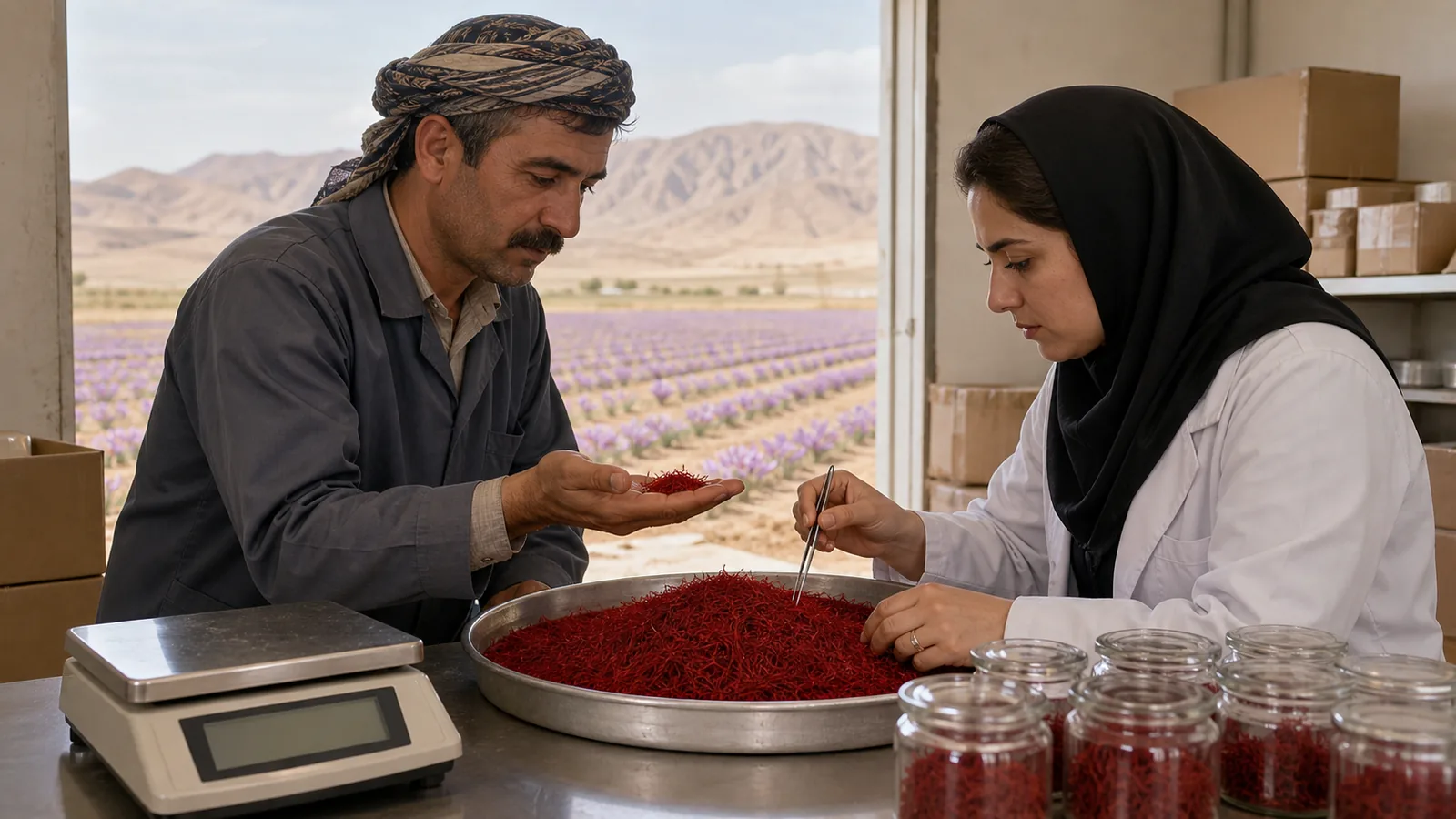
Iranian saffron suppliers 90% of the world is awkward English, but the central statistic remains well supported. In September 2025, the Food and Agriculture Organization of the United Nations said Iran produced more than 90% of the world’s saffron. Another FAO update in the same period used a more cautious range of 85–90%. Both confirm Iran’s dominant position; the range also shows why the figure should be dated rather than treated as an exact constant.
Production share is not the same as export share, supplier location or retail brand origin. Iranian saffron can be packed or re-exported through another country, while a supplier based in Iran may handle different grades and sources. Buyers need to verify the product and the lot, not rely on the headline percentage alone.
Why saffron is strategic for Iran
The original report described saffron as a strategic agricultural product and one of Iran’s important non-oil exports. It identified Iran as the largest producer and exporter, serving buyers across five continents. Saffron matters not only because of export value but because its harvest, separation, drying, testing, packing and trade support rural work in regions with limited water.
FAO’s qanat-based saffron heritage profile connects the crop with livelihoods, traditional knowledge and water-scarce agriculture in Gonabad. Its recent work with Iranian institutions focuses on authenticity, post-harvest handling and value-chain integrity—areas that determine whether production leadership becomes durable market value.
What the 90% figure means
The page’s old statement that Iran supplies 90% of world saffron consumption mixes production and consumption language. The defensible claim is about production: official FAO material has described Iran as producing approximately 85–90%, more than 90%, or over 90% of global output, depending on the publication and date.
That variation is normal for an agricultural estimate. Harvests change with weather, planted area, corm age and farm management; global totals also depend on how countries collect data. The careful wording is therefore: Iran produces roughly nine-tenths of the world’s saffron and remains the leading producer.
The title is retained exactly because it is the established identity of this page and already appears for queries such as “Iran share of global saffron production 90 percent.” The article supplies the production-versus-supplier distinction that the short headline cannot.
Khorasan is the production centre
Ali Hosseini, identified in the original interview as a board member of Iran’s National Saffron Council, said the Khorasan provinces had more than 80,000 hectares under saffron. A 2014–2015 production table submitted during development of the Codex saffron standard supports the scale: it listed 69,407 hectares in Razavi Khorasan and 14,727 in South Khorasan, more than 84,000 hectares together.
The same table listed smaller areas in North Khorasan, Isfahan, Kerman, Fars and Yazd. The interview also named Markazi as a producer and said cultivation was expanding into West Azerbaijan, Golestan and other northern provinces. It described Fars as having a long history after the Khorasan heartland, while the other areas represented established or newer production.
These are historical area descriptions, not a current province ranking. A buyer or planner who needs today’s hectares should use the latest Ministry of Agriculture-Jahad statistics rather than carry the 2014–2015 table forward unchanged.
Average saffron yield per hectare in Iran
The old interview said recent performance in the two main Khorasan provinces had fallen to about 2.5 kilograms per hectare and hoped for an average of 3.5–4 kilograms in the coming crop. A damaged phrase rendered as “a year dropped 92 kg” appears to refer to an Iranian calendar year, not a yield of 92 kilograms. Without the Persian original, that fragment cannot be repaired safely.
For comparison, the 2014–2015 Codex working document reported 3.1 kg/ha for Razavi Khorasan and 3.4 kg/ha for South Khorasan. Its smaller-province figures ranged higher in some cases, but national planning should not treat a small area and the principal production belt as directly interchangeable.
Hosseini also said that an individual farmer might sometimes reach 40 kg/ha, while warning that such an outcome may occur only once and needs management to be sustained. That is an exceptional observation, not a reasonable budget assumption. Field age, corm size and density, soil, irrigation, disease, harvest labour and the area used in the calculation can all change a reported yield. For searchers asking for the average saffron yield in Iran, the historical evidence on this page supports a low-single-digit kg/ha baseline, with 3.5–4 kg/ha presented as the interview’s target rather than a universal current average.
The production forecast and heat concern
The source anticipated a better crop after conditions in late 1393 and early 1394 in the Iranian calendar—roughly the 2014–2015 period—but warned that heat stress could reduce production. It expressed hope that the main saffron areas would avoid serious damage.
That forecast is now historical. The lasting point is that a national share does not remove weather risk. Heat during sensitive stages, poor water timing and local drought can alter flower numbers and stigma yield. A current production estimate needs current field evidence, not the optimism of an earlier season.
Why the old price numbers are not usable
The machine translation says the domestic price was at least “6 million” and at most “7 million USD,” then gives a world-market figure of “2 thousand to 2 thousand and $300-pound.” Those units are internally inconsistent. The first almost certainly lost a local currency label; the second may have lost the intended weight unit.
Neither range should be quoted as a historic or current saffron price. A usable quotation needs date, currency, net weight, grade, form, test specification, packaging, tax and delivery terms. The figures remain here solely so that the old content has not disappeared; their corruption is made explicit rather than silently converted to rials, tomans, kilograms or pounds.
Surplus purchasing and the “saffron bank” idea
Much of the interview concerned price stability at harvest. Hosseini proposed that surplus saffron be held in a trusted facility with bank financing and an agricultural receipt, allowing supply to enter the market more gradually. The stated aim was to prevent farmers being forced to sell into a glut and to limit opportunistic speculation.
A warehouse system can help only if the facility, grading, ownership record, insurance, finance and release rules are credible. Buying product does not eliminate market risk; it transfers inventory and financing risk to the scheme. The National Saffron Council’s proposal, according to the report, depended on banks supplying credit for surplus purchases.
Iran later introduced organised saffron warehouse receipts and futures. Our history of saffron entering commodity-exchange trading explains the difference between holding a graded physical lot, a warehouse receipt and a futures contract.
Price spikes can cost export markets
The interview argued that uncontrolled domestic production and price volatility could weaken Iranian suppliers against competing origins. A buyer who cannot obtain consistent quality, documentation and delivery may qualify another source even when Iran remains the dominant producer.
That does not mean prices should be artificially low. Sustainable trade has to cover farm and processing costs. The practical issue is predictability: transparent grades, traceable lots, clear contracts and dependable fulfilment give buyers a better basis for comparing offers than a sudden headline price.
Direct exports, re-exports and country counts
The original said Iranian saffron was supplied directly to nearly 50 countries on five continents and reached more than 100 countries indirectly. Those counts are attributed historical statements; they are not presented as today’s customs totals.
The distinction is important. Customs data record the immediate trade route, while a later packer or distributor may send the same saffron onward. A jar labelled or sold from another country does not establish where its flowers were grown. Conversely, an Iranian supplier address does not by itself prove that every lot is Iranian.
Quality and authenticity protect the 90% position
The interview called for better quality and stronger introduction of Iranian saffron to world markets. FAO’s current Iran programme makes the same connection: adulteration and inconsistent post-harvest handling can erode value and trust even when production volume is dominant.
A serious supplier should be able to identify the grower or source group, harvest and processing lot, grade, test method, net weight and packing record. The quality report should match the sampled lot. Origin, organic status and purity claims require evidence rather than a familiar trade phrase.
Our guide to Iranian saffron standards explains the measurements used for dried saffron. Test results do not replace supplier due diligence, but they make specifications and disputes far more precise.
How to assess Iranian saffron suppliers
The title may bring buyers looking for a supplier rather than a production statistic. Buyers searching for Persian saffron suppliers face the same verification task. Before placing a commercial order, ask for a representative sample and documents that correspond to the offered lot. Confirm the legal exporter/seller, product origin, form and grade, laboratory scope, packaging material, shelf-life basis, minimum order, lead time and delivery terms.
Check whether the seller controls farming, buys through a cooperative, processes lots, or acts only as a broker. None of those models is automatically inferior, but the answer determines which records should exist. For a high-value order, use independent sampling or testing and agree in writing what happens if the delivered lot differs from the approved sample.
Iranian saffron suppliers operate from the world’s leading production base. The strongest ones turn that advantage into traceable, tested and consistently handled product. “90% of the world” explains scale; it does not replace verification.
Sources and further reading
- FAO–Mashhad University saffron authenticity programme, FAO, 16 September 2025.
- FAO and Iran: quality integrity in the saffron value chain, including the 85–90% range.
- FAO–Iran authenticity project, describing Iran’s approximately 90% production position.
- Qanat-based Saffron Farming System in Gonabad, FAO GIAHS.
- Codex saffron project document, including Iran’s 2014–2015 province area, output, yield and export tables.

![Exporting Saffron to Turkey + Price Guide [Complete 0 to 100]](https://img.rowhanisaffron.com/20260827003933/saffron-export-turkey-quality-inspection.webp)



