


“600 kg of saffron was produced in Khomein city” records a strong historical harvest for this part of Markazi province. Abbas Arshadi, then director of Khomein Agricultural Jihad, reported the crop from 94 hectares of bearing saffron fields.
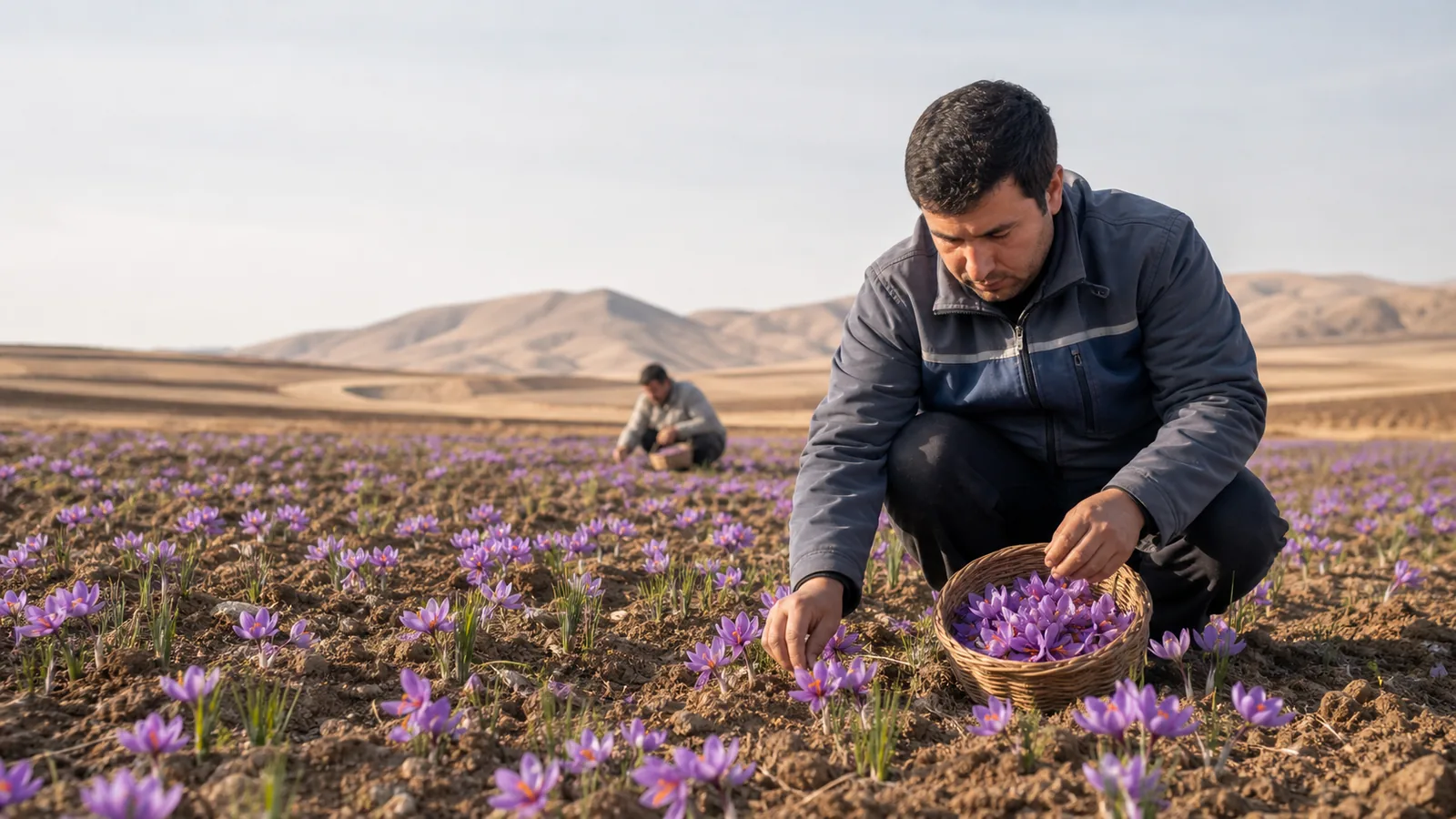
What the 600-kilogram figure means
The original English report described 600 kilograms of “high-quality saffron flowers” being produced and sent to market. Its other figures show that the amount referred to marketable dried saffron rather than the freshly picked flowers: the stated average was about 6 kilograms per hectare, a measure normally used for dried yield.
This was a report about that crop year, published in 2021. It is not a current production forecast or a claim that Khomein produces the same amount every year.
Ninety-four hectares were in production
Arshadi said Khomein had 94 hectares of productive saffron fields. Dividing the reported 600-kilogram crop by that area gives roughly 6.4 kilograms per hectare, close to the 6-kilogram average quoted in the report. The small difference may reflect rounding or a distinction between total planted land and the area used for the yield calculation.
The account did not provide field-by-field results. The average therefore describes the city-level report, not a yield that every grower necessarily achieved.
Production rose from the previous year’s 470 kilograms
The preceding harvest was reported as 470 kilograms, valued at 66 billion rials. On those figures, production increased by 130 kilograms, or about 28 percent, in the following crop year.
The earlier value works out to an implied average of approximately 140 million rials per kilogram. That is historical arithmetic based on the reported total value, not a quoted farm-gate price and not an indication of what saffron costs today.
Saffron supported growers and seasonal work
According to Arshadi, each hectare of saffron cultivation created three job opportunities. Applied to 94 hectares, that suggests about 282 opportunities across planting, field care, flower picking and processing. The same report said 200 farmers and entrepreneurs were involved in planting saffron in Khomein.
Those two numbers measure different things. A job opportunity is not necessarily one permanent, full-time position, while the count of farmers and entrepreneurs refers to people involved in cultivation. They should not be combined into a single employment total.
Why saffron suited Khomein’s farming plans
Khomein was described as the leading saffron-producing city in Markazi province. Agricultural officials considered its suitable soils, subtropical conditions, mild winters and hot, dry summers favourable for the crop.
They also promoted saffron as a relatively drought-tolerant option, particularly in the central district, where farmers were dealing with water shortages. Drought tolerance does not mean that the crop needs no water: establishment, irrigation timing, drainage and local soil conditions still influence the harvest.
The quality statement came from the local authority
Arshadi said Khomein saffron met the necessary standards and had strong aroma, colour and flavour because of the area’s soil and climate. The report did not name a laboratory, testing method, grade or specific standard, so this remains an attributed assessment rather than an independently documented quality result.
Careful harvesting and prompt separation and drying of the stigmas also affect saffron quality. The city-wide statement cannot establish that every batch from the area had the same grade.
Saffron’s place in Khomein agriculture
The report said 52 percent of Khomein’s people were farmers. Within Markazi province, it placed the city first for saffron and second for Mohammadi rose, beans and honey. These rankings belong to the period described and should not be read as a current provincial table without newer agricultural data.
Taken together, the figures show why saffron mattered locally: a reported 600-kilogram harvest from 94 productive hectares, growth from the previous year’s crop and a role for hundreds of growers and seasonal workers. They also need to remain in their historical setting, with reported estimates kept separate from independently tested facts.

![Exporting Saffron to Turkey + Price Guide [Complete 0 to 100]](https://img.rowhanisaffron.com/20260827003933/saffron-export-turkey-quality-inspection.webp)



