


Heating role in the flowering of saffron is better understood as the role of temperature across the plant’s annual cycle. Saffron corms generally need a warm period while flowers are being initiated, followed by distinctly cooler conditions before shoots and flowers emerge. That sequence matters. Simply warming a field, or holding lifted corms at one temperature indefinitely, is not a reliable way to produce more flowers.
This distinction clears up the awkward wording of the original report. Its subject was not a heater. It was a climate study from Khorasan Razavi that linked long-term minimum and mean temperatures with saffron yield in Sabzevar and Torbat Heydarieh. The practical lesson is to study a site’s temperature pattern before planting, then interpret it alongside soil, water, corm condition and field management.
What the Khorasan study actually reported
The article published here in 2015 drew on a report by the Khorasan research service of the Iranian Students News Agency (ISNA). The underlying paper was titled “Evaluation of yield and identifying potential regions for saffron cultivation in Khorasan Razavi province according to temperature parameters”. Its authors were Moein Tosan, Amin Alizadeh, Hosein Ansari and Parviz Rezvani Moghaddam. The work was associated with Ferdowsi University and was also reported as having been presented at the Second International Conference on Rural Development.
According to the original account, the researchers assembled monthly minimum and mean temperature data for two saffron-growing counties over a 93-year period, combined those records with saffron-yield information, and used regression analysis in SPSS. They reported statistically significant relationships between temperature and yield in Sabzevar and Torbat Heydarieh, identifying minimum temperature as a factor associated with flowering.
That is useful evidence, but the word “associated” is important. The short report does not provide the date range, weather stations, yield series, regression coefficients, uncertainty, model diagnostics or other variables entered into the analysis. Without those details, a reader cannot reproduce the result or turn it into a universal temperature prescription. Nor does a statistical relationship prove that artificially raising the temperature of an established field will increase its yield.
Saffron responds to a sequence, not one magic temperature
Saffron is a sterile triploid and is propagated through corms rather than seed. Its visible autumn flowering is prepared months earlier, inside the buds of the corm. The annual cycle therefore has to be read in stages.
Leaves support the formation and enlargement of replacement corms through the cool growing season. As the leaves senesce in spring, those corms enter their summer resting period. Flower initiation occurs during this apparently quiet phase. Later, falling temperatures are part of the signal for shoot growth and flower emergence. A grower who looks only at the temperature on the morning flowers appear misses much of the process.
A controlled study published in Scientia Horticulturae found that flower formation in its experimental corms was most successful at 23–27°C when that incubation lasted for more than 50 days. Flower emergence required a move to a markedly cooler 17°C. In the same experiments, 30°C reduced flower initiation, prolonged exposure could lead to flower abortion, and corms kept at 9°C did not form flowers.
Those figures explain the warm-then-cool pattern; they are not a field recipe for every region. The researchers worked under defined experimental conditions with particular plant material. Soil buffers temperature differently from an indoor chamber, local cultivars and corm sizes differ, and natural temperatures change gradually rather than on command.
Warm conditions initiate; cooler conditions help flowers emerge
Later research supports the same broad sequence. A 2021 study tested saffron corms in a two-segment indoor-and-field system and concluded that warm, intermediate and cool phases affected flower initiation and flowering differently. The authors found that an unsuitable temperature at the wrong stage could prevent initiation or interrupt flower development.
This helps explain why minimum temperature may appear as an important variable in a field-based regression. Autumn minima are part of the seasonal cooling pattern that precedes emergence. They may also act as a proxy for altitude, latitude, cloud cover, soil temperature or the timing of other seasonal events. The temperature association is biologically plausible, but a minimum-temperature value on its own does not describe the entire site.
In practical terms, “more heat” is the wrong goal. Adequate warmth during flower induction matters, excessive or prolonged heat can be harmful, and the later cooling phase must still arrive. The timing and duration of each stage matter as much as the number on a thermometer.
What to examine before choosing a saffron site
The historical report warned that saffron acreage had expanded in Khorasan Razavi while some farmers planted without first checking whether conditions suited the crop. That warning remains sensible. Saffron uses less irrigation than many summer crops, but “low water requirement” does not mean that climate can be ignored or that the crop succeeds without water.
Before committing a large area, examine:
- several years of monthly minimum, mean and maximum air temperatures, not a single seasonal average;
- the timing of spring leaf senescence, summer heat, autumn cooling and damaging frost;
- soil temperature at the likely corm depth, because it may differ substantially from air temperature;
- drainage, soil structure and the risk of standing water or compaction around the corms;
- reliable water for establishment and active growth, together with rainfall timing;
- healthy planting material, corm size, planting depth, field age and disease pressure;
- labour and drying capacity during a short, concentrated flowering period.
Temperature should therefore sit inside a site assessment, not replace it. The guide to weather and climate for planting saffron develops the regional climate questions. Our article on selecting and handling saffron corms covers the plant material that must respond to those conditions.
Measure the field rather than borrowing a distant rule
A nearby weather station is a useful starting point, but a field can have its own microclimate. Cold air drains into low ground. A south-facing slope warms differently from a shaded hollow. Bare soil, mulch and irrigation alter the temperature around the corm. Elevation can change both nightly minima and the date of autumn cooling.
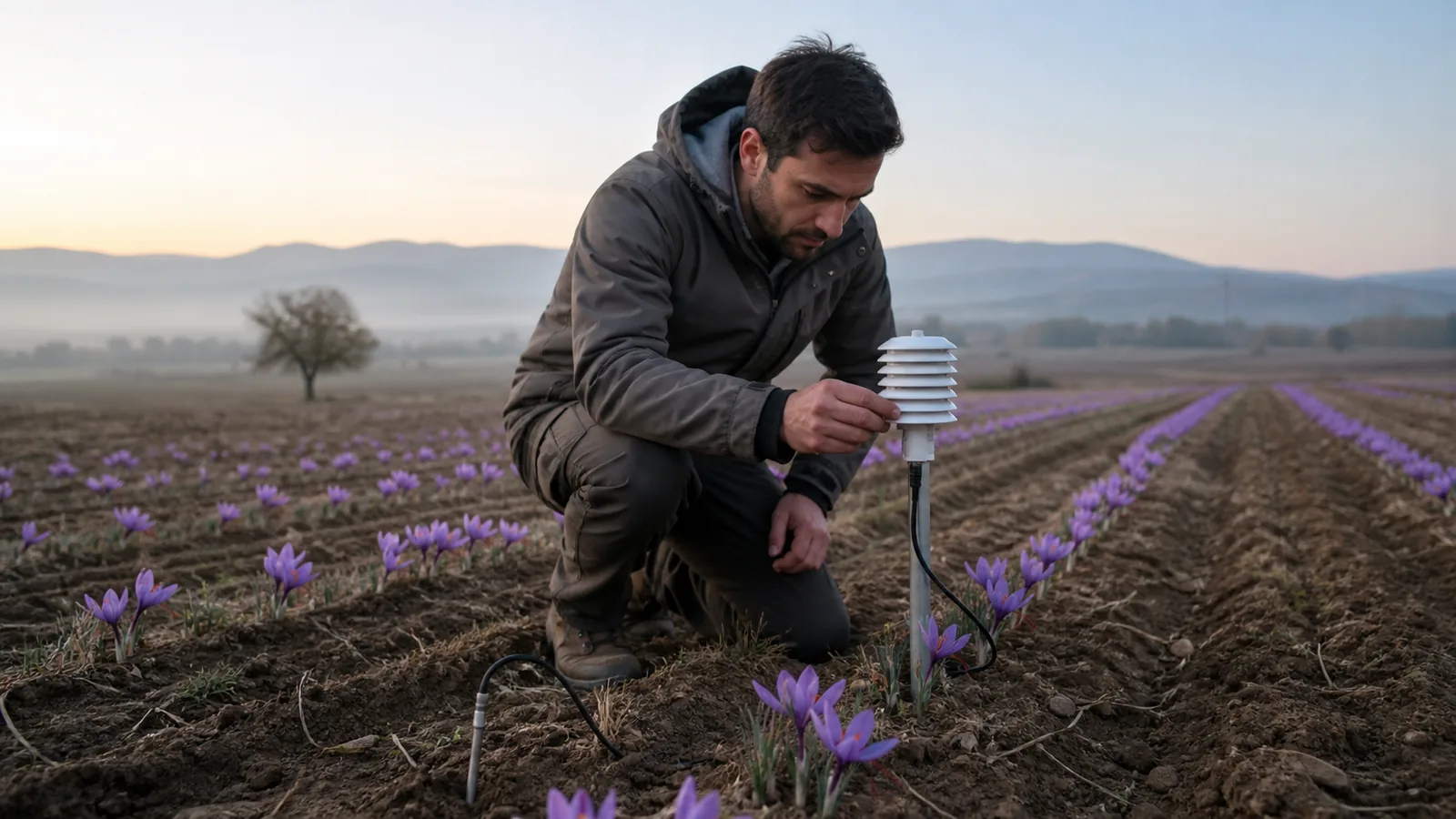
Place a shielded air-temperature logger above the crop and a soil probe at representative corm depth. Record at short, consistent intervals through dormancy, emergence and flowering. The purpose is not to collect a single peak reading; it is to see how long the field stays within a range and when the transition to cooler conditions occurs.
Keep the temperature record beside field observations. Note the first visible shoot, first flower, peak flowering days, number of flowers in fixed sample plots and the final dry stigma weight from those plots. Record irrigation, rain and unusual weather. After more than one season, the farm will have evidence about its own thermal pattern rather than a number copied from a controlled chamber.
For an unfamiliar location, start with a manageable trial plot. Compare candidate parts of the farm using the same corm source and management. A poor first season should prompt a review of corm quality, planting date, depth, water, disease and post-harvest handling as well as temperature. Changing several variables at once makes the result difficult to interpret.
Artificial heating is a controlled-production decision
Indoor storage and controlled flowering systems can regulate temperature more closely than open fields. In those systems, growers may move lifted corms between temperature phases. The research cited above is relevant to that work, but precise control creates its own responsibilities: uniform airflow, calibrated sensors, corm traceability, humidity management, sanitation, energy cost and a plan for subsequent leaf growth and replacement-corm development.
Do not put a heater into an enclosed corm store without monitoring the temperature throughout the load. Warm air near the equipment and cool pockets among stacked containers can expose corms to very different conditions. Sealed, damp or poorly ventilated storage also invites decay. If a commercial protocol is being considered, test it on a documented lot before exposing the whole planting stock.
Open-field heating is a different proposition. It is rarely reasonable to infer from a climate regression that soil or air should be heated at field scale. The better first responses are sound site selection, appropriate planting depth, temperature monitoring and a crop-specific trial. A physical intervention should have a clear objective, a measured control and an economic case.
Temperature is also an income and sustainability issue
The original university report framed this work as agricultural sustainability, not plant physiology alone. Saffron has long been an important agricultural and export product for Iran. In Torbat Heydarieh and Sabzevar, rural income and seasonal employment have been closely tied to crops such as saffron. A poorly matched site can therefore cost far more than the planting material.
Saffron’s value and relatively modest water demand make it attractive in water-constrained regions, but high market value does not guarantee high farm income. Yield, labour, drying, quality, price and the number of productive years all affect the result. Expanding acreage without checking the thermal sequence may expose growers to weak flowering or an unreliable harvest.
Climate records also need periodic review. A site that matched an older temperature pattern may experience changing summer heat, autumn cooling or frost timing. Historical averages are useful context; recent observations show whether that context still describes the field.
How to use the heating role in the flowering of saffron
The strongest conclusion is simple: temperature has stage-specific effects on saffron flowering. Warmth during the corm’s resting phase supports flower initiation; a later fall in temperature supports emergence. Either stage can be disrupted when conditions are unsuitable or last too long.
Use that principle to compare sites, monitor corm storage and interpret flowering records. Do not translate it into “the hotter, the better,” and do not assume a single minimum temperature causes yield by itself. A defensible decision combines the field’s long-term and recent temperature pattern with soil, water, corm and management evidence.
The 93-year dataset, SPSS regression, Sabzevar and Torbat Heydarieh findings, university and conference attribution, author names, Khorasan Razavi expansion, rural-income context and minimum-temperature conclusion are retained from the research report originally covered on this page. The short report did not publish enough model detail here to reproduce the analysis. Scientific sources were reviewed on 29 August 2026.

![Exporting Saffron to Turkey + Price Guide [Complete 0 to 100]](https://img.rowhanisaffron.com/20260827003933/saffron-export-turkey-quality-inspection.webp)



