


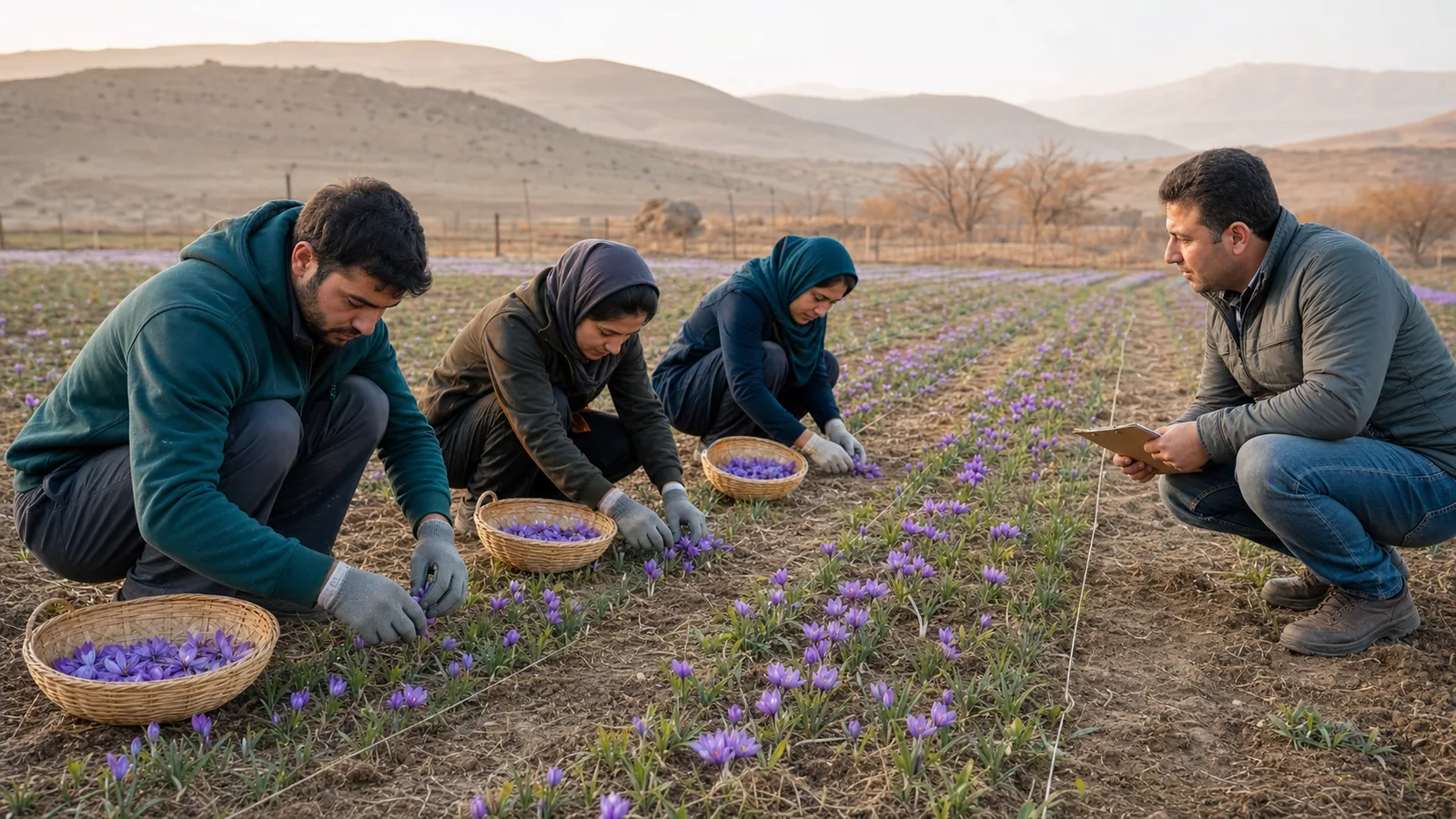
Prevent mechanized harvesting saffron when the equipment has not proved that it can protect the crop, the harvested flowers and the people whose income depends on the season. That does not mean rejecting every machine. It means withholding a particular field-harvest method until a local trial shows that its benefits exceed its losses.
The historical report on this page took that cautious position for Khorasan Razavi. Its speaker preferred to develop mechanized planting while leaving flower collection with people, partly because saffron was grown on fragmented smallholdings and supported rural and border communities. The useful modern task is to turn that policy opinion into measurable stop conditions rather than treat “manual” or “mechanized” as an ideology.
What the original Khorasan report argued
Ramin Esmi, identified as the saffron expert responsible in the Khorasan Razavi Agricultural Jihad organisation, spoke to the Khorasan edition of the Iranian Students News Agency (ISNA). He said mechanizing saffron harvest would harm employment in the sector.
His reasoning began with farm structure. Saffron was described as a smallholder crop, with an average provincial plot of 6,000 square metres. In his view, mechanized harvest and collection were more suitable for crops planted over extensive areas.
Esmi said no machine for mechanized saffron planting was available at that time, although a device was being completed and developed. Testing could take place only during a limited 20-day period each year, he explained, so some faults were corrected from one season to the next.
The report said the Saffron Production Council had chosen to mechanize planting rather than harvest. Esmi linked that decision to saffron’s economic and social importance in rural and border areas. Instead of replacing harvest labour, the policy aimed to change production cost by increasing yield per unit area.
He also described saffron knowledge as indigenous and argued that domestic manufacturers should improve product quality inside Iran. The report went further, suggesting that other countries lacked adequate knowledge of saffron’s growth habits and that meaningful production abroad was uncertain. That national comparison does not stand as a current fact: saffron is cultivated and researched in several countries. Local experience remains valuable without denying evidence developed elsewhere.
Why a small plot changes the machinery decision
A 6,000-square-metre average in the 2015 report is a historical provincial figure, not a definition of every saffron farm. It nevertheless points to a real engineering issue. A machine rated in hectares per hour may spend much of its time travelling between parcels, turning at headlands, being adjusted for different row layouts or waiting for access.
Field shape matters as much as area. Narrow entrances, irregular boundaries, terraces, stones, soft soil and closely spaced rows can make a large machine impractical even when the total planted area looks sufficient. Ownership boundaries may also prevent operators from combining adjacent parcels into one efficient route.
The answer is not always to prohibit machinery. A compact hand-guided tool, a shared service or equipment for transport and processing may suit small fields better than a dedicated self-propelled harvester. FAO’s definition of sustainable mechanisation spans simple hand tools through motorised equipment and asks that economic, social, environmental and cultural conditions be considered.
Employment is a real result, but it needs measurement
The original warning about jobs should be examined, not repeated as a certainty. Count who currently picks flowers, how many paid days the harvest provides, what workers earn, which households rely on the income and whether the area faces a genuine labour shortage at peak bloom.
Mechanisation can reduce paid picking hours. It can also create work in operation, hire services, transport, cleaning, repair and maintenance. The number, timing, skill requirement and ownership of those jobs may differ sharply from the work displaced. One better-paid operator position does not automatically compensate a village for many lost seasonal days, and many difficult manual jobs should not be preserved without regard to health.
Manual saffron harvest involves repeated bending and squatting. A 2026 observational study of 220 harvesters in Khorasan Razavi documented postural load and musculoskeletal discomfort during the harvest season. An employment policy should therefore improve the work as well as count it. Better field access, low seats or aids, shallow collection containers, rotation, scheduled breaks and partial mechanisation may reduce strain without removing the entire task.
FAO’s mechanisation strategy guidance recommends a participatory process involving farmers, equipment and service providers, and the public sector. It also recognises employment in manufacturing, repair and machinery services. Those possibilities need a local plan; they are not an automatic side effect of buying equipment.
When field-harvest mechanisation should be stopped
A grower, cooperative or public programme should pause a machine trial when any of these conditions appears:
- it misses or damages enough flowers to reduce saleable dry saffron;
- it cuts leaves, disturbs corms, compacts wet soil or harms the next crop cycle;
- soil, stones, leaves or other foreign matter enter the collected load;
- flowers are bruised, compressed or left waiting longer before separation and drying;
- the machine cannot turn, align or travel safely in the actual parcels;
- cleaning between fields is inadequate for pest, disease or lot-separation control;
- capacity claims fail under the farm’s flower density and morning conditions;
- full seasonal cost exceeds the verified labour and loss reduction;
- the labour transition creates an avoidable local harm that has not been addressed.
These are investigation triggers, not permanent labels. A design can be adjusted and tested again. A successful demonstration on one flat, uniform field also does not remove the need to check another soil, row pattern or crop density.
The 20-day testing problem
Esmi’s statement that a planting device could be tested during only about 20 days each year captured a practical constraint in saffron engineering. Flower emergence and some seasonal field operations occur in narrow windows. A fault discovered late may have to wait until the next crop cycle for a realistic retest.
That makes test design important. Before the season, the team can check safety, dimensions, controls, cleaning, transport and spare parts without a crop. During the field window, it should use a written protocol and collect comparable manual-control data from the same day. Video, marked plots and retained product samples allow the brief season to produce evidence that can be reviewed later.
One season is rarely enough. Weather, flower density, soil moisture and operator experience change. Record prototype version and settings so that an improvement is not compared with an undocumented earlier machine. The fact that faults are corrected each year is evidence of development, not evidence that the device is already ready for wide release.
Planting may be the better place to begin
The historical council’s preference for planting mechanisation can make sense when laying out a new field. Consistent rows and spacing may make later cultivation easier, while mechanical assistance can reduce a large one-time labour demand. Planting equipment still has to protect corms, place them at the intended depth and density, and work in the soil available.
Planting and harvesting affect employment differently. A saffron field is planted or renewed periodically, while flowers are collected each season. Mechanizing the first does not necessarily remove the same number or type of paid days as mechanizing the second. It may also improve row regularity without deciding how flowers will be picked.
The completed article on planting, harvest mechanisation and rural employment develops that policy choice. The separate guide to testing saffron harvest equipment covers collection, stigma separation, throughput and product-quality measurements. This page owns the stop conditions and smallholder safeguards.
Quality should be followed to the dry product
A machine can collect a larger basket and still produce less valuable saffron. Quality depends on what happens after the flower leaves the field: container depth, shade, transport time, stigma separation, drying, cooling, storage and lot control.
Prototype research supports that caution. A published field study of a mechanical saffron flower device and airflow separators recorded different collection success under different operating motions, while two tested separation systems damaged many stigma filaments. These are results for particular prototypes, not a verdict on every machine. They show why recovered flower count and intact dry product both belong in a trial.
Use the same drying and laboratory procedure for manual and machine-collected lots. Measure foreign matter, damaged flower share, stigma loss, dry saleable weight and the time from field to dryer. If the machine changes the harvested material, ask the laboratory and buyer whether the difference affects specification or price.
Count the whole seasonal cost
The purchase price is only the beginning. Include finance, transport, field preparation, operator time, fuel or electricity, cleaning, maintenance, spare parts, storage and the number of days the machine can actually work. Add the value of missed flowers, damaged crop and any delay downstream.
For smallholders, ownership may be the wrong model even when the equipment works. FAO’s 2024 guide to mechanisation business models for small farmers emphasises matching the service to local demand. A contractor, cooperative or machinery ring can spread fixed costs, provided the service arrives during the short flowering window and has enough capacity for all members.
Run the economics with conservative figures from the farm’s own trial. Do not turn a hoped-for yield increase into revenue before it has been measured. Mechanised flower collection does not correct poor corm health, irrigation, field age, drying or marketing, and the historical objective of raising yield per unit area may require investments elsewhere.
Use local knowledge without closing the door to outside evidence
Saffron growers know how flowering responds to their fields, when labour arrives and where equipment is likely to fail. That knowledge should shape the design, test protocol and acceptance decision. A manufacturer who ignores it may optimise a machine for the wrong crop height, soil condition or work rhythm.
Outside research remains useful. Modern reviews describe saffron production in established and emerging regions and call for further work on mechanisation. The equipment itself should be judged by transparent field evidence, regardless of where it was designed. Domestic manufacturing can improve repair access and adaptation, while shared research can expose failure modes sooner.
A responsible prevention decision
Prevent mechanized harvesting saffron when local evidence is absent, the machine damages crop or product, the economics fail, or the labour impact is unacceptable and unmanaged. Reconsider it when a revised tool passes the same field, quality, cost and social checks.
That approach preserves what the 2015 report understood: saffron is both a crop and a rural livelihood. It also corrects the false choice between permanent manual work and automatic mechanisation. The right technology may be planting equipment, a small collection aid, transport, separation, drying or a shared service. The operation that removes the real bottleneck with the least harm should come first.
Ramin Esmi’s role, ISNA attribution, employment warning, 6,000-square-metre average plot, absent planting machine, device-development statement, 20-day annual test window, council preference for mechanized planting, rural/border impact, yield-per-area strategy, indigenous-knowledge claim and domestic-quality argument are retained as attributed details from the report published here in 2015. No current programme or equipment status is inferred. Sources were reviewed on 29 August 2026.

![Exporting Saffron to Turkey + Price Guide [Complete 0 to 100]](https://img.rowhanisaffron.com/20260827003933/saffron-export-turkey-quality-inspection.webp)



