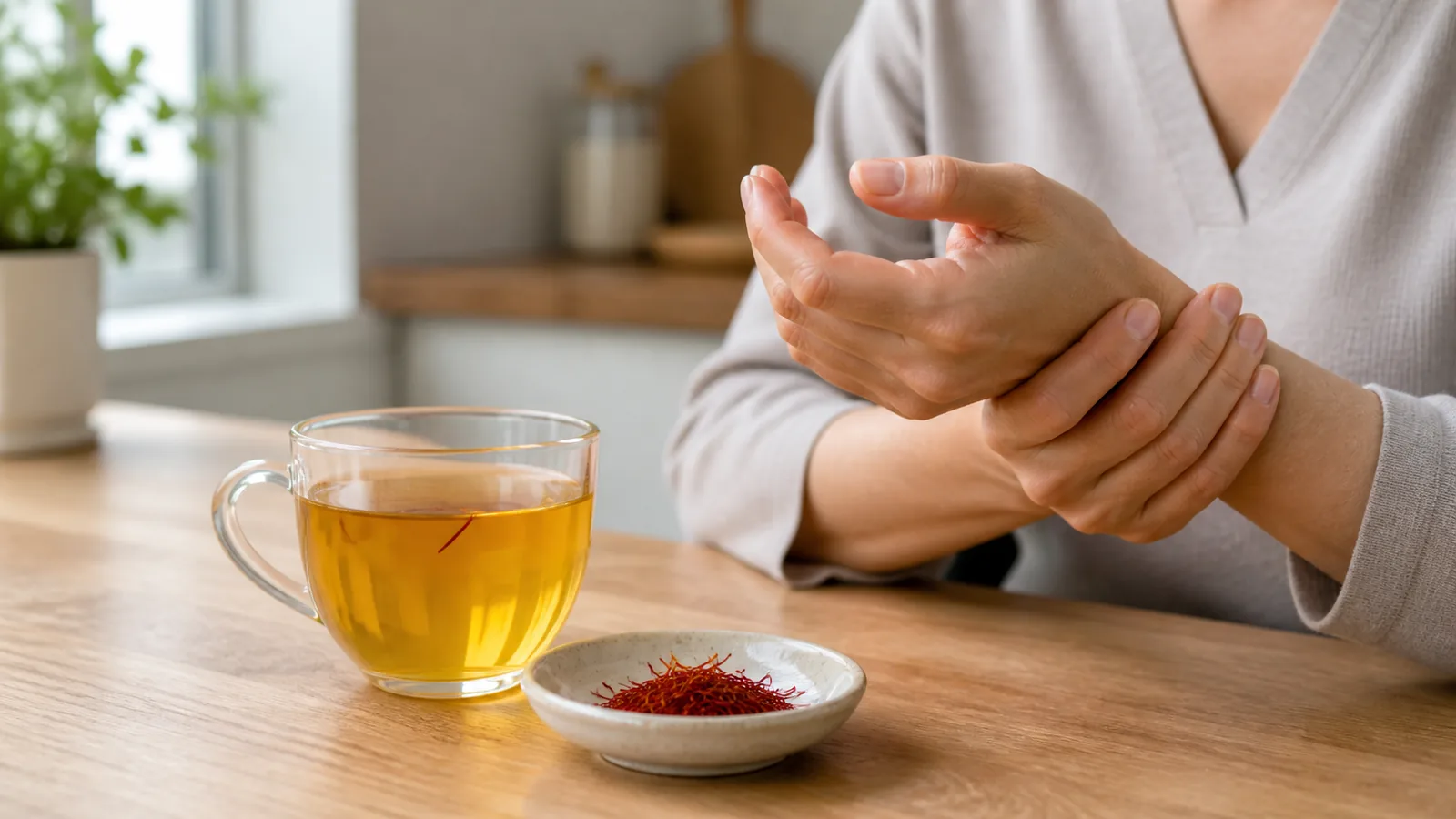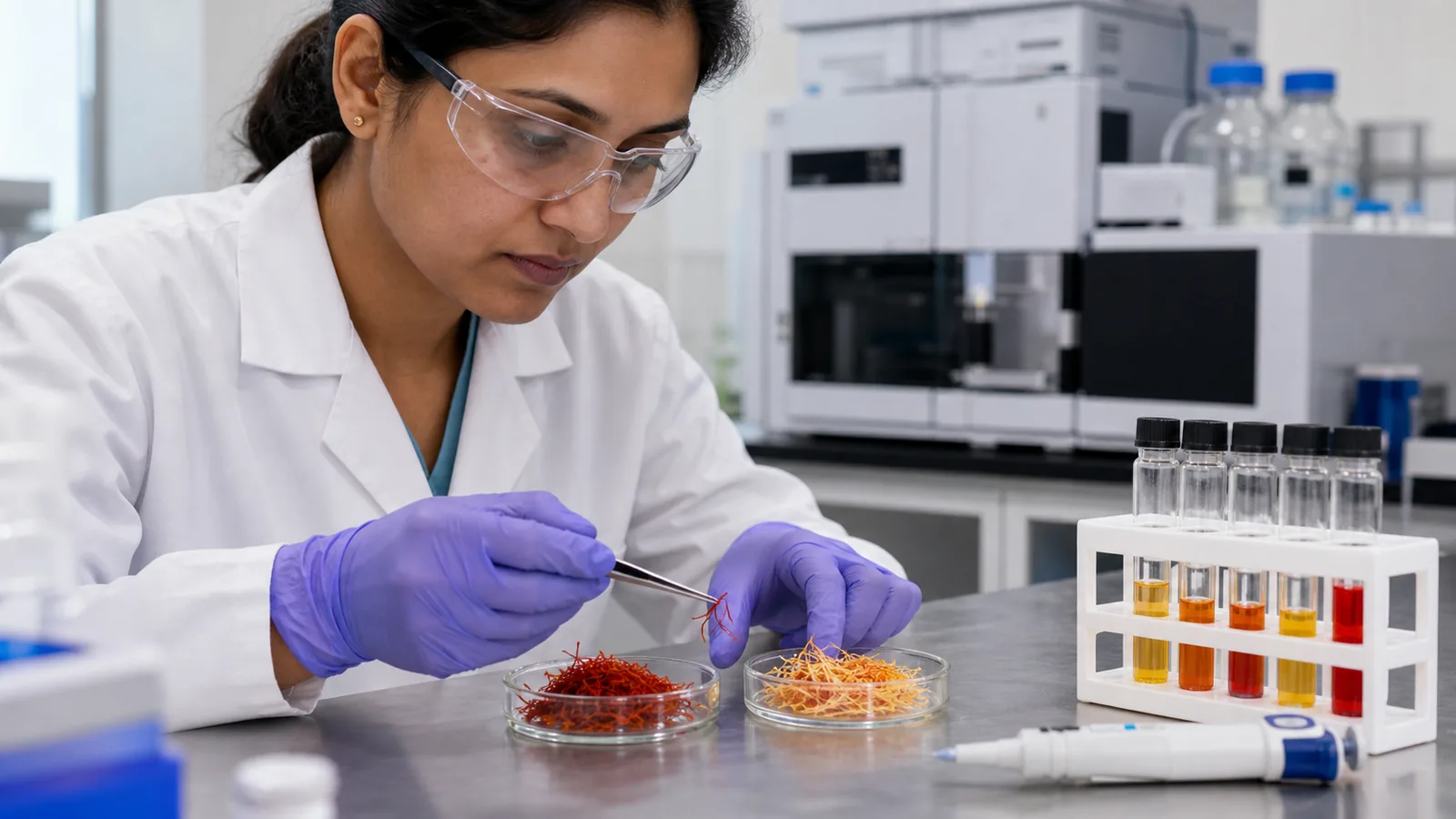
Fake saffron and carcinogenic dyes are related concerns, but they are not the same claim. Counterfeit saffron may be made from dyed plant material, and some unauthorised industrial dyes have genotoxic or carcinogenic potential. A sample cannot be called carcinogenic from its colour, price or behaviour in hot water. The material has to be identified.
The 2015 report on this page alleged that fraudsters were colouring white parts of the saffron flower and selling them as premium red saffron. That is plausible as a form of economic adulteration. Its warning about “carcinogenic chemical dyes,” however, did not name a dye, test a sample or provide a laboratory result. The safe modern conclusion is narrower: an unknown colourant in a spice is a reason to stop using the lot and have it investigated, not a reason to diagnose its hazard by eye.
What the original market report alleged
Ali Hosseini, identified as a member of Iran’s National Saffron Council, spoke to the Iranian Students News Agency (ISNA) about a volatile domestic market. He said fraudsters were buying white saffron stems, colouring them with natural or chemical dyes and selling the result under the saffron name.
The report gave a historical price chain. White stems were said to cost 2.5 million toman per kilogram, compared with 100,000 toman at an earlier time. Hosseini alleged that coloured material produced at least two million toman in profit per kilogram. First-grade saffron had reportedly traded at 5.3 million toman late in the previous week and then reached 5.7 million toman per kilogram.
He also described a 50:50 mixture of coloured material and natural saffron. On his figures, one kilogram of the mixture cost the fraudster four million toman and was sold to traders for about six million toman. Exporters, he said, could no longer buy with confidence, which disrupted trade while the fraudsters benefited.
Those values and accusations belong to the market described in 2015. The article provides no invoice, laboratory record, named enforcement case or date series. They should not be converted into current prices or used to accuse every supplier in that market.
What “white saffron stems” are
The valuable red part of Crocus sativus is the stigma. Each flower has three red stigma branches, which narrow into a lighter style lower down. Some commercial styles of saffron retain a portion of the yellow or pale style; other grades are trimmed to emphasise red stigma.
That pale floral tissue is not automatically toxic or counterfeit. The fraud occurs when low-value style or another plant material is coloured and represented as red stigma, or mixed into a lot without declaration. Calling every pale strand “fake saffron” loses this distinction and can lead a buyer to reject a legitimate grade for the wrong reason.
Dyed substitutes can also be made from other flowers, fibres or paper. Genuine saffron can be adulterated with some of those materials and still contain real stigmas. A useful investigation therefore asks whether the lot is entirely substituted, partly adulterated, misgraded, mislabelled or contaminated. Those are different findings.
Does fake saffron cause cancer?
No single answer applies to every fake product. Safflower sold honestly as safflower is not the same safety question as an industrial dye applied to an unknown fibre. Added sugar is an economic adulterant with a different risk profile again. The health assessment depends on what is present, how much is present and how a person is exposed.
There is real evidence behind concern about illegal dyes in spices. The European Food Safety Authority reviewed industrial dyes found illegally in food and concluded that several were, or could be, genotoxic or carcinogenic. Genotoxic means capable of damaging genetic material; it does not mean that one exposure inevitably causes cancer. EFSA also noted that the available data did not support a complete risk assessment for every dye.
A later European Commission Joint Research Centre control exercise found unauthorised dyes in 12 of 141 saffron samples. The reported substances included Sudan I, Sunset Yellow, Azorubine, Acid Yellow 3, Tartrazine, carminic acid, Allura Red, Auramine O and combinations of more than one dye. This survey documents a control problem in the sampled market; it does not show that 12 out of every 141 saffron products everywhere contain dye, and not every listed colour has the same legal status or toxicology in every use.
The current US Food and Drug Administration guidance on food colours makes the general rule clear for that jurisdiction: a colour additive needs approval for its intended food use, with conditions for identity, purity, amount and labelling. “Natural” is not an exemption from food-colour oversight, and “chemical” does not by itself mean carcinogenic. Other countries apply their own authorised lists and limits.
The boiling-water test is only a warning sign
The old report recommended dropping a little saffron into boiling water and watching colour separate from the white material. A surface dye that rushes off a pale fibre can certainly look suspicious. It may justify quarantining the product. It does not identify the colourant or prove that the remaining red strands are genuine.
Real saffron also releases water-soluble colour. Extraction speed changes with temperature, thread size, age, quantity, agitation and previous treatment. A sophisticated adulterant may release colour gradually, while a genuine but broken or old sample may look unusual. A hot-water demonstration has no chain of custody, reference material or analytical specificity.
Do not taste a suspicious lot after a home test. Do not burn it, add household chemicals or handle a powder in a way that creates dust. These experiments can introduce new contaminants or expose the person doing the test without answering the safety question.
What laboratory authentication can establish
No single method answers every question. A competent laboratory chooses tests from the suspected fraud and the form of the sample.
- Morphology and microscopy can distinguish intact stigma structures from obvious foreign plant tissue, but finely ground material removes many visual clues.
- HPLC or HPTLC can separate characteristic chemical patterns and reveal some added dyes, synthetic aroma compounds or undeclared saffron flower parts.
- Spectroscopic methods can screen composition and compare a lot with authenticated reference material, provided the method has been validated for the question.
- DNA barcoding can identify other plant species, although processing and mixtures affect what can be recovered and the method does not measure every chemical adulterant.
- Targeted dye analysis is needed when the concern is an unauthorised colourant. A generic quality grade cannot substitute for it.
A 2024 market study tested 104 samples from 16 countries using morphology, HPLC, HPTLC and DNA barcoding. The methods did not identify exactly the same adulterated samples; DNA testing found other plant species, while chromatographic methods found different chemical problems. The study illustrates why an investigation often needs complementary methods rather than one “purity test.” Its sample set should not be treated as a prevalence estimate for every shop or country.
The official Codex standards catalogue lists CXS 351-2022, which defines dried saffron as floral parts from Crocus sativus and sets a baseline for product styles, quality, hygiene and contaminants. Meeting routine saffron quality measurements does not automatically rule out every botanical substitute, dye or origin fraud. The test report should state what was examined and what the result can support.
How a buyer should handle a suspicious lot
Stop the lot from being sold, blended or repacked while it is investigated. Keep the original container, seal, label, lot number, invoice, supplier correspondence and any unopened units. Take photographs without changing the material, and record who handled each sample.
A business buyer should use its written hold-and-release procedure and send a representative sample to a competent laboratory. Ask the lab to preserve a reserve sample and report the method, detection limit and chain of custody. If the question is dye, name the suspected dye panel or ask the laboratory which authorised and unauthorised colours its method covers.
A consumer should contact the seller and the relevant local food-safety authority rather than posting an unverified accusation against a supplier. If anyone becomes unwell after eating a suspected product, seek advice from the local poison service or medical provider and retain the packaging. Symptoms cannot identify an adulterant, and this article cannot assess an individual exposure.
Prevention is stronger than a dramatic home test
Whole threads give the buyer more visible information than powder, although they still require evidence. Buy against a written specification that names Crocus sativus, product style, grade or agreed quality limits, origin claim, pack condition and lot. Match the purchase order, label, invoice and laboratory certificate to the same lot and date.
Supplier approval should include traceability, complaint handling and a plan for unexpected results. An unusually low price, sudden colour change or inconsistent thread shape is a prompt for questions, not proof of fraud. The completed buyer’s guide to genuine, fake and origin-mislabelled saffron explains the limits of visual, paper, water, aroma and document checks in more detail.
For exporters, authenticity is also a market-access issue. A mixed or dyed lot can damage more than one shipment because buyers respond by increasing testing, delaying release or distrusting the supply chain. Lot-level records and targeted verification protect legitimate growers and traders better than a claim that all fraud can be exposed in one glass of water.
Keep the warning accurate
The old report was right to treat dyed material sold as saffron as serious fraud. It was also right that mixtures can be harder to recognise than complete substitutes. What it did not establish was the identity or dose of a carcinogenic dye in a tested lot.
The responsible message is therefore precise: fake saffron may contain unauthorised colourants, and some illegal dyes raise genotoxic or carcinogenic concerns. Do not consume or resell a suspicious batch. Preserve the evidence, identify the material with suitable testing, and base any safety or enforcement statement on that result.
Ali Hosseini’s council role, the ISNA interview, coloured white-stem allegation, natural/chemical-dye wording, 2.5-million- and 100,000-toman stem prices, two-million-toman profit, 5.3-million- and 5.7-million-toman genuine-saffron prices, 50:50 mixture, four-million-toman cost, six-million-toman sale and export-disruption claim are retained as attributed details from the report published here in 2015. No current market price, named dye or individual cancer risk is inferred. Regulatory and scientific sources were reviewed on 29 August 2026.