


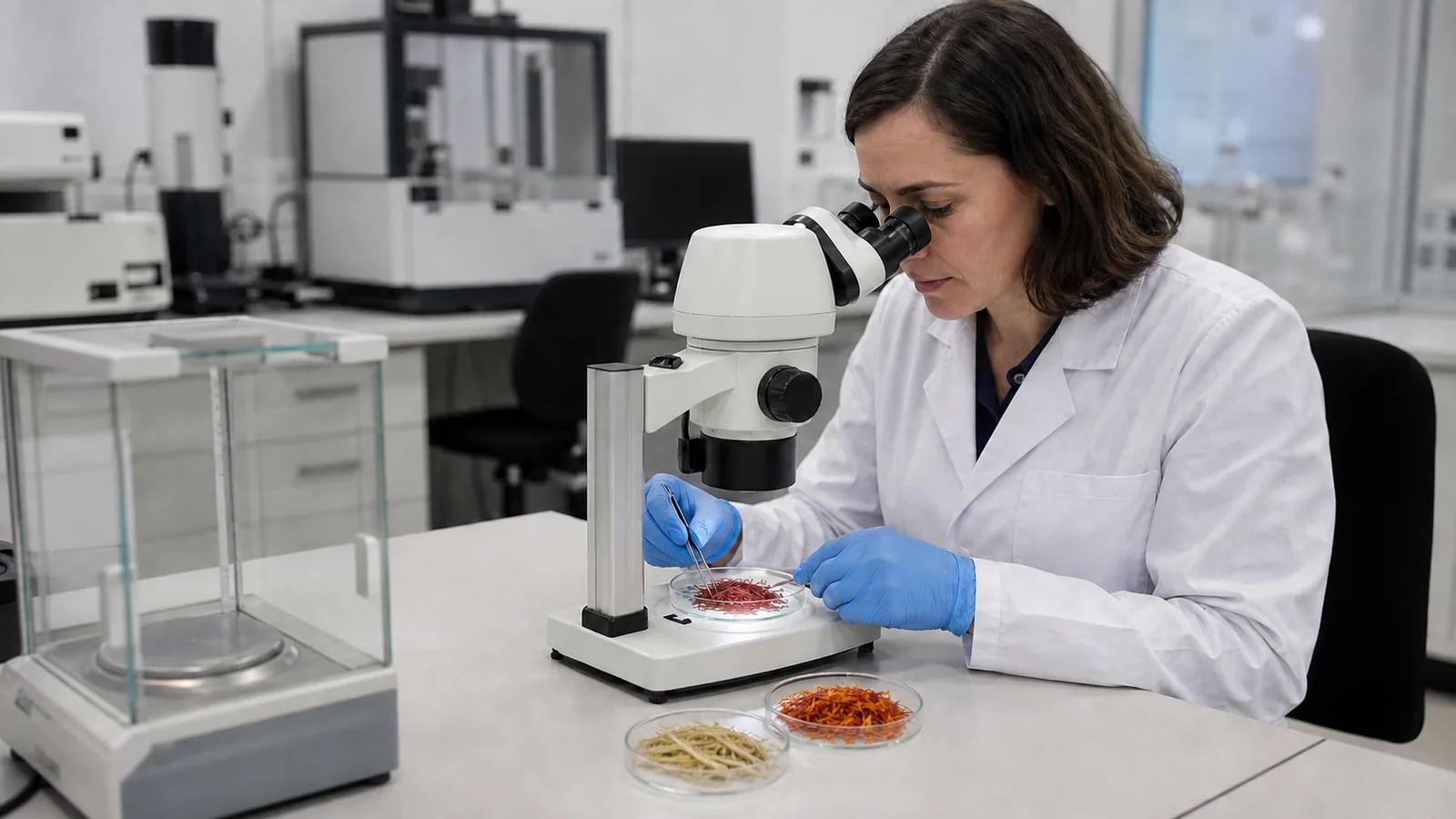
Chinese saffron and fake saffron are not the same category. Genuine Crocus sativus is cultivated in China, and China also imports saffron from countries including Iran and Spain. Counterfeit, adulterated and origin-mislabelled products can appear in any market. A buyer should judge the identified lot and its evidence, not assume authenticity or fraud from a country name.
This page was originally titled “Chinese fake saffron. Warning.” That wording blurred nationality, botanical identity and fraud into one accusation. The warning worth keeping is narrower: saffron is valuable, adulteration is documented, and buyers need traceability and suitable testing. Research on saffron in the Chinese market has examined both legitimate domestic production and imported products, as well as the challenge of false origin claims.
Is saffron grown in China?
Yes. Peer-reviewed studies describe Chinese saffron cultivation in areas including Shanghai, Zhejiang, Henan, Anhui and Tibet. Hangzhou saffron from Jiande in Zhejiang has geographical-indication status, and researchers have studied domestic Chinese lots alongside imports. Search phrases such as “China saffron,” “Chinese saffron,” “saffron China” and “saffron in China” therefore do not describe a fake product by definition.
The more useful origin question is whether a seller’s claim matches the product. Stable-isotope and elemental analysis can help distinguish growing regions in research settings. That is different from judging quality: a genuine origin does not automatically assign a grade, and a chemical quality score alone may not prove geographical provenance.
What fake saffron can contain
Fake saffron may be a completely different material sold under the saffron name, while adulterated saffron contains some genuine spice mixed with undeclared matter. Mislabelled saffron may be genuine Crocus sativus but carry a false origin or grade.
Documented possibilities include:
- safflower petals or other coloured flower material;
- dyed plant fibres, paper, straw or thread-like material;
- non-stigma parts of the saffron flower;
- added sugar, salt, starch, sand or other material that increases weight;
- excess moisture;
- undeclared colourants;
- poorly stored product contaminated by insects, fungus or mildew.
Safflower (Carthamus tinctorius) is a real plant and a legitimate ingredient when sold under its own name. Its petals can add colour to food, but they are not saffron. A fake saffron flower may also be a photograph or description of another crocus or coloured plant presented as Crocus sativus.
Whole threads are easier to inspect than powder
Powdered saffron is not automatically counterfeit. Grinding removes many visible features, however, which makes undeclared additions harder for a buyer to see. ISO’s saffron specification covers filaments, cut filaments and powder, and laboratory methods are available for all three forms.
For an unfamiliar supplier, intact or cut threads provide more visual information. Look for a reasonably consistent lot rather than expecting every piece to be perfect. Transport and handling cause fragmentation, and legitimate grades may include different thread lengths.
What genuine saffron threads look like
A dried stigma typically has a deep red to red-orange body, with one end broader or trumpet-like and the lower part narrower. A lot can contain pieces rather than complete three-branched stigmas. Lighting, drying and storage affect appearance, so an online colour sample is not a universal pass/fail reference.
The old text described a tuft-like form and an upper branch wider than the lower, horn-like part. That observation is useful when the material is intact. It cannot authenticate powder, and skilfully cut or dyed substitutes may imitate one visible feature.
Why the paper oil test is weak evidence
One traditional check presses threads between paper, straw or newspaper and looks for a fat or oil mark. That is not a recognised certification method. Paper type, pressure, environmental moisture and substances added to the sample can all change the result. Passing this test does not establish purity, and failing it does not identify the contaminant.
Do not rub an unknown spice on printed newspaper and then taste or cook with it. Printing inks and surface contamination introduce a separate food-safety issue.
What a water test can and cannot show
When genuine saffron is placed in water, soluble colour compounds move into the liquid, often producing golden-yellow to orange tones while the plant tissue remains visible. A suspicious sample may release an intense surface dye immediately or leave obviously unrelated fibres. Those observations can justify further investigation.
They are not conclusive. Genuine extraction changes with water temperature, thread size, age and quantity, while a prepared adulterant can be designed to behave convincingly. The statement that saffron powder is completely dissolved in hot water is inaccurate: soluble compounds disperse or extract, but plant material does not have to vanish completely.
Aroma, taste and age
Good saffron has a distinctive aroma and a bitter taste, but “sharp and piercing” is subjective. Low odor can reflect age, weak material, dilution or poor storage. Strong fragrance can also be added or manipulated, so smell alone does not certify a lot.
Do not taste a product you suspect contains an unknown dye, contaminant, fungus or mildew. Sensory assessment belongs after basic supplier and safety checks, not before them.
Do Iranian export documents prove authenticity?
The original article said Iranian saffron exports were tested and approved through IRICA and health requirements. Customs, plant-health, food-safety and commercial documents may all be relevant to a shipment, but no logo or document name should be treated as a universal purity guarantee.
Check that each certificate applies to the same supplier, product, lot, weight and date. Confirm the issuing body where the risk justifies it. A generic health certificate, customs declaration or company licence does not replace a laboratory result for the actual saffron being purchased.
What reliable testing looks for
ISO 3632:2025 specifies requirements for dried saffron from Crocus sativus pistils in filament, cut-filament and powder forms. Its framework addresses product characteristics and includes test methods in the companion standard. Laboratories may add microscopy, chromatography, spectroscopy, DNA-based methods or isotope analysis when the question is adulteration or origin.
The correct method depends on the claim. Colour, aroma and flavour strength are not the same as botanical identity. Botanical identity is not the same as geographical origin, and origin is not the same as the absence of added sugar or synthetic dye. Ask the laboratory what its method can actually conclude.
A buyer’s saffron warning checklist
Before accepting a lot:
- identify the botanical product, form, claimed origin and grade;
- match the sample, invoice, lot code and test report;
- inspect whole threads where possible, without relying on one shape or colour;
- look for foreign fibres, particles, excess moisture, insects, fungus or mildew;
- treat an unusually low price or vague origin story as a reason to ask more questions;
- use a competent laboratory when authenticity, safety or commercial value matters.
If a sample contains visible salt, sugar, sand or unrelated plant material, reject or quarantine it under the buyer’s quality procedure. Do not try to rescue a questionable lot with a home test. Our broader article on saffron fraud and purchasing controls explains the main fraud patterns, while the real-versus-fake saffron guide focuses on visual and practical inspection.
Sources and review note
We reviewed this article on 28 August 2026. Evidence that genuine saffron is cultivated and sold within China comes from the peer-reviewed study of imported and domestic saffron in the China market and the open-access research on saffron cultivation and corm pathogens in China. Product requirements come from ISO 3632-1:2025. Adulteration and analytical-method context comes from the updated saffron quality-control review. None of these sources supports treating national origin by itself as proof that saffron is genuine or fake.

![Exporting Saffron to Turkey + Price Guide [Complete 0 to 100]](https://img.rowhanisaffron.com/20260827003933/saffron-export-turkey-quality-inspection.webp)



