Iranian saffron and Alzheimer’s research has produced several small clinical trials, but it has not established saffron as a cure or a replacement for medical care. The best-known Iranian study followed 54 adults with mild-to-moderate Alzheimer’s disease for 22 weeks and compared a standardised saffron extract with donepezil. Its result was encouraging enough to justify more research, not strong enough to settle long-term effectiveness or safety.
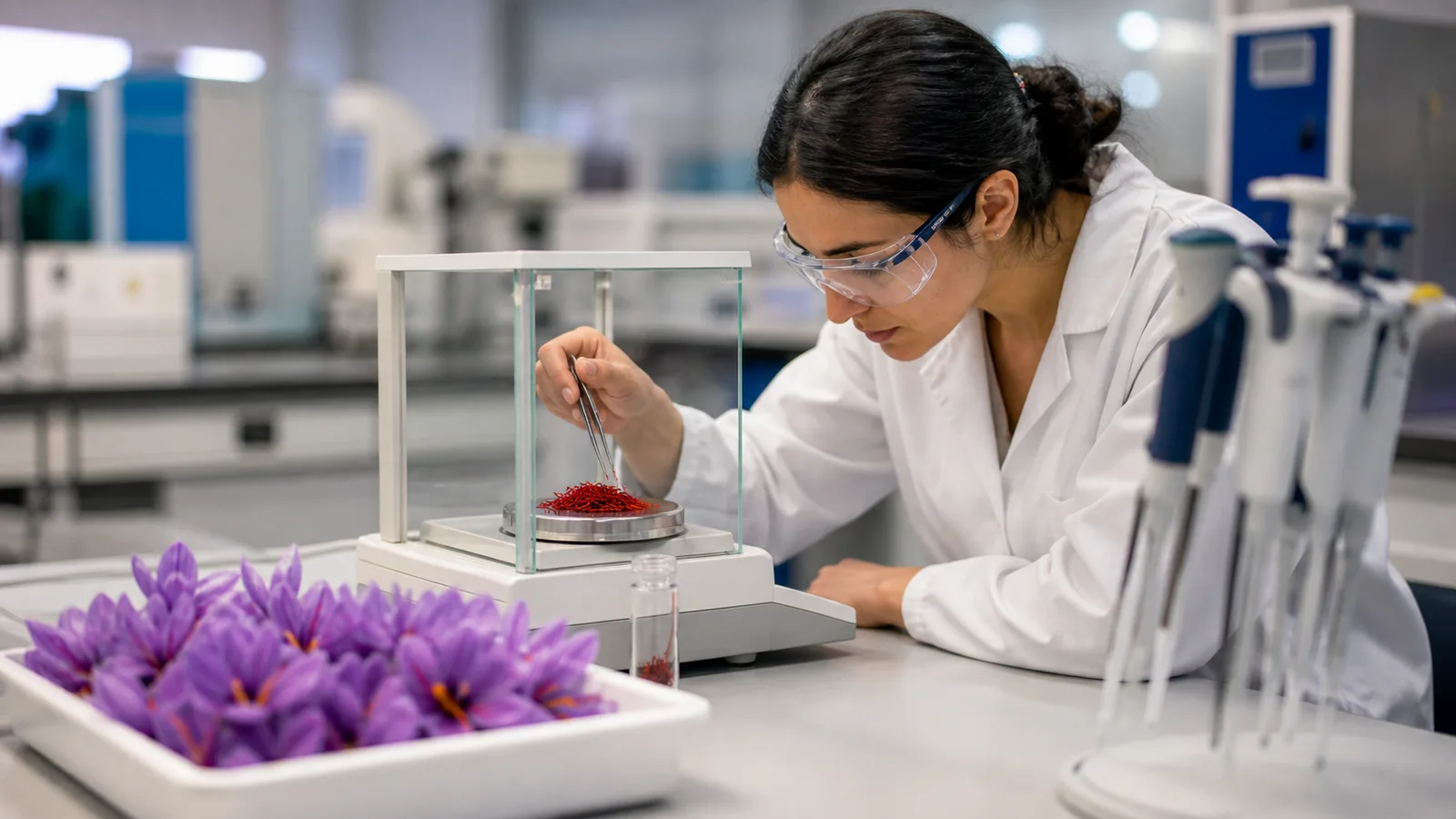
This distinction matters because older reports on saffron research often moved too quickly from “studied” to “treats.” They also mixed whole saffron, measured extracts and isolated compounds such as crocin or safranal as though they were interchangeable. They are not. A culinary spice, a trial capsule and a pharmaceutical formulation can differ substantially in dose, composition and quality control.
The 22-week Alzheimer’s trial behind the original report
Psychiatrist Shahin Akhondzadeh and colleagues enrolled 54 Persian-speaking adults aged 55 or older with mild-to-moderate Alzheimer’s disease. In the randomised, double-blind trial, participants received either 30 mg of saffron extract per day or 10 mg of donepezil per day. Researchers assessed cognition and clinical function over 22 weeks.
The published phase II trial reported similar changes in its two treatment groups on the selected rating scales. Adverse-event frequency was also similar, except vomiting occurred more often in the donepezil group. “Similar” in this setting does not prove that saffron is generally equivalent to donepezil: this was a small, short trial without a placebo group, and it did not answer questions about disease progression, daily functioning over years or different extract formulations.
The original destination article correctly preserved the 54-patient, 22-week outline, but its wording implied treatment had been established. The researchers themselves described the result as preliminary evidence of a possible therapeutic effect.
A separate placebo-controlled Alzheimer’s study
The same research group also conducted a 16-week double-blind trial in which 46 people with probable mild-to-moderate Alzheimer’s disease were screened and assigned to saffron extract or placebo. The saffron group received 30 mg per day. The published placebo-controlled study reported better scores on its cognitive and clinical measures in the saffron group and no significant difference in observed adverse events.
That study called for larger confirmatory trials. Taken together, the two early studies are a reason to investigate a standardised extract in dementia care. They are not evidence that adding culinary saffron to food prevents Alzheimer’s disease, reverses it or is safe for every patient.
What later Alzheimer’s research adds
A later Iranian double-blind trial compared saffron with memantine in people with moderate-to-severe Alzheimer’s disease. It broadened the research question, but it remained modest in size. Reviews now discuss saffron, crocin, crocetin and safranal across laboratory, animal and human studies, while continuing to call for better dose-response data, longer follow-up and larger controlled trials.
Those gaps are important in a progressive disease. Short rating-scale changes do not tell families whether an intervention delays institutional care, preserves independence or changes survival. Anyone caring for a person with memory loss should seek a clinical assessment rather than use a spice or supplement to diagnose or manage the condition.
Crocin tablets and the Mashhad depression pilot
Two assigned source posts described a crocin tablet developed around Mashhad University of Medical Sciences. Their names were badly machine-translated: “kerosene” meant crocin, and the researcher and company names were not rendered reliably. The useful evidence behind those reports is a published pilot trial, not the garbled product language.
In that randomised, double-blind, placebo-controlled pilot, 40 adults with major depressive disorder continued a prescribed SSRI and received either 30 mg of crocin per day or placebo for four weeks. The crocin group showed larger improvements on self-reported depression, anxiety and general-health scales. The authors identified the short duration, small sample, self-report measures and medication adherence as limitations.
The historical reports also said a production licence had been obtained and that an initial batch of 20,000 tablets was distributed through Mashhad pharmacies with a pharmaceutical partner. They did not provide a regulator record, product leaflet, registration number or durable source for those commercial details. Those statements can be preserved as a dated account of development, but they should not be read as proof of current approval, availability or clinical effectiveness.
Crocin is one of saffron’s carotenoid compounds. A crocin tablet used at a measured dose alongside an antidepressant in a supervised study is not equivalent to cooking with saffron, and the pilot did not test crocin as a stand-alone replacement for prescribed treatment.
The reported “SaffroTin” Alzheimer’s product
Another source reported that a Tehran-linked knowledge-based company had developed an Alzheimer’s symptom product called “SaffroTin” after a ten-year research programme. It attributed claims of comparable effectiveness, fewer side effects, export plans and international registration to company representative Jamal al-Jalali.
The article supplied no registration identifier, formulation, dose, published trial or regulator decision for that named product. Its statements about preventing cancer and replacing imported medicines are therefore not carried forward as medical facts. A company announcement may document an attempt to commercialise research; it cannot establish efficacy or safety on its own. The peer-reviewed saffron-extract trials above are the appropriate evidence to discuss.
Saffron and ADHD: what the six-week pilot found
ADHD can involve persistent inattention, impulsivity and/or hyperactivity that interferes with school, work or relationships. It is diagnosed from a broader clinical assessment, not from a short symptom list.
A 2019 randomised, double-blind pilot study enrolled 54 children and adolescents aged 6–17 with ADHD. Participants received weight-adjusted saffron capsules or methylphenidate for six weeks; 50 completed the study. Changes in parent and teacher rating scales did not differ significantly between groups, and recorded adverse-effect frequencies were similar.
The source article called saffron a “cure” and proposed it as a replacement for Ritalin. The study did neither. It compared two small groups for six weeks, had no placebo arm and explicitly requested larger, longer controlled trials. A later systematic review found only four saffron studies involving 118 patients in total and described the evidence as promising rather than sufficient for a treatment recommendation. Parents should not stop, substitute or add an ADHD medicine or supplement without the prescribing clinician.
Pain, inflammation and rheumatoid arthritis
Two assigned sources were near-duplicates of an interview with pharmacology researcher Hamidreza Sadeghnia. They listed analgesic and anti-inflammatory activity, diabetic nerve pain, rheumatoid arthritis, seizures, morphine dependence, sun protection, cardiovascular prevention, memory and kidney stones. The list combined different evidence levels and repeatedly used “proved” where the interview itself referred to animal or unfinished research.
Human rheumatoid-arthritis evidence has since included a small 12-week placebo-controlled trial in 66 women, with 61 included in the final analysis. The saffron group reported improvements in tender and swollen joints, pain and a disease-activity score. However, a systematic review of saffron in rheumatic diseases found only five underlying randomised trials, substantial heterogeneity, incomplete herbal-product standardisation and concerns about bias. It concluded that evidence was insufficient to establish a direction of effect for the examined outcomes.
That is a more accurate conclusion than saying saffron’s analgesic properties were “confirmed.” The interview’s diabetic-neuropathy and kidney-stone statements referred to laboratory or animal work, not established human treatment. Its seizure and morphine-dependence claims likewise should not be converted into clinical advice. Mild laboratory sun-protection activity is not a substitute for tested sunscreen, and no evidence in the sources supports telling readers that saffron prevents heart attacks or strokes.
How to read the different kinds of evidence
The research becomes easier to interpret when each claim is tied to its study type:
- Laboratory work can show a chemical or cellular effect, but not whether a person will benefit.
- Animal studies help researchers investigate mechanisms and safety signals; their results cannot be assumed in humans.
- Small pilot trials test feasibility and look for a signal. They are especially vulnerable to chance, short follow-up and formulation-specific results.
- Larger, replicated trials can provide more reliable estimates, particularly when the product, dose, comparator and outcomes are defined in advance.
- Regulatory authorisation concerns a specific product and jurisdiction. It is not created by a university announcement or transferred to every saffron supplement.
Standardisation is central. Crocin and safranal content can vary among extracts, and a result from one capsule cannot automatically be applied to a different extract, a tea or threads used in a meal.
Why saffron research infrastructure matters
The final source reported a visit by Akhondzadeh to Torbat-e Heydarieh University of Medical Sciences. He argued that a major saffron-growing and trading region should have research centres and pharmaceutical companies able to connect agriculture, universities and carefully governed product development.
University representatives said their publication output had doubled and their reported h-index rose from 7 in 2017 to 14 in 2018, with saffron, neuroscience and biotechnology among their priorities. Akhondzadeh also gave a historical estimate that only about 200 of roughly 800 Iranian research centres were active. These are dated institutional statements, not current national statistics.
The lasting point is sound: locally relevant research needs more than production volume. It needs registered protocols, accurately identified plant material, reproducible extracts, appropriate comparators, adverse-event reporting and results published whether positive or negative. Those practices make it possible to separate a promising Iranian research programme from an unsupported health claim.
A careful conclusion for readers
Iranian teams have made a meaningful contribution to early saffron research in Alzheimer’s disease, depression and ADHD. Their small trials justify continued investigation and have helped define questions for larger studies. They do not make ordinary saffron a proven medicine, and the broad treatment lists in older news reports go beyond the evidence they cite.
Saffron can remain a valued culinary ingredient while researchers study standardised preparations. If the question concerns memory decline, depression, ADHD, pain or another medical condition, the safe next step is qualified care. A clinician or pharmacist can consider the diagnosis, current medicines, dose, product quality and individual risks in a way a blog article cannot.