


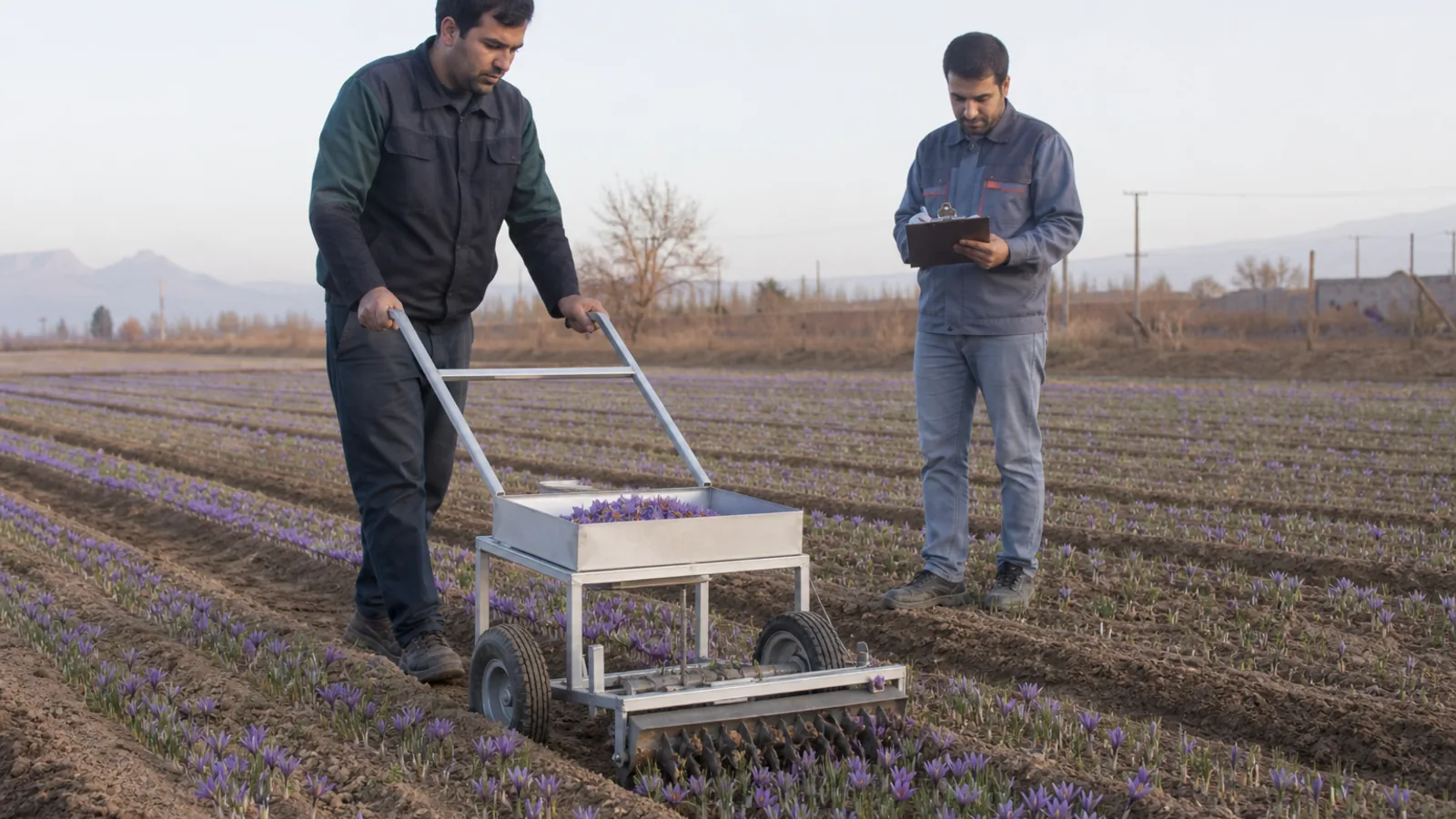
Mechanized harvesting saffron is a difficult engineering problem because the crop is delicate, the flowering window is short and the valuable part of each flower weighs very little. A machine that gathers more flowers per hour is useful only if it leaves the corms and foliage unharmed, does not mix soil or leaves into the load, and delivers flowers to separation and drying in good condition.
A 2015 report on this page argued that mechanisation could support production and protect export markets in Khorasan Razavi. It also acknowledged a real social cost: replacing seasonal farm labour can reduce employment. Both points still belong in the decision. The sensible question is not whether machinery is automatically better, but which operation is creating the bottleneck and whether a tested tool improves the whole harvest without shifting loss to the next stage.
What the Khorasan Razavi report said about saffron
The article attributed its remarks to Mohammad Sabour Bilandi, acting deputy in the Khorasan Razavi Agricultural Jihad organisation’s crop-production department, speaking at a press conference on 25 Khordad reported by the Khorasan edition of the Iranian Students News Agency (ISNA). The surviving English translation mangled his name as “Mohammad patient Bylndy”; the Persian embedded in the page supports the rendering used here.
Bilandi said mechanized harvesting was in the interest of saffron production. He linked mechanisation with higher harvest output and quality, but warned that it could increase agricultural unemployment. The organisation’s stated policy, as reported, was to maintain export markets for a strategic crop and develop mechanisation in the saffron production process.
He also described two provincial mechanisation credit lines: 80 billion toman in the previous year and 52 billion toman in the current year. Those amounts were reportedly communicated to counties to attract applicants. The old translation incorrectly rendered the currencies as dollars. These are historical allocations from the press conference, not available finance today, and the report does not state lending terms, uptake or how much was specifically for saffron.
The wider argument was that new technology could help agriculture and horticulture retain their position in world markets. That policy claim does not prove that any particular saffron harvester worked. Equipment still has to be tested against the crop, the field and the post-harvest line.
“Harvesting” covers several different jobs
Saffron harvest is often discussed as though it were one operation. In practice, it is a chain:
- detect flowers that are ready in a field with uneven emergence;
- detach or collect them without damaging the plant or loading them with soil;
- move the fresh flowers quickly in shallow, clean containers;
- separate the three red stigmas from petals and other flower parts;
- dry the stigmas under controlled conditions, then cool, grade and pack the lot.
A tool may mechanise one of these jobs and leave the rest manual. Bed preparation, corm lifting, grading, planting, weeding, flower collection and stigma separation also require different mechanisms. A tractor attachment, a hand-held flower collector, a vision-guided picker and an airflow separator should not be compared as though they solve the same problem.
The 2020 scientific chapter on mechanisation of saffron production describes this uneven state of development. Existing equipment can assist some field operations, while planting and harvest require specialised machines. The authors also note that better-controlled flower picking and separation may lower labour cost and microbial contamination. “May” matters: those benefits depend on machine performance and hygiene, not on the word mechanised.
Why field collection remains hard to automate
A saffron field is not a factory surface. Flowers stand at different heights and angles; leaves, clods and residue can hide them; light changes during the morning; and soft tissue is easily bruised. A collector must find the flower, reach it, detach it at an appropriate point and move it away without crushing neighbouring flowers.
Timing adds pressure. Flowers appear over a concentrated season and are normally collected frequently, often early in the day. A slow prototype can make a clean cut and still fail commercially if it cannot cover the required area before flowers open, weather changes or the processing team is overwhelmed. A fast device can also create losses if its success rate falls in dense, sparse, wet or uneven plots.
Field research has shown why performance must be measured rather than assumed. A published study of a mechanical flower device and airflow separators reported different collection success rates under different operating motions, and two tested separation systems damaged a substantial share of stigma filaments. Those prototype results do not condemn mechanisation. They show that throughput alone is an incomplete result.
Recent work uses imaging and automated detection to decide whether a flower is harvestable, but recognition in a research dataset is only one part of field readiness. A machine must also navigate, reach, detach, collect and clean in the actual crop. Before purchase, the grower needs independent field data from conditions close to the intended farm.
Stigma separation is a different engineering task
Once flowers reach the workroom, the bottleneck often moves to separation. Manual workers open or handle each flower and remove the stigma with the required amount of style. The work is repetitive and time-sensitive. Fresh flowers should not sit in deep, warm piles while everybody waits for a separator to catch up.
Researchers have tested cutting systems, optical detection, mechanical alignment, suction and airflow. An automated cutting-system study used image processing to find a cutting position and drive a mechanical cutter. It demonstrates a workable concept, but a controlled prototype cycle is not the same as a complete commercial line receiving mixed flowers from a field.
Separation quality should be checked by what leaves every outlet. Count intact red stigmas in the product stream, valuable material lost with petals, yellow style retained, broken filaments and foreign matter. Then check how quickly the output reaches drying. If a separator feeds a slow dryer, the line still has the wrong capacity balance.
Quality cannot be inferred from machine speed
The historical report associated mechanisation with higher quality. That can happen when a well-designed process reduces delay, hand contact, contamination or inconsistency. It can also do the opposite when the machine bruises flowers, gathers soil, loses stigmas or leaves material waiting in unsuitable conditions.
Use a side-by-side trial with the same field, harvest period and drying method. Record flowers or area handled per hour, labour hours, collection success, plant damage, foreign matter, flower temperature and elapsed time to separation and drying. Weigh dry, saleable saffron from each treatment rather than extrapolating from flower baskets.
Laboratory assessment should use representative lots and a declared method. The official Codex standards catalogue lists CXS 351-2022 for dried saffron, which provides an international baseline for product identity, styles, quality, hygiene and contaminants. A compliant result still needs traceability to the tested lot; it does not make all output from a machine equivalent.
Labour should be designed into the change
The employment warning in the 2015 report should not be dismissed. Saffron’s short harvest employs many people for field collection and stigma separation, and those earnings can matter to rural households. Mechanisation can remove tasks, reduce hours or change who receives the value.
It can also address genuine problems: a shortage at the flowering peak, exhausting postures, repetitive work and a workload that cannot be completed before quality declines. A 2026 observational study of saffron harvesters in Khorasan Razavi documented substantial postural loads and musculoskeletal discomfort during the season. That evidence supports ergonomic improvement; it does not by itself select a machine.
Plan the labour transition before installation. Operators need training, maintenance and hygiene responsibilities. Experienced pickers can help set acceptance criteria and detect failure modes that a supplier demonstration misses. If the actual constraint is planting rather than flower collection, the completed discussion of planting, harvest mechanisation and rural employment explains why the investment may belong at a different stage.
How to test a saffron harvester before buying it
Begin with the farm’s current workflow. Measure peak flowers, area covered, labour hours and waiting time at each stage. The longest queue may be in transport, separation or drying, not in field picking.
Ask the supplier to identify exactly what the machine does and under which conditions its figures were measured. “Capacity” should name an area, flower count or mass per hour. It should also state operator numbers, row layout, field preparation, flower density, collection success, losses, cleaning time, power, consumables and downtime.
Run a limited field trial beside the existing method. Include sparse and dense patches and more than one time of morning. Mark a representative area before work, then count flowers collected, missed and damaged. Inspect leaves and soil surface. Follow each lot through separation and drying so that a faster field result cannot hide a lower saleable yield.
Calculate the full seasonal cost: purchase or hire, finance, transport, setup, energy, operator hours, maintenance, spare parts, cleaning, storage, insurance and the useful number of operating days. Saffron equipment may work for only a brief annual window. Cooperative ownership or a trained contractor can make more sense than one machine per farm, but only if arrival time and service capacity are reliable.
The rest of the 2015 press conference
The source article ranged well beyond saffron. Those figures provide the provincial policy setting for the mechanisation remarks, but they should not be mistaken for current Khorasan Razavi statistics.
Greenhouses and export planning
Bilandi reported 184 hectares of greenhouses: 150 hectares for vegetables and summer crops and 27 hectares for flowers and ornamental plants. He said 879 greenhouse units provided 3,719 direct jobs, and that the programme intended to add 70 hectares. Asked about reaching 1,000 hectares by Iranian year 1404, he said expansion was possible if facilities and export mechanisms were provided; otherwise, expanding greenhouse products would be unhelpful. Target markets needed to be identified. The report also attributed a national first-place claim to the province’s hydroponic greenhouses with “40 percent coverage,” but did not define the denominator.
Wheat, rainfall and combines
The same conference reported guaranteed purchases of 93,300 tonnes of surplus wheat, described as a 200 percent increase from the previous year. It cited 193,000 hectares of irrigated wheat and 125,000 hectares of rain-fed wheat; 202 millimetres of rain from 1 Farvardin to 22 Khordad, 22.8 percent above the previous year but 3.8 percent below the earlier rainfall period; and a forecast of 664,000 tonnes of wheat, including 410,000 tonnes expected to be purchased as surplus.
Bilandi said one-third of wheat production became improved seed, more than 20,000 tonnes of improved irrigated and rain-fed seed were expected that year, and a four-year target sought 75 percent. He also listed 540 local and 600 visiting combines and said combines harvested 80 percent of provincial wheat and barley.
One translated barley sentence gives 160 hectares harvested, 55,000 tonnes purchased and a price of 920 toman without a quantity unit. Those values cannot be reconciled from the surviving text and are retained only as a damaged historical passage, not corrected by guessing.
Pest management and incentive records
The speaker reported weed and pest work over 245,000 hectares of wheat and barley. A broken passage then listed 47 incentive licences in Iranian year 1391, 210 in 1392 and 667 in the previous year. It paired 74 hectares with 135,000 tonnes of melons, tomatoes and potatoes, an implausible relationship for which the missing text supplies no safe repair.
Finally, the report said 37,277 hectares were covered by an integrated pest-management plan in crop year 1393–94, using chemical controls alongside biological and mechanical methods, and claimed 90 percent of provincial products could qualify for an incentive certificate. The original English called this “IMP”; the standard term and Persian context indicate IPM. No current certificate eligibility should be inferred from that old statement.
A good decision is a measured production decision
Mechanized harvesting saffron can relieve a genuine bottleneck, but it is not a single machine category and it does not guarantee quality, export success or lower cost. Define the operation, test it against manual work, follow both lots through drying, and include labour and field damage in the result.
The strongest part of the 2015 policy argument was its focus on maintaining a valuable crop and its markets. The missing step was verification. A machine earns its place when it produces more traceable, saleable saffron from the same harvest window without unacceptable damage or social cost.
The mechanisation, unemployment, export-market, 80-billion-toman, 52-billion-toman, greenhouse, wheat, rainfall, combine, barley, pest-management, licence and certificate figures are retained as attributed statements from the provincial press conference reported here in 2015. Undefined units, damaged relationships and missing methods are identified rather than silently repaired. Scientific and standards sources were reviewed on 29 August 2026.

![Exporting Saffron to Turkey + Price Guide [Complete 0 to 100]](https://img.rowhanisaffron.com/20260827003933/saffron-export-turkey-quality-inspection.webp)



