


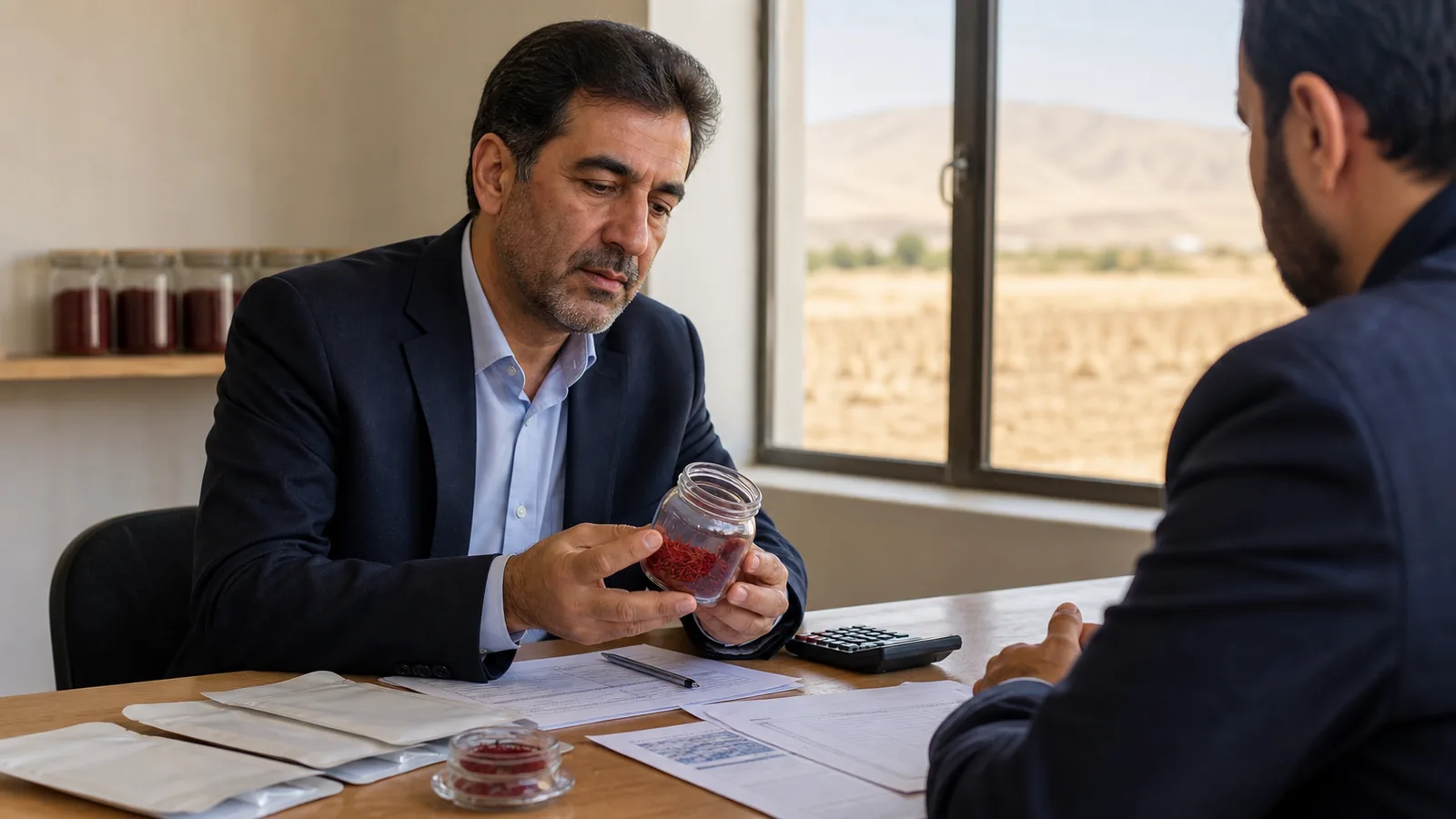
The Rowhani Saffron interview published by CNN in June 2015 was a snapshot of trade under pressure. Iran was negotiating sanctions relief, exporters could not rely on ordinary international banking, and established saffron markets were harder to reach. Mehrdad Rowhani explained how the company adapted without pretending that the workarounds were easy or secure.
This article brings the complete account together in clear English. Its prices, production shares and export figures belong to the period covered by the original report; they are not current market quotations. That distinction matters because sanctions, exchange rates, customs rules and saffron output can all change.
Why CNN called saffron Iran’s “red gold”
CNN’s original report by Kieron Monks opened with the economics of hand harvesting. It described top-quality saffron selling for as much as $65 per gram in some retail contexts and noted the extraordinary amount of flower handling needed to produce a pound of dried threads. Those were the article’s 2015 figures, not a promise about today’s retail or wholesale price.
The report placed Iran at the centre of a cultivation tradition stretching back roughly 3,000 years. It said the country produced more than 90% of an estimated 250 tonnes of annual world output at the time. Khorasan, where Rowhani Saffron is based, was described as producing more than 70% of Iran’s crop.
Those numbers explain why saffron mattered beyond the value of an individual jar. It supported growers, harvest workers, processors, packers and exporters across a large regional supply chain. Yet a dominant production share did not guarantee easy access to the people who wanted to buy it.
How sanctions changed an ordinary export
The restrictions discussed by CNN limited access to Europe, the United States and Canada and excluded Iranian companies and banks from much of the global financial system. For an exporter, that created two separate problems: moving the product and receiving payment for it.
Mehrdad Rowhani told CNN that the company could not use banks. It relied instead on private messengers, dealt directly with customers and had to trust that payment would arrive. The couriers cost more, and the arrangement exposed the business to fraud. The important point is not that couriers were a clever substitute for banking. It is that every transaction carried added cost and uncertainty.
Other Iranian businesses used barter arrangements. According to the report, some Chinese and Indian partners paid for Iranian goods with shipments of food and consumer products. Barter kept trade moving, but it also made pricing, settlement and working-capital planning more complicated than a normal bank transfer.
The move toward Gulf and Middle Eastern markets
Rowhani Saffron responded by placing more emphasis on the Persian Gulf and wider Middle East. CNN reported that this shift allowed the company to maintain exports of about 50 kilograms per month. That quantity was the company’s reported monthly rate in 2015, not a current sales figure or a guarantee of continuous volume.
Iranian traders also reached some Western customers through intermediaries in places such as the United Arab Emirates. That route provided access, but it came with a strategic cost. Every additional intermediary separated the Iranian producer from the final buyer, absorbed part of the margin and created more room for another country or company to own the customer relationship.
The lesson still travels well: market diversification can protect an exporter when one route closes, but it should not come at the expense of traceability. Buyers need to know the saffron’s origin, grade and handling history even when several businesses participate in the sale.
What the 2014 export figures actually said
The National Saffron Council figures quoted by CNN showed total Iranian saffron exports rising 36% in 2014. The report put the price at around $2,000 per kilogram after a slight increase. These figures refer to an industry-wide result and should not be confused with the earlier $65-per-gram figure, which described the highest-quality product in a different sales context.
Rowhani also reported a 27% price increase, reaching 35% for some Negin-grade saffron. The company was preparing new packaging and planned to pursue certifications, including ISO 9001 for quality-management processes, before approaching European and US markets. ISO 9001 does not grade saffron or prove a health benefit; it concerns how an organisation manages consistent processes.
The three sources assigned to this destination repeat the same CNN account, but one preserves an additional business figure. Ali Sheikh, identified in the report as a London representative of Iran Hassos and a founding member of the British Iranian Chamber of Commerce, said his company had lost more than $7 million in annual UK sales while retaining turnover of about $48 million in 2014. Because the translated source is unclear about the entities and comparison period, those amounts should be read as attributed historical figures, not an audited statement about Rowhani Saffron.
Demand survived, but competitors gained room
Sheikh’s broader observation was that established goods such as saffron and pistachios still found buyers. He said demand exceeded supply and that many traders had no fresh stock until the following August. He also reported talks with German, French and British companies that were waiting for banking restrictions to ease.
At the same time, the gap in direct Iranian market access gave competitors more room. CNN discussed Afghanistan’s expanding cultivation and Spain’s role in selling saffron to international buyers. It also repeated claims that Iranian material could be given another origin identity or blended and marketed through Spain. Those are attributed claims from the 2015 article, not proof that every Afghan or Spanish saffron product was mislabelled.
This is why quality alone is not a complete defence. Iranian saffron may have strong colour, aroma and flavour, but buyers also judge documentation, packaging, delivery reliability and after-sale accountability. Our separate review of Iranian saffron competitors explains how those commercial details affect origin recognition.
Packaging and certification were part of the response
The planned return to Europe and the United States was not described as a matter of sending the same bulk product through a newly opened route. Rowhani spoke about purpose-designed packaging and quality-management certification. Both ideas addressed the trust gap created when buyers could not deal directly and consistently with Iranian suppliers.
Useful packaging protects saffron from moisture, light, contamination and physical damage. It also provides room for an accurate net weight, batch identity, origin, storage instructions and the information required in the destination market. Certification can support those controls, but it must match the claim being made. A management-system certificate is not a substitute for batch testing, food-safety compliance or truthful origin labelling.
New products were an opportunity, not a health claim
CNN noted industry interest in technology and new applications, including saffron gum and possible medical uses. That passage described development ambitions. It did not establish that saffron treats a disease, nor did it provide clinical evidence for a therapeutic product.
Moving beyond bulk threads can create more value through food products, extracts or other carefully regulated applications. Each category brings its own safety, labelling and evidence requirements. Product development should therefore begin with a defined buyer need and the rules of the intended market, not with an unsupported promise about what saffron can do.
What changed, and what the interview still explains
The CNN article was written during the 2015 nuclear negotiations. Its expectation that restrictions would ease, Western investment would arrive and demand would push prices upward belonged to that moment. It should not be used as a description of today’s sanctions regime or as a forecast. Anyone planning a shipment now needs current legal, banking, customs and destination-country advice.
What remains useful is the business anatomy of the problem. When normal finance disappears, an exporter faces higher transaction costs and more payment risk. When goods travel through intermediaries, origin recognition and margin can weaken. When direct market access returns, packaging, documentation and consistent quality determine whether the producer reconnects with the buyer.
Those pressures also connect to the wider production and export-value challenges facing Iranian saffron. More output does not automatically create more durable trade. The crop needs a dependable path from a known farm and tested batch to a buyer who can verify what is being purchased.
A historical interview with a practical message
The 2015 Rowhani Saffron interview is not a current price sheet or sanctions guide. It is a record of how one exporter kept operating when banking access and established routes were constrained. The company used direct relationships, private couriers, new regional markets and, where necessary, unconventional settlement arrangements. It also recognised that a return to major markets would require better packaging and documented processes.
Bringing the full account into this destination gives readers arriving from the three older source posts the answer they were promised. It preserves the historical figures, separates company experience from industry data and keeps the original CNN report available for anyone who wants to read the source in full.

![Exporting Saffron to Turkey + Price Guide [Complete 0 to 100]](https://img.rowhanisaffron.com/20260827003933/saffron-export-turkey-quality-inspection.webp)



