


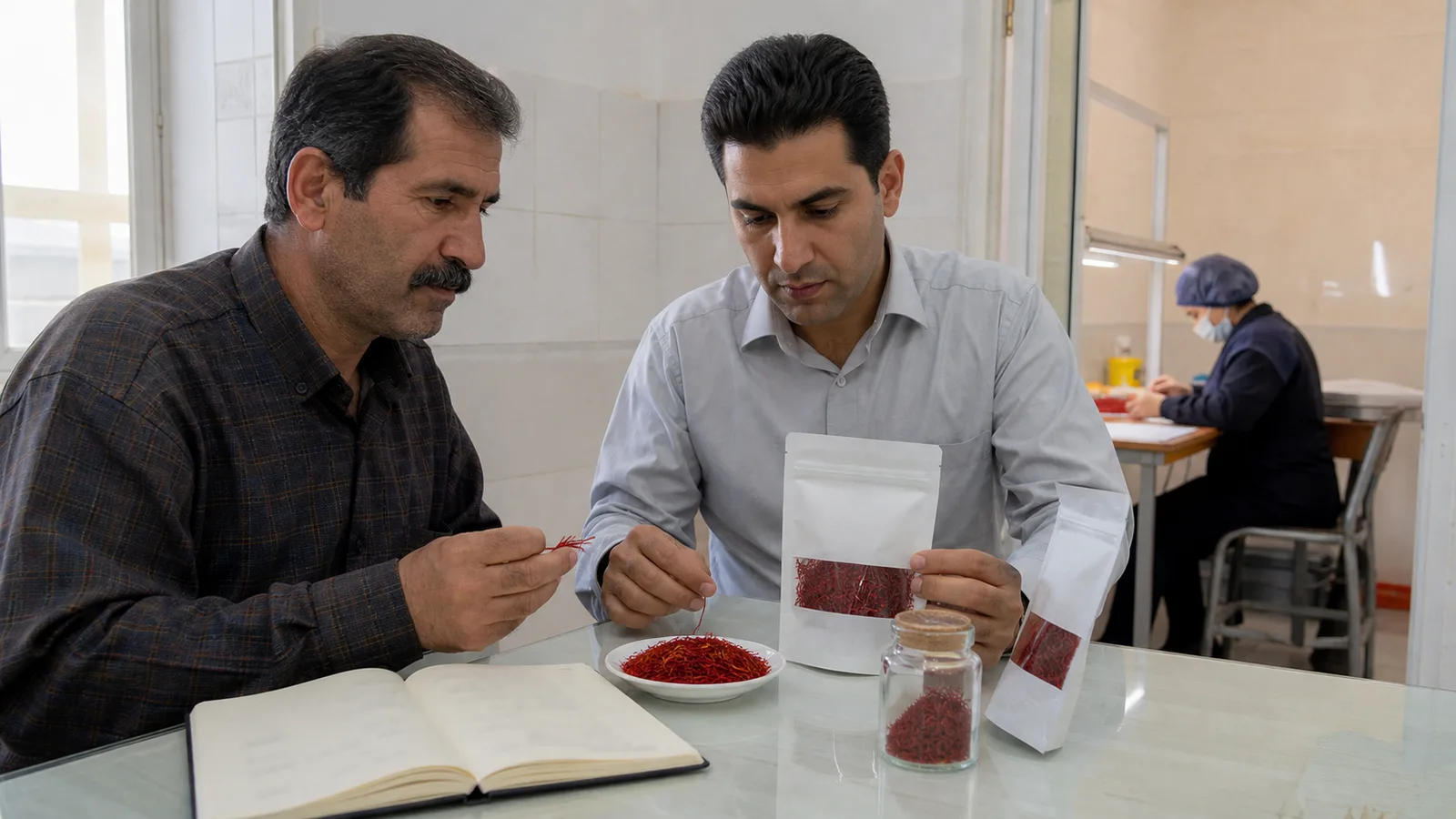
Iranian saffron competitors did not emerge for one simple reason. Archived industry interviews name China, India and Afghanistan most often, then add Spain, Greece, Morocco, Malaysia and Pakistan in different roles. Some were expanding cultivation. Spain was described mainly as an importer, packer and marketer. Others appeared in policy warnings long before their actual output was measured.
What the reports have in common is more useful than the country list. Iranian officials worried about low farm yield, high and unstable prices, anonymous bulk exports, inconsistent post-harvest quality and rules that made exporting harder. Those weaknesses gave other origins and brands room to compete even while Iran supplied most of the world’s saffron.
The figures below come from archived statements published between 2014 and 2022, often without a clear crop year. They explain how the industry understood the threat at the time; they are not current production rankings, prices or tariff schedules.
The original China, India and Afghanistan warning
Gholam-Hossein Shafei, then chairman of the National Saffron Council, said China, India and Afghanistan were joining older competitors such as Spain. He described Iranian output as rising from about 180 tonnes in one year to a forecast near 240 tonnes in the next, an increase of roughly 20–30%.
Shafei also put average yield around 3.5 kilograms per hectare and argued that better infrastructure could raise it. Neither the production forecast nor the yield figure is safe to reuse as a current statistic. They establish the period’s baseline: Iran expected more volume while already questioning its efficiency and market position.
Who the archived sources counted as competitors
Gholamreza Miri, identified as a National Saffron Council vice-president and exporters’ representative, named Afghanistan, China, Greece, Morocco, Malaysia and Spain. He argued that high Iranian prices, amplified by intermediaries, encouraged other countries to cultivate or market saffron.
These countries should not be treated as equal producers. One Khorasan horticulture report called India the second-largest producer at about 9 tonnes per year, but supplied no year or global table. It also confirmed that saffron cultivation was becoming more popular in Afghanistan and Pakistan while denying rumors that premium Iranian corms had been smuggled across the border.
The denial matters. The old translation repeatedly says “onions” or “bulbs,” but saffron is planted from corms. Crocus sativus is sterile and propagated vegetatively; a peer-reviewed botanical account describes it as a male-sterile triploid propagated by corms. A rumor about planting material is not evidence of where a competitor obtained it.
Spain’s role was market access, not simply farm output
Miri described Spain as a net importer that bought Iranian saffron in bulk and sold part of it with Spanish market identity. His concern was not that Spain could outgrow Iran acre for acre. It was that the country had stronger access to customers, packaging and brand recognition, allowing more of the final margin to stay with Spanish traders.
The same interview said Iran had not secured a universal “genetic and geographic” registration for saffron. That phrase combines different legal and technical concepts. A geographic indication protects a defined origin under applicable law; a trademark identifies a business or product; genetic documentation describes plant material. No single registration makes all saffron worldwide “Iranian.” The underlying problem was traceable origin and market identity, also central to the later National Saffron Council branding and traceability plan.
Historic export figures do not form one time series
The nine sources contain several snapshots:
- Miri recalled about 220 tonnes of exports in Iranian year 1384, approximately 2005–06, falling below 150 tonnes by the later interview;
- another interview described production up to 300 tonnes, exports around 240 tonnes worth roughly $400 million and domestic use near 20%;
- Shafei reported 170–200 tonnes harvested from South Khorasan and Khorasan Razavi in one season;
- a Khorasan horticulture official cited $51.346 million in saffron export earnings for an unspecified reporting period; and
- other passages said about 75% of production was exported.
These numbers refer to different years, geographies and possibly customs definitions. The 170–200 tonnes covers two provinces, while the 300-tonne figure is national. The $51.346 million statement lacks a period. They can all remain as historical testimony, but they cannot be blended into a precise trend without the underlying customs and harvest tables.
The same caution applies to the recurring 92% and 95% world-production shares. They show that officials regarded Iran as the dominant producer. A current share requires global data from the same year, not repetition of the largest archived percentage.
Packaging below 10 and 30 grams
Shafei reported strong growth in exports of packages below 10 grams and below 30 grams. The aim was to move closer to the final consumer rather than send all saffron abroad as bulk material.
In that period, he said nominal saffron prices had recovered from about 1.5 million tomans per kilogram to roughly 2–2.3 million tomans. These are old nominal prices with no grade, exchange rate or date sufficient for a present comparison.
Small packaging can retain more brand identity, but it is not automatically profitable. Exporters still need destination-compliant labels, food-contact packaging, moisture protection, traceability, distributor margins and a buyer willing to pay for the format.
Customs and tax obstacles described by exporters
Miri listed a complicated set of historical barriers. Customs instructions requiring foreign-currency commitments were reportedly cancelled or changed, yet exporters still encountered related demands. He also cited a 5% charge on packages above 30 grams, loss of eligibility for export awards and tax-office pressure for farmers’ national identification codes that growers were reluctant to provide.
Those rules help explain why package size appeared in the strategy, but they should not be treated as current law. The source refers to Iranian year 1392 and does not supply the circulars. Any future exporter must check the rules in force for the shipment date rather than rely on this archive.
Miri also alleged that India offered preferential treatment to Afghan saffron while Iranian saffron faced a 38% tariff, and that the United States promoted an Afghan market described as 40 tonnes even though he believed actual capacity was closer to 3 tonnes. These are attributed geopolitical claims from the interview, not verified current tariff or production data.
Quality, drying and microbial control
Several speakers warned that traditional flower handling, stigma separation and drying could introduce microbial contamination or waste. Shafei said a low-cost saffron identification and quality pilot had been completed in three cities, while calling for broader farmer training.
The general quality concern has evidence, but it should not be exaggerated. A peer-reviewed study of 79 saffron samples from major producer countries found microbial contamination markedly lower than in many other spices; it found no Salmonella and only limited counts of several organisms. That does not make handling irrelevant. It shows why testing and controlled post-harvest practice are better than claiming all traditionally handled Iranian saffron is unsafe.
Clean collection surfaces, trained workers, controlled drying, moisture protection and lot testing can strengthen both safety and consistency. The Khorasan official’s call for standard drying and packaging belongs in that practical system.
The saffron identification plan and the unfunded master plan
Shafei linked the three-city pilot to a broader identification programme intended to improve quality and traceability. He also said a comprehensive saffron plan had been approved by the presidency and the Ministry of Agriculture Jihad but remained unimplemented for lack of funding. The stated requirement was 250 billion tomans.
That amount is a historical request, not an active budget. Three duplicate versions of Shafei’s speech at the third national saffron conference also called for agriculture to receive budget priority because saffron supported rural livelihoods in underdeveloped parts of Khorasan.
The policy argument was coherent: production, quality, rural employment and export infrastructure had to be planned together. The sources do not show that the proposed budget was later allocated or that the master plan was completed.
Would the Iran Commodity Exchange solve the problem?
Mohammad Reza Ghodsi, identified as Khorasan Razavi’s horticulture director, proposed routing national and international saffron transactions through the Iran Commodity Exchange. He expected standardized lots, more transparent prices, fewer intermediaries, better fraud control, improved branding, investment and a more efficient distribution network.
Those are potential benefits, not automatic results. An exchange works only if grading is trusted, enough buyers and sellers participate, delivery and warehouse rules are reliable, and off-exchange trade does not simply continue. Requiring every international transaction to use one venue could also create operational and legal questions that the article does not address.
Ghodsi also claimed that World Trade Organization rules give a country producing more than 58% of a product the right to host an international exchange and control production policy or pricing. No such rule appears in the WTO legal text reviewed for this article. The General Agreement on Tariffs and Trade addresses trade disciplines, state trading and equitable shares in certain contexts; it does not award global pricing rights at a 58% production threshold. That claim is removed from the strategy.
Potato replacement in Ardabil and Hamedan
At the national conference, Shafei said some farmers in Ardabil and Hamedan were replacing potato fields with saffron. He did not celebrate the shift without reservation. He asked whether it matched national cropping policy and the long-term needs of agriculture.
That caution is important. Saffron can use less water than some crops, but replacement decisions also affect food supply, rotation, labor, local processing and farm income. A high-value crop is not automatically the right use of every suitable field.
Shafei added that the Netherlands had increased saffron harvests up to fourfold through what the translation called “seed onion” improvement. The source provides no study, farm area or baseline, and saffron does not reproduce from seed in commercial cultivation. The safest interpretation is a claim about improved corm material or propagation, not verified evidence that Dutch national yield quadrupled. It should prompt local corm research, not serve as a benchmark.
From packaging to higher-value products
The sources say Khorasan had enough packaging units but lacked stronger “conversion industries,” particularly products for pharmaceutical, health and cosmetic markets. Shafei and Miri argued that more value should remain in Iran instead of flowing to intermediaries.
One interview suggested foreign-exchange earnings of roughly $700 million could increase as much as sevenfold if barriers were removed and technology improved. The sentence is badly translated and supplies no model; taken literally, sevenfold would approach $4.9 billion. It is an aspiration, not a forecast. Ghodsi separately described exports above $1 billion as a possible goal.
Product development can diversify demand, but it requires research, safety evidence, regulatory approval and a real customer. Mentioning pharmaceutical or cosmetic use does not prove that a saffron ingredient treats disease or that every derivative will be profitable.
Khorasan’s production base still mattered
The competition debate was rooted in rural production. One horticulture report said saffron was grown in 21 Khorasan cities, led by Torbat Heydarieh, Kashmar, Gonabad, Ghaen and Ferdows. It described the crop as particularly important for lower-income families facing drought.
That is why export reform cannot be separated from farm performance. A lower intermediary margin does not help if fields are unproductive; a higher yield does not help if the market cannot absorb the harvest; and a national brand does not help if lots are inconsistent.
A realistic response to Iranian saffron competitors
The combined archives support a practical response:
- publish crop-year production, export and competitor data on a common basis;
- improve corm health, local agronomy and field yield without repeating unverified foreign benchmarks;
- train harvest and drying teams, then verify lots with appropriate quality and microbial tests;
- expand traceability and origin identification beyond a small pilot;
- use small consumer packages where demand and destination rules justify them;
- make commodity-exchange trading optional or mandatory only after grading, delivery and participation are proven;
- remove documented export friction through current law, not archived tariff anecdotes; and
- develop food, cosmetic or other products only with evidence, compliance and buyers.
Iran’s strongest defense is not trying to stop every other country from growing saffron. It is making Iranian saffron easier to trust, identify, buy and use while ensuring more of the value reaches the farms and businesses that produce it. The connected production-yield and export-value review explains why field data and value capture have to improve together. That addresses the real weaknesses behind the old warnings about China, India, Afghanistan and Spain.

![Exporting Saffron to Turkey + Price Guide [Complete 0 to 100]](https://img.rowhanisaffron.com/20260827003933/saffron-export-turkey-quality-inspection.webp)



