


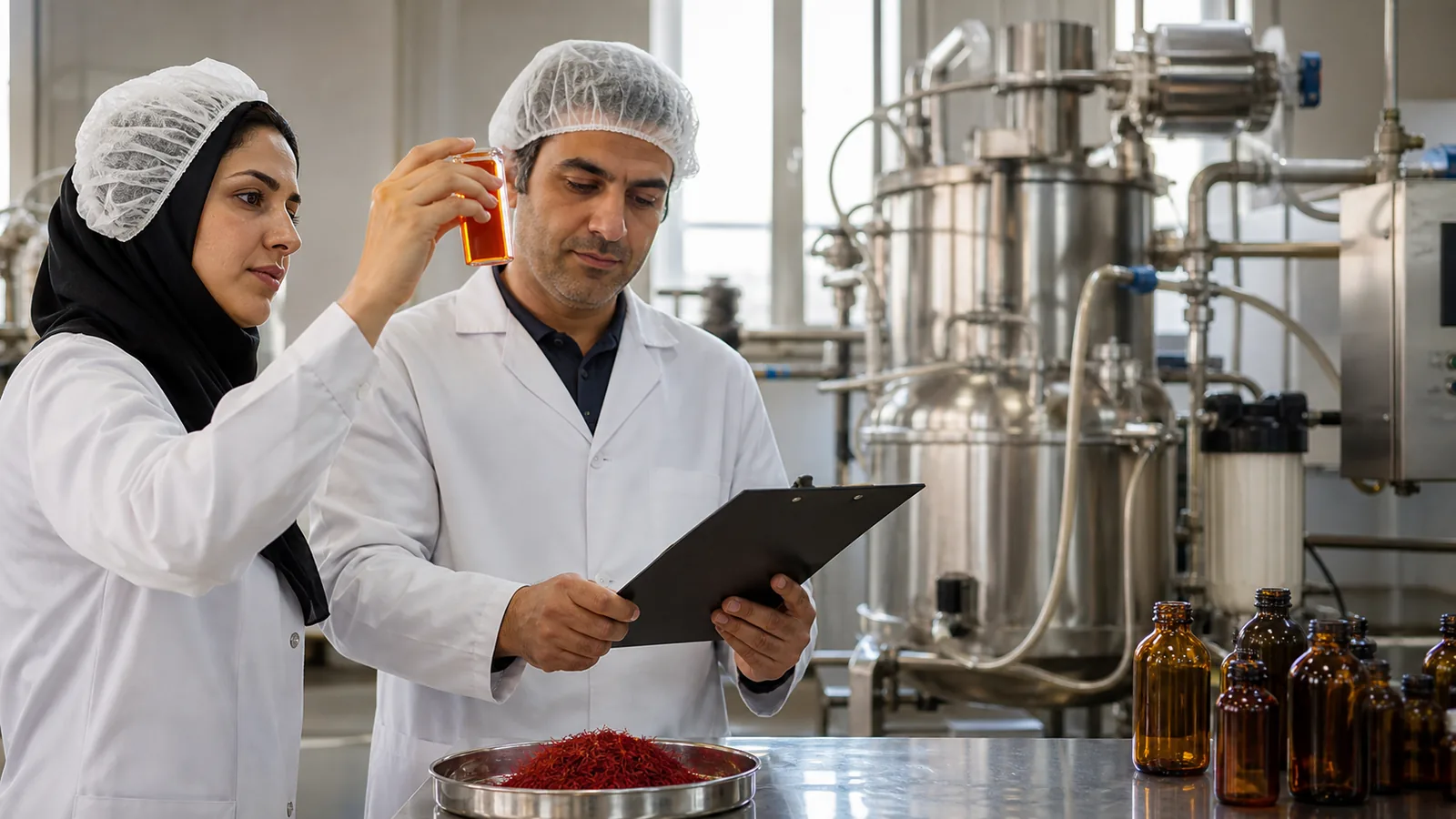
Access to technical knowledge extraction of saffron in Iran was announced in 2015 by the chief executive of a technology company supported by the Vice Presidency for Science and Technology. The claim referred to a commercial saffron extract, not the familiar kitchen method of steeping threads in water. Turning saffron into a repeatable export product requires a defined raw material, controlled process, measured composition, food-safety system, stable packaging and approval for the product’s intended use.
The original article contained useful numbers but was badly damaged in translation. It called Zardband “Yellow Section,” translated the surname Gorji as “Georgian,” and left several sentences incomplete. Those names and claims are repaired here without treating a company announcement as independent proof of a first invention, an approved health product or a current export programme.
What the Iranian company announced
The report said that Zardband, described as a technology company backed by the Vice Presidency for Science and Technology, had developed saffron-extraction technology for the first time in Iran. Gorji, its chief executive, said part of the finished product was being exported to Switzerland.
In the first phase, the company reportedly sent 1,000 glass bottles, each containing 15 millilitres of saffron extract, to Switzerland. A second shipment was said to be due soon. The United States was identified as the eventual target market, with preparatory work under way.
Gorji also described a plan to export 20,000 bottles a month at a stated price of US$6 per bottle. He said market demand exceeded the company’s capacity and asked for greater support and facilities so the operation could expand. The surviving text says the project could create direct work and indirect opportunities for hundreds of people, but the number of direct jobs is missing and should not be guessed.
The article closed with the advantages then associated with recognised knowledge-based companies, including tax exemptions, banking facilities and other incentives. Gorji argued that such support should be used in line with each company’s technical objectives. None of those 2015 terms should be presented as a current entitlement without checking today’s rules and the company’s present status.
“First in Iran” is an attributed claim
A first-of-its-kind claim needs a clear boundary. It might mean the first process developed by that company, the first supported by a particular programme, the first at a stated scale, or the first product of a particular specification. The old report does not supply a patent, process dossier, independent technical review or search of earlier Iranian work.
The safe wording is therefore precise: Zardband’s chief executive said in 2015 that the company had achieved the technology for the first time in Iran. That preserves the announcement without converting it into a verified national invention claim.
The same limit applies to export. Sending bottles to Switzerland would establish a shipment if supported by commercial and customs records. It would not, by itself, prove that the extract had been authorised for every food, supplement, cosmetic or pharmaceutical use in Switzerland.
Start by defining what the extract is
“Saffron extract” is not one universal product. A water-soluble colour and flavour ingredient, a standardised supplement ingredient, a research preparation and a cosmetic ingredient can begin with the same spice but require different composition, controls, claims and regulatory files.
The product specification should identify the plant material and part used, extraction medium, concentration basis, carrier or other ingredients, physical form and intended use. “Fifteen millilitres” describes package volume, not the amount of saffron in the bottle or the concentration of any marker.
That identity also determines which evidence is relevant. Codex CXS 351-2022 sets requirements for dried saffron floral parts. It is useful for qualifying the incoming spice, but it is not a finished-extract specification.
Raw saffron controls the starting point
A reproducible process cannot rescue unidentified or inconsistent raw material. Each incoming lot should be linked to supplier, origin, harvest or processing period, grade and laboratory results. Moisture, foreign matter, colour strength and evidence of adulteration matter before extraction begins.
Crocin compounds contribute much of saffron’s colour, picrocrocin its characteristic bitterness and safranal much of its aroma. Drying and storage affect that profile. Two lots of equal weight can therefore behave differently in the same vessel.
The site’s guide to crocin in saffron explains one important marker. Commercial extract control needs a wider fingerprint and an authenticity strategy, because a single high reading does not necessarily prove that the full profile came from genuine saffron.
Technical knowledge means a controlled process
A laboratory method becomes manufacturing knowledge only when another trained operator can repeat it at the intended scale. The process description needs controlled ranges for raw-material preparation, ratio of material to extraction medium, time, temperature, mixing, separation, concentration and finishing.
Those variables affect different parts of the extract in different ways. A change that improves colour recovery may not preserve the same volatile aroma. More severe conditions can increase throughput while changing the chemical profile. The goal is not simply to make the darkest liquid; it is to meet the declared specification consistently.
Scale-up adds problems that a bench beaker does not show. Mixing can become uneven, heating and cooling take longer, filters foul, volatile compounds are lost, and cleaning becomes a production operation of its own. The company needs an approved batch record, calibrated equipment, in-process limits and a documented response when a result leaves the allowed range.
Standardisation has to measure more than one attractive number
A 2023 study of commercial products, available through PubMed Central, found meaningful variability among saffron extracts and examined crocin-isomer and picrocrocin profiles as possible standardisation criteria. Its central lesson is practical: repeatable extract quality needs a suitable analytical fingerprint, not just a marketing statement about saffron content.
The finished specification might include identity, dry matter or concentration, selected marker ranges, solvent residues where relevant, microbiological limits, contaminants, additives and sensory or physical properties appropriate to the use. The method, sampling plan and acceptance range should be defined before production results are seen.
Yield must also be expressed clearly. Extract volume, total solids, recovered marker and acceptable finished bottles answer different questions. Reporting only the number of bottles hides dilution, rejected batches and variation in incoming saffron.
Food safety and traceability continue after extraction
An extract can concentrate desirable components, but processing can also concentrate contaminants or introduce new hazards. Water quality, approved processing aids, food-contact equipment, cleaning, environmental hygiene and employee practice belong in the production design.
Every bottle should trace back through its finished batch to the incoming saffron lots. A useful record connects receipt, sampling, release, processing parameters, laboratory results, filling, closure, label version, storage and shipment. If a problem appears in Switzerland or another market, the producer must be able to identify the affected units rather than recall everything it has ever made.
Packaging is part of stability, not decoration. Light, oxygen, temperature and the closure system can change colour, aroma or concentration over time. Shelf life should follow a protocol using the actual formula, bottle and storage conditions, with acceptance limits set in advance.
The United States target required a product-specific route
The old report called the American market the ultimate goal. In the United States, the route depends on what the product is and how it is used. The FDA currently lists saffron under food colour-additive regulation, but that does not automatically authorise every concentrated extract, formulation, supplement claim or drug use.
An exporter has to settle the ingredient’s identity, intended technical effect, conditions of use and label before deciding which requirements apply. A health claim can change the regulatory problem. Evidence that an ingredient contains crocin or safranal is not evidence that the finished bottle prevents or treats disease.
The same discipline applies to Switzerland. A buyer’s order, customs clearance, food-market acceptance and approval for a particular claimed use are separate records. The 2015 article establishes only what the chief executive reported; it does not include those documents.
Capacity and foreign-exchange claims need a full cost model
The planned 20,000 monthly bottles and US$6 price describe a sales target. They do not show the amount of saffron required, saleable yield, buyer discount, rejected product, freight, testing, packaging, finance cost or net foreign exchange retained by the producer.
A scale decision should follow a mass balance for each batch: saffron in, acceptable extract out, recovered or discarded material, losses and rework. Production capacity must include the slowest step, which may be testing, filtration, cleaning or filling rather than extraction itself.
Support is most useful when it removes a demonstrated bottleneck. A loan for a larger vessel will not help if the laboratory cannot release batches, the bottle fails stability testing or the target market has not accepted the ingredient. Technical assistance, validated methods, quality staff and regulatory work may create more usable capacity than equipment alone.
What would verify the 2015 milestone today
- the product identity, intended use and complete specification;
- a dated process dossier and evidence of repeatable commercial batches;
- independent or competent laboratory results using validated methods;
- traceable records for the 1,000-bottle Swiss shipment and any second shipment;
- the actual status of the proposed US route and claims;
- current production, sales and employment figures separated from targets;
- current knowledge-based-company recognition and support terms.
The real value of extraction technology is not that saffron disappears into a bottle. It is that a variable agricultural material becomes a defined product that can be made again, tested, traced, stored and used as promised. Zardband’s 2015 announcement belongs in that industrial story, but its shipment, scale and “first” claims should remain dated until the records behind them are available.
The Zardband, Gorji, first-in-Iran, Switzerland, 1,000-bottle, 15-millilitre, second-shipment, United States, 20,000-per-month, US$6, demand, employment and knowledge-based-support statements are retained as attributed claims from the site’s 2015 report. Codex, FDA and extract-standardisation sources were reviewed on 29 August 2026; no historical product or export status is represented as current.

![Exporting Saffron to Turkey + Price Guide [Complete 0 to 100]](https://img.rowhanisaffron.com/20260827003933/saffron-export-turkey-quality-inspection.webp)



