


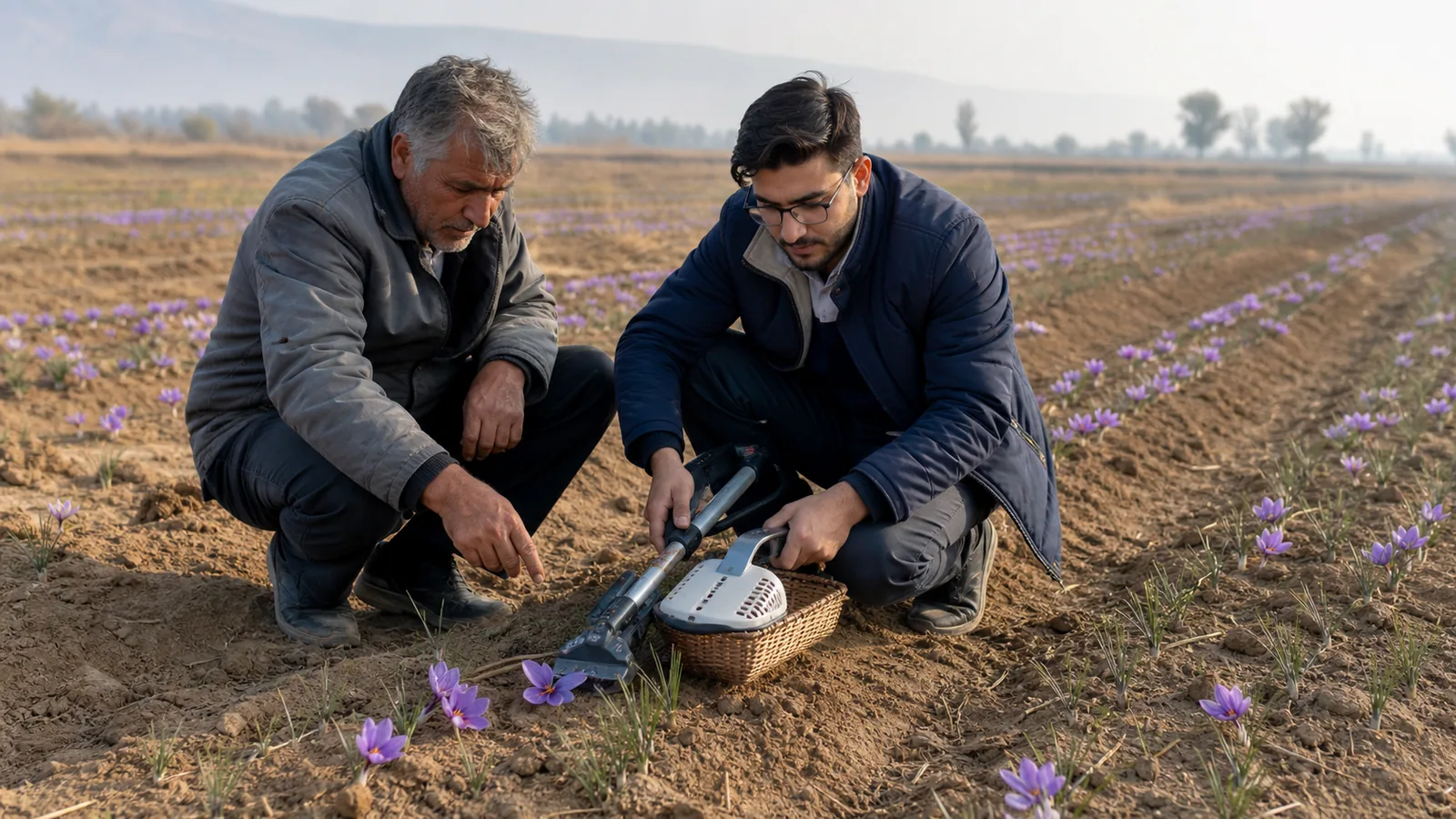
“Saffron should be mechanized harvest” sounds like a simple yes-or-no proposition. The field decision is more careful. A saffron harvester can reduce bending and help a farm cope with a short flowering rush, but a machine that misses buds, cuts leaves, crushes flowers or forces unsuitable row spacing may cost more than it saves. On small Khorasan plots, employment and access to equipment matter as much as speed.
The historical interview on this page did not call for replacing every flower picker. It argued that harvest mechanisation could damage rural employment and that planting and other operations were better early targets. Current engineering research supports testing several forms of assistance, from corm handling to flower collection and stigma separation, rather than treating one fully autonomous machine as the only modern option.
What the original Khorasan interview said
The article was published here in 2015 from a poorly translated ISNA report. It quoted Ramin Esmi, identified as the saffron specialist at Khorasan Razavi Agricultural Jihad. His central concern was social as well as technical: mechanising the saffron harvest could reduce employment in a crop that supports rural and border communities.
Esmi described saffron as a smallholder crop and put the average provincial holding at 6,000 square metres, or 0.6 hectare. In his view, mechanised collection was more suitable for crops grown over broad, continuous areas. That distinction matters. A large machine can lose much of its advantage when it must be transported among small, irregular fields or turned repeatedly in short rows.
The report also said there was not yet a finished machine for mechanised saffron planting. Construction and development were continuing, with faults corrected as more tests became possible. Because saffron flowers for only a short period, it described an annual testing window of roughly 20 days. That was a development constraint, not a claim that every saffron harvest everywhere lasts exactly 20 days.
According to the interview, the Saffron Production Council had chosen mechanised planting as a priority. Instead of removing harvest jobs, the proposed strategy was to reduce production cost by improving yield per unit area. Esmi also called saffron knowledge indigenous and urged domestic manufacturers to improve product quality inside Iran.
The value of local knowledge is real, but the old translation overreached when it implied that other countries did not understand how saffron grows. Saffron is cultivated and studied in Iran, India, Spain, Italy and other countries. Khorasan growers possess deep experience of their own soils, climate, corm cycles and harvest organisation; engineering improves when that experience is measured and built into a design.
A saffron harvesting machine solves only one stage
People often use “saffron harvesting machine” for equipment that performs different jobs. A field harvester locates and detaches flowers. A collector carries them away without compression. A separator opens the flower and separates the red stigmas from petals and stamens. Drying and sorting equipment begins another stage. Success at one stage does not prove that the full process is automated.
This distinction protects quality. A fast flower picker is not useful if its collection system bruises the crop or delivers a mixed mass that cannot be separated and dried promptly. A stigma separator may save indoor labour even while flowers are still picked by hand. A planting aid can standardise depth and row placement without changing the harvest workforce. Each machine needs its own purpose and test.
A 2020 technical chapter on mechanisation of saffron production describes a much broader sequence: corm digging and sorting, soil preparation, planting, crop protection, flower harvest and stigma separation. Existing general farm tools can handle some early operations, while planting and harvest require crop-specific equipment. The authors also note the potential for mechanised harvest and separation to reduce labour cost and microbial contamination. Potential is not the same as a field guarantee.
Why a fully automatic saffron harvester remains difficult
Saffron flowers sit close to the ground among narrow leaves. Bud height and opening stage vary, the soil surface is uneven, and a valuable stigma is protected by delicate floral tissue. A machine has to identify the flower, detach it at an appropriate point, avoid the leaves and move it into a container without excessive pressure. It must do this quickly enough to justify its cost.
Field layout adds another problem. Row spacing and plant density developed for hand work may not leave room for wheels, a robotic platform or a wide picking head. Changing the field for a machine can reduce the planted area or alter agronomy. The benefit must therefore be calculated for the whole production system, not just the seconds required to pick one flower.
A peer-reviewed 2021 study proposed a portable, battery-powered semi-automatic saffron harvesting device intended to reduce bending while remaining affordable. The paper was a proof of concept with preliminary tests. Its review of earlier autonomous systems reported limitations in success rate, initial cost, portability and field-space requirements. That is a useful description of the engineering problem, not evidence that one model is ready for every commercial field.
Research published through the Indian Council of Agricultural Research has likewise described mechanical devices and field tests for saffron harvesting. The work shows that supporting human labour is a legitimate mechanisation path. A small tool that removes the most punishing motion can be more practical than a machine designed to remove the worker altogether.
What a field trial must measure
A video of a machine collecting flowers proves movement, not commercial performance. The trial needs a representative part of the farm, a manual comparison and enough repetitions to include changes in soil, flower density, opening stage and operator experience. The farm should record labour time for setup, collection, cleaning and repair as well as the time spent moving down a row.
- count flowers available, collected, missed, cut incorrectly and lost in transfer;
- check damage to flowers, leaves, corm rows and the soil surface;
- compare usable dry stigma recovered from equal field areas, not flower count alone;
- measure total labour hours, including transport, adjustment, sorting and cleaning;
- inspect foreign matter, compression, delay to separation and drying, and the final lot quality;
- calculate ownership or service cost over realistic annual operating hours, with repairs and downtime;
- ask workers whether the tool reduces difficult posture and whether safe training and guarding are adequate.
The comparison should be made on more than one morning. Closed buds, open flowers and wet or dry surfaces may behave differently. A trial conducted only at the easiest crop density can hide missed flowers or blockages that appear during the peak.
Mechanisation does not automatically raise yield per hectare
A machine can raise output per worker. Yield per hectare is a separate measure: the dry saffron recovered from a defined land area. Planting material, corm health, field age, spacing, soil, irrigation, weeds, nutrition, weather, harvest losses and post-harvest handling all contribute to that result.
The original interview’s proposal to control cost through better yield per unit area therefore needs diagnosis before equipment is chosen. If the constraint is uneven planting depth, a planting machine may help. If old or diseased corms are the problem, mechanised picking will not correct it. If flowers wait too long before separation and drying, a better collection schedule or processing line may recover more saleable quality than a faster field harvester.
The completed guide to machines used from saffron harvest to sale separates field picking from transport, separation, drying and packing. Farms considering a purchase can use that process map before comparing equipment.
Jobs and worker safety belong in the calculation
The concern about rural employment should not be dismissed as resistance to technology. Peak saffron work brings income to households, and a sudden move to expensive owner-operated machinery can shift value away from people who depend on those days. Small farms may also be unable to justify a machine that works for only a brief season.
Manual harvest has costs that deserve equal attention. Repeated bending, early starts and intense work during a compressed flowering period can be physically demanding. Labour shortages may leave flowers unpicked, while rushed indoor separation can delay drying. A fair assessment asks whose work disappears, whose work becomes safer and who receives the savings.
There are choices between individual ownership and doing nothing. A cooperative, contractor or village service can spread the cost across several holdings. Lightweight semi-automatic tools can assist pickers rather than replace a crew. Training, maintenance and quality-control roles may grow around a new system. None of those outcomes is automatic; the service model must be designed alongside the machine.
The site’s earlier analysis of saffron harvest cost and machine payback shows why a percentage claim is not enough. A farm needs its own labour hours, wages, flower density, usable output, machine availability and financing cost before it can calculate a saving.
Quality must survive the faster workflow
Mechanisation is successful only if the final saffron remains suitable for sale. Containers should not compress or overheat fresh flowers, contact surfaces must be clean and suitable for food handling, and the collected crop must reach separation and controlled drying without an avoidable delay. Equipment also needs a cleaning plan that prevents soil, plant debris and residues from moving into the next lot.
FAO’s 2025 visit to Mashhad farms and processors highlighted both traditional harvesting and modern processing while focusing on quality integrity and post-harvest practice. The two are not opposites. Local harvest knowledge can define the gentle handling, timing and acceptance limits that a new device must reproduce.
Batch testing remains necessary after a successful field trial. The Codex standard for dried saffron provides an international baseline for identity, styles, quality, contaminants, hygiene and labelling. A manufacturer should not advertise a quality improvement until comparable lots show it.
So, should the saffron harvest be mechanised?
It should be mechanised where a defined tool solves a measured constraint without causing greater agronomic, quality or social loss. That may mean mechanised planting on suitable fields, a portable aid that reduces bending, a collection system, an indoor separator or a coordinated processing line. Full autonomous flower picking is only one option.
For a small Khorasan holding, the sound first step is a field trial and a service-cost calculation, not a universal promise. Preserve what experienced pickers know, measure what the machine changes and judge the result by usable saffron, worker conditions and whole-season cost. Mechanisation is valuable when it fits the crop and the community—not merely when a prototype can move through a row.
The Ramin Esmi, ISNA, employment, 6,000-square-metre holding, wide-field suitability, unfinished planting machine, roughly 20-day testing window, Saffron Production Council, yield-per-area, indigenous-knowledge and domestic-quality statements are retained as claims from the historical interview published here in 2015. They are not represented as current programme status or universal farm data. Research and FAO/Codex sources were reviewed on 29 August 2026.

![Exporting Saffron to Turkey + Price Guide [Complete 0 to 100]](https://img.rowhanisaffron.com/20260827003933/saffron-export-turkey-quality-inspection.webp)



