The claim that 75% of the price of saffron is harvested costs came from a Khorasan Razavi official in 2015. It captured a real problem—saffron demands concentrated hand labour—but the surviving report does not define the denominator. The figure should not be read as 75 percent of today’s retail price, or even as a universal share of farm production cost.
A reader searching for “the gathering of saffron price” is asking the useful question behind the awkward phrase: how much does collecting and processing the flowers add to the cost of the finished spice? The answer depends on what is counted as harvest, the wage and crop year, field layout, yield, family labour, separation and drying, and whether equipment is owned, hired or shared.
What the original report said
The post reported an ISNA interview with Najafgholi Salehi, identified as a deputy for plant-production improvement in the Khorasan Razavi Agricultural Jihad organisation. Salehi said 75 percent of saffron’s price related to harvest costs.
He argued that mechanising the harvest could lower the finished cost and benefit both producer and consumer. Building suitable machines was technically possible, he said, but expensive and difficult at that time. The report also mentioned meetings with France and Germany about cooperation, with no final agreement reached. If the other parties agreed, Salehi said, finance for purchasing the machines would be available.
The last translated sentence is incomplete, but its intention is clear enough: more of the farmer’s saffron work should become mechanised. None of those comments establishes that an imported machine was later agreed, purchased or successfully used. They remain a record of the 2015 proposal.
Why the 75-percent figure needs a denominator
“Price” can refer to farm-gate value, processor purchase price, export price or a small retail pack. Harvest cost might mean flower picking alone, or it might include repeated field passes, transport, stigma separation, drying, sorting and the supervision around all of them.
Family labour creates another accounting choice. A cash ledger can show no wage when relatives do the work, but the time still has an economic value and another possible use. Machinery can also look inexpensive if depreciation, interest, maintenance, fuel, cleaning, storage and idle months are omitted.
To reconstruct a cost share, use one farm and one season. Add every harvest-related cash and non-cash cost, then divide by a clearly named base such as total production cost—not by the final shop price in another country. Show both numbers. Without that information, 75 percent is an attributed historical claim rather than a reusable formula.
Which tasks make saffron harvest expensive
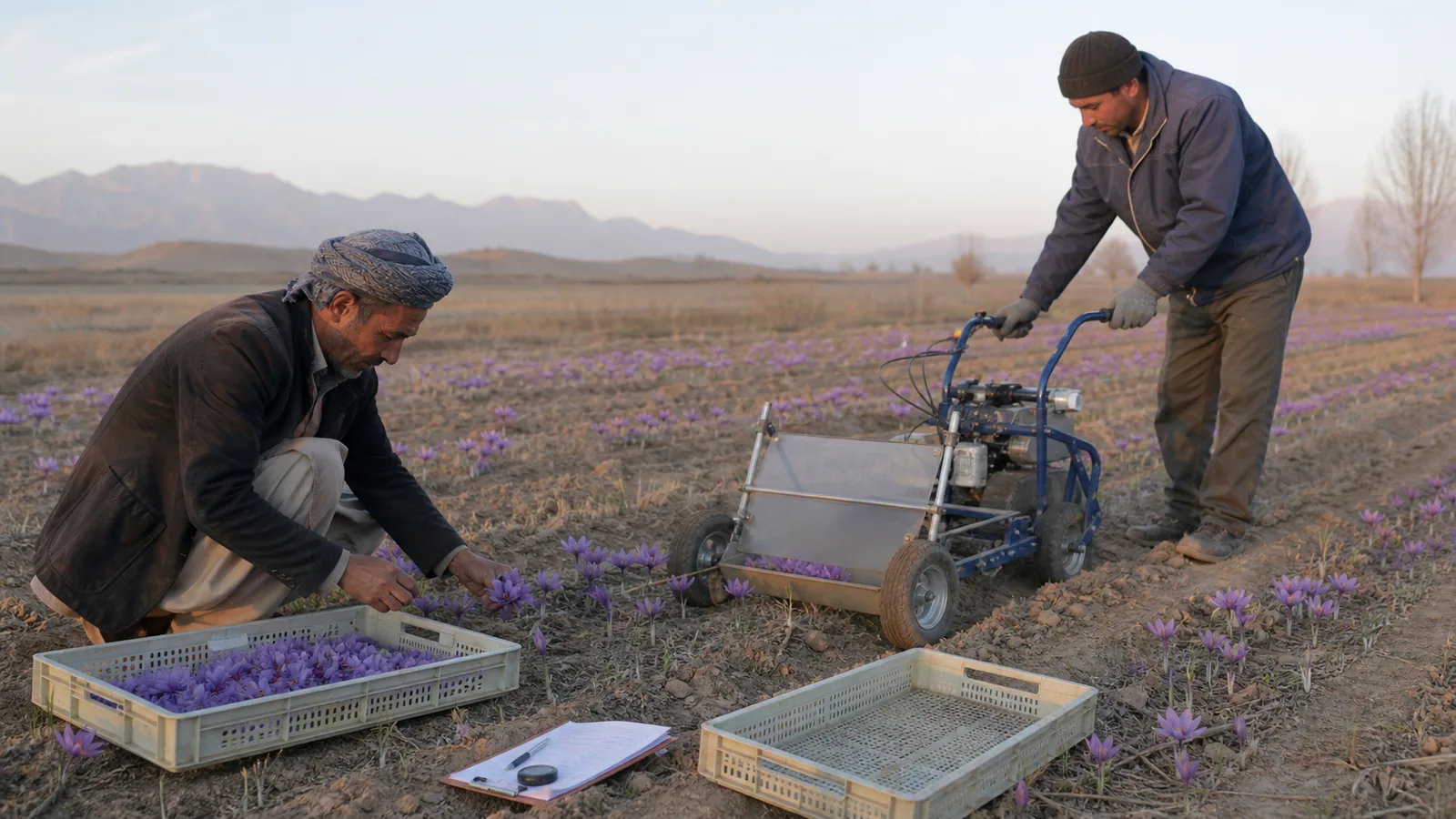
Flowers emerge over a concentrated period rather than all at once. Workers make repeated passes through the field, bend to collect low blooms and handle them gently enough for the next stage. The flowers must then be moved in shallow containers and processed promptly.
Field collection is only one labour peak. Each flower has to be opened so that the three red stigma branches can be separated from the rest. The fresh stigmas then need controlled drying, cooling, inspection, weighing and lot storage. A machine that gathers flowers does not automatically perform those later operations.
A study of technical efficiency on saffron farms in Gonabad described labour shortages and high expenses for hand weeding and flower harvesting as notable production challenges. The peer-reviewed Gonabad farm study is useful evidence that labour pressure is real, but its figures should not be copied into a different province or year as a universal cost ratio.
Our guide to the complete saffron harvesting steps follows the work from a harvest-ready bloom through stigma separation, drying and sealed storage. Keeping those stages distinct is essential when deciding what a machine can actually save.
Mechanisation is not one machine
There are at least two unusually difficult operations: detaching and collecting the flower in the field, and separating the red stigmas indoors. They need different engineering. Equipment may also assist with field preparation, planting, cultivation, transport, drying or sorting without touching the flower-picking stage.
A field harvester must work close to the soil, follow uneven ground and avoid damaging corms, leaves, unopened buds and the flowers it collects. Bloom height and row geometry vary. A machine designed around uniform beds may perform poorly in an older field planted for hand work.
Stigma separation presents another problem. Flowers differ in size, shape and orientation. A cutting or vision system must locate the right part accurately while keeping unwanted plant material out of the saffron. A prototype can demonstrate a mechanism without proving commercial capacity, hygiene or economic return.
An Iranian Agricultural Engineering Research Institute project, indexed by FAO AGRIS, evaluated flower-harvesting and processing machines in 2014. It reported specific prototype capacities and estimated payback periods under its assumptions. Those results show that economic evaluation is possible; they do not guarantee the same performance on another farm.
What a fair hand-versus-machine test measures
A useful trial places the equipment and a skilled hand crew in comparable field sections during the same bloom. It records more than speed:
- flowers available, collected, missed and damaged;
- unopened buds, leaves or corms affected;
- kilograms of flowers handled per worker-hour and machine-hour;
- labour needed to operate, clear, clean and transport the machine;
- soil, slope, row spacing, flower height and moisture conditions;
- delay from collection to stigma separation;
- foreign matter, bruising, microbial and final quality results;
- usable dried saffron obtained from each method;
- capital, interest, energy, repair, storage and training costs.
The result should be expressed per hectare, per kilogram of flowers and per gram of acceptable dried saffron. A machine that picks quickly but misses a valuable share of blooms may cost more than it saves. One that reduces bending or solves a labour shortage can still be worthwhile even when its hourly cash saving is modest.
How to calculate whether a harvesting machine pays
Start with the annual cost of ownership: depreciation over a realistic life, financing, insurance where applicable, storage and fixed maintenance. Add operating labour, energy, consumables, cleaning and repairs. If field rows must be changed, include that transition.
Then calculate the value of labour genuinely displaced, not the total harvest wage. Operators, loaders and people separating stigmas may still be needed. Add the value of flowers collected in time that would otherwise have been lost, but subtract damage, misses and any reduction in dried-lot value.
Divide the net annual saving into the full investment only after testing more than one harvest day. Peak bloom can make a machine look exceptionally productive, while a sparse day may reveal long travel and setup time. Weather, labour availability and annual yield should be tested as cautious and optimistic scenarios.
Small farms may not have enough annual machine-hours to justify individual ownership. A contractor, cooperative service or rental pool can spread the capital over more hectares. Shared equipment still needs booking rules, trained operators, cleaning records, transport arrangements and responsibility for damage.
Quality and hygiene belong in the cost model
Lower labour cost is not a gain if the resulting lot contains more soil, bruised flowers or foreign material. Food-contact surfaces should be cleanable, and flowers should not collect in a deep hot mass while the machine continues across the field. Collection containers and the indoor processing line have to keep lot identity intact.
Mechanisation may reduce repeated handling and make timing more consistent, but that benefit has to be measured. A 2020 technical review of saffron production mechanisation discusses the potential to lower labour and contamination while also noting that specialised planting and harvesting equipment remains less developed than machinery for general field tasks.
Final acceptance should compare moisture, foreign matter and the agreed quality characteristics of dried lots. Faster flower collection has limited value if separation or drying becomes the new bottleneck.
Why partial mechanisation may be the better first step
A farm does not have to jump from hand picking to an autonomous harvester. Adjustable collection aids, shallow transport systems, ergonomic workstations, controlled dryers and better material flow can remove delay and strain from particular stages.
Field design also matters. Uniform bed width, accessible paths and consistent planting depth can make future equipment easier to use. Our report on an Iranian saffron harvesting-machine prototype shows how one device depended on row width, ground level and adjustable picking height. That page owns the prototype’s mechanism; this one owns the cost decision.
Begin with the bottleneck the farm actually has. If flowers are collected on time but stigma separation runs late, a field picker will not solve the main problem. If labour cannot cover peak bloom, collection assistance may have the highest value. If drying is inconsistent, a documented drying process can protect more saleable quality than a faster harvester.
How producer and consumer can both benefit
Salehi’s stated objective was lower finished cost for the producer and, eventually, the consumer. That outcome is possible only if the equipment reduces total cost or loss without transferring unacceptable risk to workers, fields or quality.
A grower should see the result through higher net return, reliable harvest capacity or less exposure to a short labour market. A processor should receive cleaner, timely flowers in predictable lots. A buyer should receive consistent saffron, not merely a story about advanced machinery. Any consumer saving depends on the rest of the supply chain; it cannot be inferred from one farm’s reduced picking cost.
The 75-percent headline therefore remains useful as a question, not a timeless answer. Harvest labour is a major part of saffron economics, and mechanisation deserves serious testing. The safe decision is to define the cost base, separate each operation, run a field comparison and calculate return from acceptable dried saffron. Only then can a machine be called cheaper than skilled gathering.
The 75-percent, Najafgholi Salehi, France/Germany, machine-development and purchase-finance statements are retained as claims from the site’s 2015 ISNA report. AGRIS and peer-reviewed mechanisation research were reviewed on 29 August 2026; no historical agreement or cost share is represented as current.