


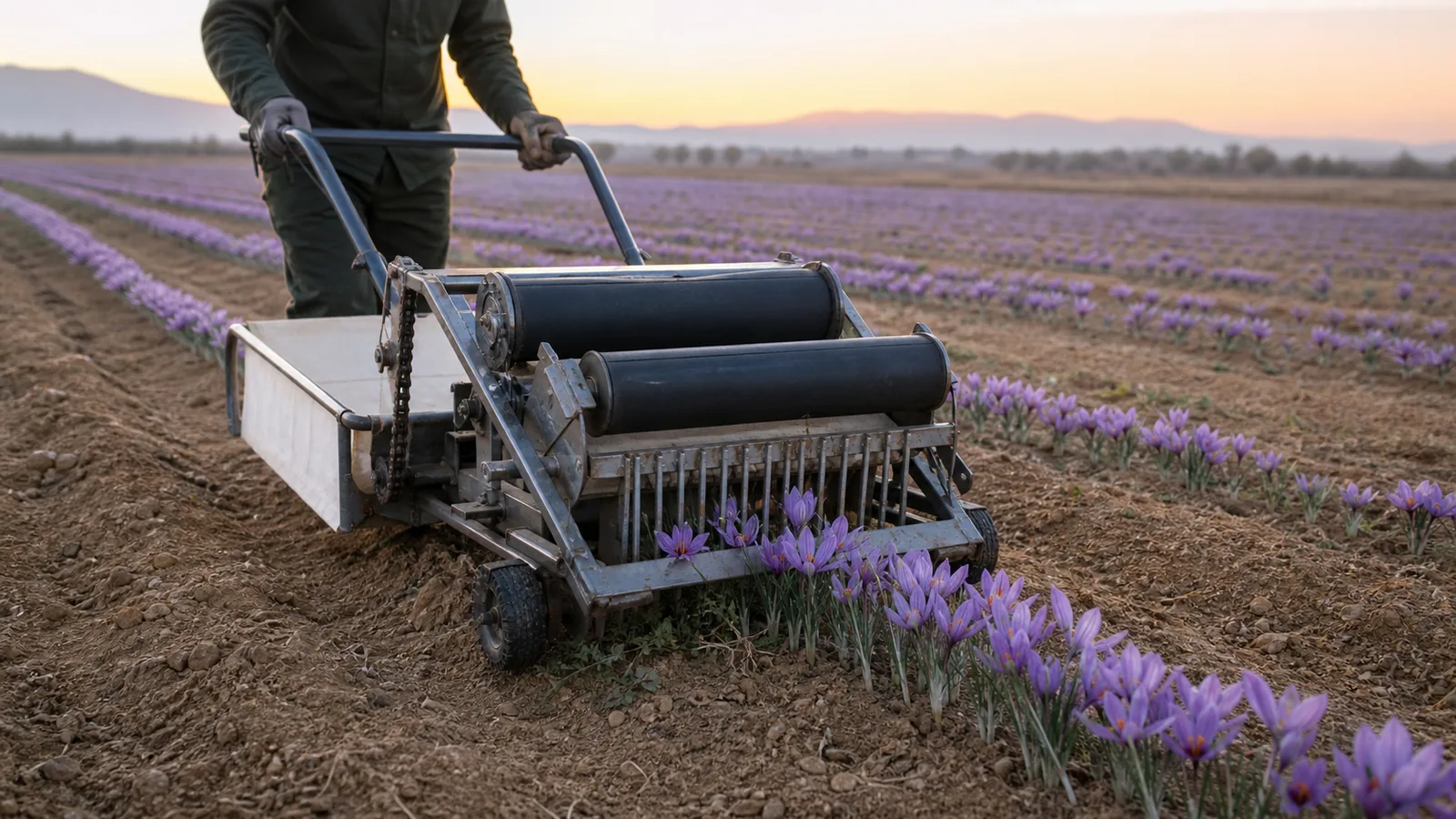
Making saffron harvesting machine in Iran is an engineering challenge shaped by the flower itself. Saffron blooms close to the soil, the stems are delicate, and the crop may need to be collected quickly during a short flowering window. A useful machine therefore has to detach and gather flowers without crushing them, while moving through a field whose row spacing and flower height match the machine.
A 2017 Iranian prototype approached that problem with two counter-rotating parts: a slotted, rubber-covered carousel at the front and a smooth roller behind it. The concept was simple enough to be driven by the machine’s wheels, but it depended on careful field preparation and precise adjustment.
How the Iranian saffron harvesting machine was designed
The front carousel—called the “nose” in the translated project report—was built from spaced rods. A saffron stem could enter the gap between those rods as the machine advanced. Behind it sat a smooth cylindrical roller. Both cylinders ran across the direction of travel rather than along it.
The two surfaces rotated in opposite directions. Their contact point was intended to meet the plant below the flower. As the slotted carousel guided a stem backwards, the smooth roller helped detach the bloom. The flower was then thrown towards a cloth collector behind and beneath the roller, ready to be taken to the next stage of processing.
Rubber on the rotating surface was meant to provide grip without forcing the flower through a hard metal pinch point. The report did not publish bruising, collection-rate or field-loss measurements, so this should be understood as the design logic of a prototype, not proof of commercial performance.
A wheel-driven mechanism matched to walking speed
A chain-and-gear transmission connected the rotating mechanism to the carrier wheels. That made carousel and roller speed rise or fall with the machine’s forward movement. At approximately normal walking speed, the flower-handling parts were therefore intended to stay synchronised with travel rather than operating at one fixed rate.
The front carousel was designed to turn faster at its perimeter than the rear roller. Its higher position and greater surface speed helped send detached flowers backwards onto the collection cloth. Height at the front wheel and the clearance between carousel and roller could be adjusted to meet flowers at the intended point on the stem.
Why the chassis mattered
The project developer, named in the translated source as Mostafa Khojastanjand, described the chassis as a critical part of the design. It had to be rigid enough to keep the spacing between components stable. Flex in a compact frame could alter the gap between the carousel and roller and prevent the mechanism from working consistently.
Weight also served a practical purpose. Because the prototype relied on wheel rotation to drive its chain transmission, the frame needed enough downward force to keep the wheels in reliable contact with the ground. A wheel that lifted or slipped would interrupt both forward movement and flower-picking speed.
That creates a trade-off. A heavier chassis may improve traction, but it can also increase soil pressure and make the device harder to manoeuvre. A production design would need to balance grip, stability, transport weight and field compaction rather than treating maximum weight as an advantage.
The field had to be prepared for the machine
This prototype was not designed to enter any existing saffron field. Its useful working width was reported as 76 centimetres, while the total width including the wheels was about 120 centimetres. The suggested planting width was therefore 70 centimetres, leaving the crop inside the working path and room for the wheels to travel beside it.
Uniform planting depth was equally important. Corms set at inconsistent depths can produce flowers at different heights, making it difficult for one carousel-and-roller setting to meet every stem below the bloom. The field also needed a level surface so the front mechanism would not rise and fall unpredictably.
The developer noted that irrigation scheduling could influence the timing of flowering. In practice, water, soil temperature, corm condition and local weather all affect emergence, so irrigation cannot guarantee one perfectly uniform bloom height. It can, however, be part of planning a harvest window.
What the prototype tried to solve
Hand picking is selective and gentle, but it is labour-intensive. The Iranian design tried to preserve the whole flower while reducing repeated bending and matching collection speed to the machine’s travel. It also used separable components so fittings could be changed as the geometry developed, and the first version was conceived as a human-powered wheeled machine to keep cost and complexity down.
The device addressed flower collection only. Detaching the valuable red stigmas, drying them correctly, grading the dried spice and protecting it from moisture still require separate operations. Mechanising one stage does not turn harvesting into a fully automated process.
How this design fits wider saffron-harvester research
The Iranian prototype is one of several approaches explored by engineers. A 2014 paper described a mechanical saffron flower harvesting system. Other researchers have tested an autonomous harvesting vehicle and a portable gripper-and-vacuum collector. These projects use different ways to locate, detach and collect flowers, but they face the same fundamental questions:
- Can the machine collect flowers without damaging them or the corm?
- How many open flowers does it recover, and how many does it miss?
- Does it work when flower height, soil level and row geometry vary?
- Is it faster and less costly than hand picking under real field conditions?
- Can the collected flowers reach stigma separation and drying quickly enough?
A photograph or working mechanism cannot answer those questions by itself. Useful evaluation needs field trials reporting recovery rate, damage, labour, operating speed, energy use and cost.
What growers would need before adopting one
A grower considering a saffron picking machine would first compare its working width with the farm’s existing row layout. Retrofitting a 70-centimetre prototype to a different field may require new wheel spacing, a wider collection head or a different bed system.
Ground level, flower-height variation and access between beds matter as much as motor power. Operators would also need a safe way to clear wrapped stems and debris, clean every food-contact surface and move full collection cloths without compressing the flowers.
For context on how row design, drainage and corm placement affect the crop before harvest, see our guide to saffron cultivation and growing conditions.
A promising mechanism, not a finished verdict
The 2017 project preserved a worthwhile engineering idea: use a slotted front carousel and counter-rotating roller, drive both from the carrier wheels, adjust the picking height, and prepare the field to suit the working width. It was an attempt to make saffron flower harvesting more consistent without turning the machine into an expensive, highly complex platform.
Its missing piece was published field-performance evidence. Until recovery, damage, speed and cost are measured against skilled hand picking, the safest description is an Iranian saffron harvesting machine prototype with practical design lessons—not a proven replacement for manual harvest.

![Exporting Saffron to Turkey + Price Guide [Complete 0 to 100]](https://img.rowhanisaffron.com/20260827003933/saffron-export-turkey-quality-inspection.webp)



