


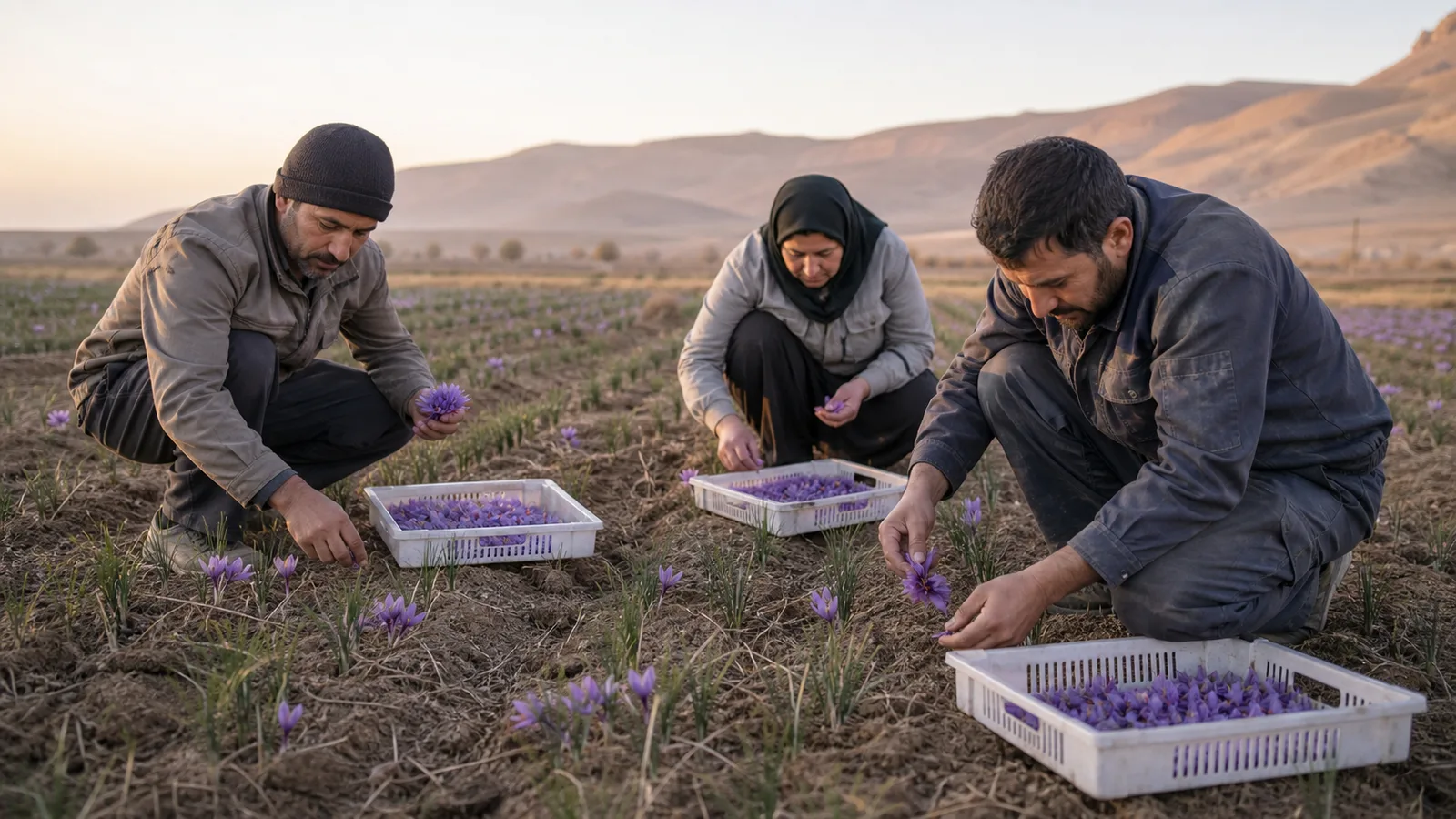
Saffron harvesting steps begin with the flower, not with pulling red threads in the field. Pick dry flowers as they are beginning to open, keep them cool in a shallow clean container, separate the three stigmas promptly, dry those stigmas with a controlled method, then cool, grade and seal each traceable lot. The work is delicate because every handling and drying decision can affect the final spice.
That short answer covers the sequence. If you need to know how to harvest saffron from Crocus sativus, the details below explain each operation, why most of the process is still manual and where avoidable quality losses occur.
The former page was a brief YJC item attributed to a “Hot News” reporter and introduced as a set of harvest images for readers. Its botanical outline and traditional drying note are retained here inside a complete, evidence-checked process.
Before harvest: know what you are picking
Crocus sativus is a small perennial geophyte in the iris family, Iridaceae. It grows from a corm, not a true onion. Narrow leaves emerge around the flowers, which are often about 10 centimetres tall at bloom but vary with the field and stage of development. The old article described a stem ending in one to three flowers; in practice, flower number varies by corm size, age and growing conditions.
Each purple flower has six petal-like tepals, three yellow stamens and one pistil whose stigma divides into three red branches. The stigma branches are the valuable part harvested for culinary saffron. Petals, stamens, leaves and corm tissue are not saffron spice.
Flowering season depends on climate and hemisphere. In many northern-hemisphere fields it occurs in autumn, commonly over a concentrated period in October or November. The field must be checked every day during bloom because flowers do not all emerge together.
The saffron harvesting steps, from field to sealed lot
- Prepare clean containers and a processing area. Wash hands, sanitise food-contact surfaces and use clean, preferably ventilated collection containers. Assign a lot number to the field, bed and harvest date before flowers are mixed.
- Choose flowers at the right stage. Harvest flowers that are fully elongated and just beginning to open. Do not take mouldy, soil-contaminated or damaged flowers. If there is dew, frost or rain, wait until the flowers are dry and thawed where practical.
- Pick gently, usually in the morning. Hold the flower near its base and detach it without crushing nearby buds or pulling up the corm. Early-morning collection helps limit exposure to heat and direct sun, but flower condition matters more than a rigid clock time.
- Keep the flowers shallow, shaded and cool. Do not compress a harvest into deep sacks. A pile generates heat and condensation, while bruising makes later separation harder. Move flowers under cover and into the processing area quickly.
- Separate the stigmas. Open each flower on a clean surface, identify the three red stigma branches and cut or pinch them at the chosen point on the style. Keep soil, tepals and yellow stamens out of the food lot. Separation should happen within a few hours when possible; extension guidance allows brief refrigerated holding if it cannot be completed immediately.
- Dry promptly with a controlled process. Spread stigmas in a thin, even layer on clean food-safe material. Use a documented time, temperature, load and airflow schedule that has been validated for the equipment. Check the whole tray rather than assuming every layer dries at the same rate.
- Cool, inspect and pack. Let dried saffron cool away from humid air, remove foreign and extraneous matter, record the dried weight, and seal it in a clean airtight container. Keep the lot number with the container and protect it from light, moisture and heat.
When should saffron be harvested?
A practical target is a dry flower that is fully elongated and beginning to open. Picking too early can mean underdeveloped, shorter stigmas; leaving open flowers in sun, wind or rain exposes them to more damage. This is why workers make repeated passes through the same field during a short flowering window.
“Early morning” is useful guidance, not permission to collect wet blooms. University of Vermont Extension recommends waiting for dew to evaporate and, where possible, for rain to finish. Flowers should remain only a few layers deep in a clean container and should be protected from sun, heat, wind, animals and further moisture.
How the three saffron threads are separated
The three red stigma branches join a pale yellow or white style. How much of that style remains determines the visual form of the dried product. Codex describes filaments as dried stigma with part of the style and cut filaments as detached dried stigmas with the style removed.
Some searches call this the “saffron extraction process.” At harvest, no solvent is involved: the worker is extracting or separating the stigma from the crocus flower. Extract manufacturing is a different industrial process and is outside these harvesting steps.
Iranian trade names add another layer. A full stigma-and-style bundle is often sold as dasteh or “bunch” saffron; dokhtar-pich is another name used for a tied traditional bunch. pushal generally retains some yellow style, while sargol is an all-red separated grade. Negin is also used for long, more intact all-red stigma pieces. Exact commercial definitions can vary by seller and market, so a label should describe the actual material rather than rely on a grade word alone.
The former machine translation called these “white strings,” “twisted daughter,” “root head” and “tufted head.” Those phrases were attempts to render style and Iranian grade terms; they are not separate parts of the flower.
Drying is part of harvesting, not an afterthought
Fresh stigmas contain a great deal of water. Drying stabilises them and helps create the characteristic aroma, but too little drying invites mould and poor storage while excessive or uneven treatment can damage colour and volatile compounds. Peer-reviewed studies show that time, temperature, airflow, load and method interact, which is why a single universal oven instruction is unsafe.
The old article advised drying the red threads in a cool, shaded place on clean cotton cloth. Shade drying is a traditional method, but it can take too long in humid conditions and cloth can add handling or contamination risk. Controlled dehydration on clean food-safe liners is easier to document. Codex sets a maximum moisture content of 12 percent by weight for dried saffron classes; laboratory measurement is more reliable than colour or feel alone.
A brittle thread that snaps is a useful field cue, not a substitute for moisture and quality testing in a commercial operation. Record the date, drying method, temperature, duration, fresh and dry weights, and any unusual weather or handling event for every lot.
Why saffron harvesting remains labour-intensive
Many field and processing tasks can be assisted by equipment, but selective flower picking and clean stigma separation remain predominantly manual. Flowers sit low among leaves, bloom unevenly and bruise easily. A machine must distinguish harvest-ready flowers from immature buds and avoid soil, leaves and corm damage.
Research on computer vision and specialist saffron harvesters is advancing. A 2026 study trained a detector to separate immature buds from flowers and buds ready for harvest, but it described the system as a component for a future autonomous robot, not evidence that field-to-stigma harvesting is already automated. Our report on a saffron harvesting machine developed in Iran explains another attempt to reduce field labour without treating a prototype as universal practice.
This concentrated hand work is why saffron has long been described as “red gold” and as an economic lifeline in desert communities. The phrase is cultural, but the underlying labour is real: flowers must be visited repeatedly, handled gently, separated quickly and dried in small, controlled lots.
Where is saffron harvested?
Iran, particularly the Khorasan region, is the best-known large production centre. Saffron is also cultivated and harvested in India, Afghanistan, Spain, Morocco, Greece, Italy and a growing number of smaller trial and commercial regions. The sequence is broadly similar, but timing and drying practice change with climate, facilities and market requirements.
Growers planning a crop should first match corms and field conditions to local evidence; our saffron planting guide covers that earlier stage. After packing, protect the finished spice using the practices in our saffron storage guide.
The complete harvesting process is therefore more than picking a pretty flower. It is a traceable chain from a harvest-ready bloom to three clean stigma branches, then through prompt controlled drying and airtight storage. Each step protects work already invested in the field and helps the final saffron retain the colour, aroma and food safety a buyer expects.
Sources reviewed: FAO/WHO Codex Alimentarius CXS 351-2022, amended 2025; University of Vermont Extension, Saffron Post-Harvest Handling Best Practice Recommendations; the peer-reviewed review Detection of Saffron’s Main Bioactive Compounds and Their Relationship with Commercial Quality; and the 2026 saffron harvestability-detection study. All accessed 25 August 2026.

![Exporting Saffron to Turkey + Price Guide [Complete 0 to 100]](https://img.rowhanisaffron.com/20260827003933/saffron-export-turkey-quality-inspection.webp)



