


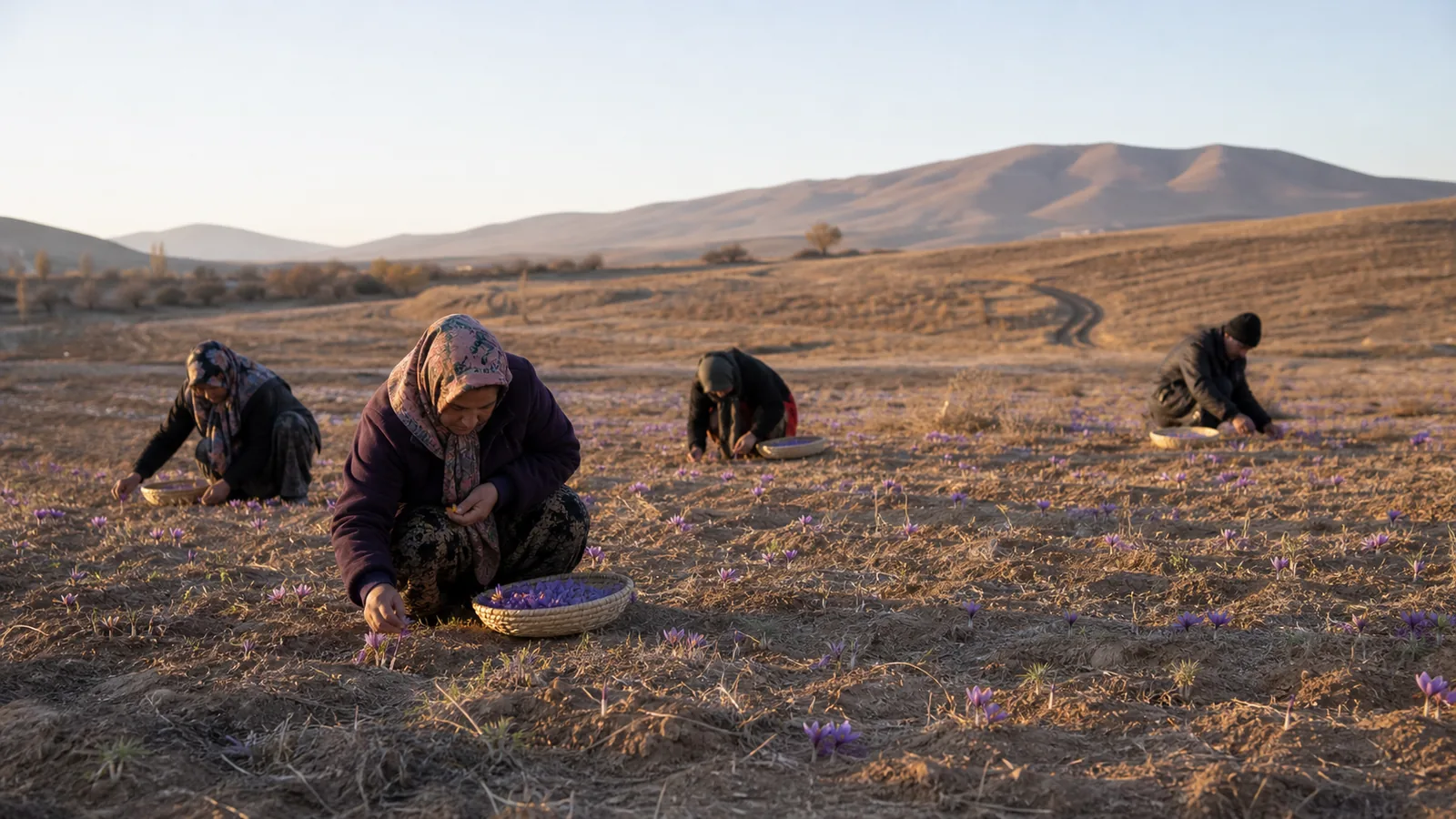
Torbat Heydarieh saffron is harvested across a large, climatically varied part of southern Khorasan Razavi. One archived county report described 8,400 hectares of saffron fields, an average yield of four kilograms per hectare, and annual output of about 34 tonnes. A province-wide report placed the county closer to 9,000 hectares. These are historical snapshots, not current acreage, but together they explain Torbat Heydarieh’s place in the wider regional harvest.
The reported Torbat Heydarieh harvest
Mohammad Karimi Farzaghi, then director of Agriculture Jihad in Torbat Heydarieh, announced the start of picking across the county’s fields. His report used 8,400 hectares and four kilograms per hectare as the local area and average yield. Those figures broadly align with the stated annual total of around 34 tonnes.
The official expected a better crop than the previous year after favourable spring rainfall, but the archived article did not publish a final measured harvest. The 34-tonne figure should therefore be understood as the reported annual scale, while any predicted increase remains a forecast rather than a confirmed outcome.
Why harvest dates differ within the region
Saffron does not flower everywhere on the same morning. The county report described a sequence across three local climate zones:
- the cooler Rokh Plain around Torbat Heydarieh;
- the more temperate central Torbat Heydarieh and Zaveh areas; and
- the warmer Mahvelat area.
Across those zones, it placed picking from roughly early October through late November. Cooler and warmer locations enter the flowering window at different times, allowing the regional harvest to move geographically rather than beginning everywhere at once. The calendar is still season-specific; weather and irrigation can shift it.
The saffron corm’s summer dormancy
The source also noted a defining feature of the crop: saffron grows from a corm that is dormant through part of the summer. Local planting and field work can be scheduled during dormancy, before development resumes for autumn flowering. The old translation attached exact Persian-calendar months to biochemical changes in the corm, but it supplied no agronomic reference or local field protocol.
Growers should therefore treat those dates as a description of local practice, not a universal instruction. Corm condition, soil temperature, planting depth, irrigation, and local climate all matter. Our broader guide to saffron cultivation and growing conditions explains the field cycle without turning one county’s calendar into a rule for every climate.
The province-wide Khorasan Razavi picture
A second archived report quoted provincial horticulture director Hashem Naqibi. He said Khorasan Razavi’s saffron area had grown by more than 5,000 hectares from a previous 69,500 hectares, putting the new total at roughly 74,500 hectares. He also counted 132,000 growers and gave the province-wide average yield as four kilograms per hectare.
Naqibi’s county ranking put Zaveh first with about 11,000 hectares, followed by Torbat Heydarieh at 9,000 and Roshtkhar at 6,000. At the other end, Torghabeh-Shandiz, Kalat, and Sarakhs each had fewer than 20 hectares. He expected the provincial harvest to continue until late November.
Why one report says 8,400 hectares and another says 9,000
The two Torbat Heydarieh figures should not be averaged or silently replaced. They may reflect rounding, different reporting cut-offs, or changes in registered area, but neither article provides enough underlying records to identify the cause. The honest conclusion is that the archived sources placed the county between about 8,400 and 9,000 hectares at the time, with four kilograms per hectare as the shared reported average.
How to read the old world-production claim
The provincial report also attributed 85% of world saffron production to Khorasan Razavi. That is a large historical claim without a stated crop year, trade dataset, or calculation method. It should not be reused as the province’s current verified share.
FAO currently describes Iran as the world’s leading producer and treats Khorasan saffron as important to rural jobs and income. Its 2025 visit to Khorasan farms and processors focused on post-harvest practices, quality integrity, and competitiveness rather than assigning an updated world percentage to one province. That official framing supports the region’s importance without overstating a number the archived page cannot substantiate.
From flowers to a marketable spice
Large acreage does not by itself create high-quality saffron. Flowers must be picked within their short bloom, transported without excessive compression, and separated promptly. The red stigmas then require clean, controlled drying and protection from moisture, contamination, and misleading mixing.
The current ISO 3632-1:2025 specification covers dried saffron in filament, cut-filament, and powder forms and includes recommendations for storage and transport. It provides a more useful basis for product claims than a regional superlative. Torbat Heydarieh’s scale explains why the county matters; testing and traceability determine what an individual batch can honestly promise.
What the combined reports establish
The county account supplies the close view: local climate zones, a staggered flower harvest, corm dormancy, and an 8,400-hectare production estimate. The province account supplies the frame: about 74,500 hectares, 132,000 growers, a four-kilogram average, and a clear ranking of major and minor saffron counties.
Together they make the article more useful without pretending that old figures are live statistics. Picking saffron in Torbat Heydarieh is a local harvest within a much larger Khorasan Razavi system—and its value depends as much on careful handling after picking as on the number of hectares in flower.

![Exporting Saffron to Turkey + Price Guide [Complete 0 to 100]](https://img.rowhanisaffron.com/20260827003933/saffron-export-turkey-quality-inspection.webp)



