


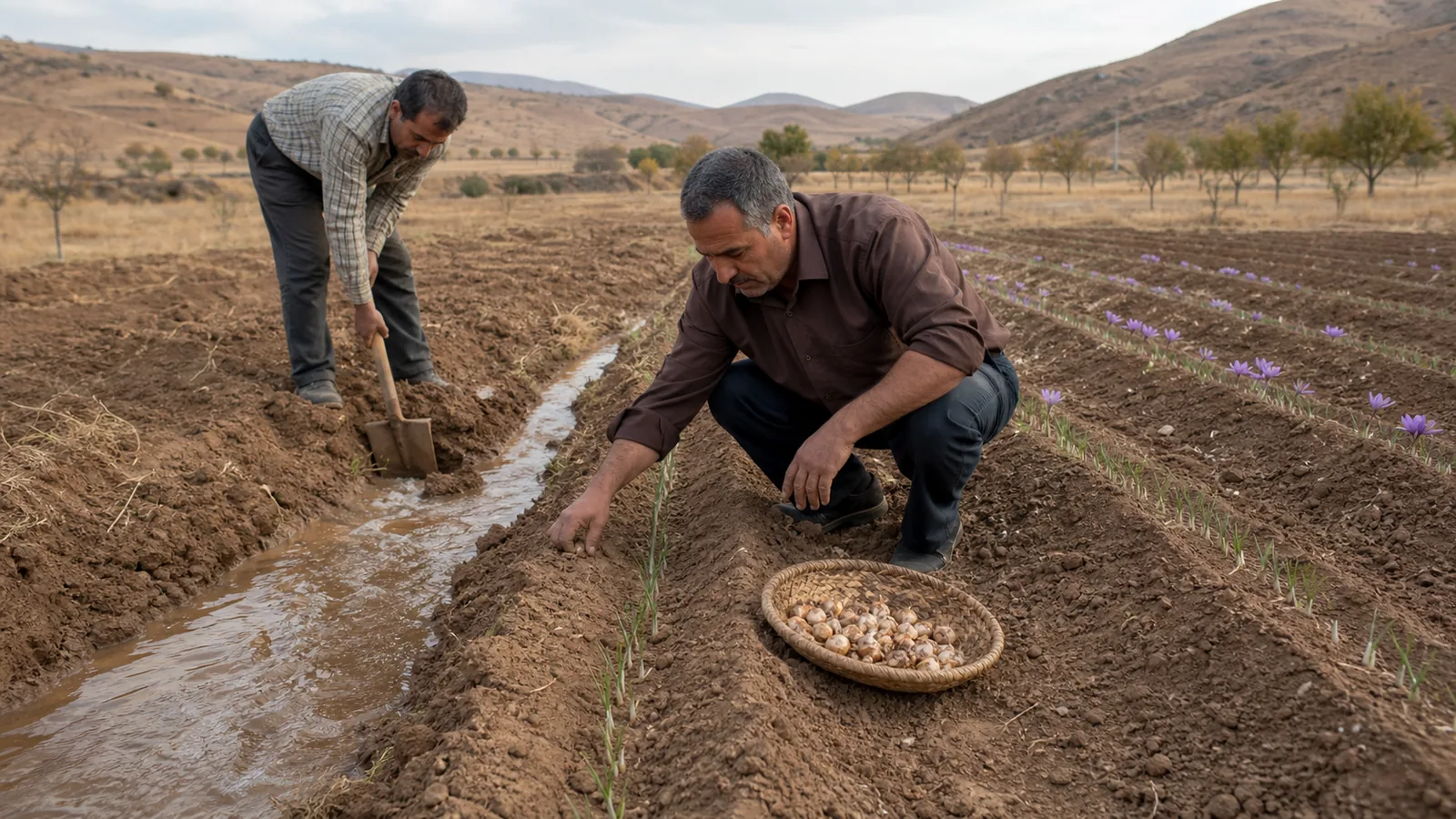
Planting saffron in Abhar was presented as a small but promising response to water pressure in Zanjan Province. An archived local report described 10 hectares, eight kilograms of production, 60 jobs, and 56 million tomans in expected farmer income. Reports from Aran and Bidgol, Azadshahr, Mahneshan, and Kurdistan schools show how other emerging regions approached the same crop through water planning, local training, corm supply, buyer support, and education.
The historical Abhar saffron figures
An Abhar Agriculture Jihad official identified as Hajikhani said the county had 10 hectares of saffron. The report forecast eight kilograms of output and put the season’s farmer income at 56 million tomans, based on saffron prices of six to eight million tomans per kilogram at that time. Those are archived market values, not current prices.
The income arithmetic is coherent: eight kilograms at about seven million tomans equals 56 million. The yield wording is less precise. Eight kilograms across 10 hectares implies 0.8 kilogram per hectare, while the report separately says the average was one kilogram per hectare. Rounding or a difference between planted and productive area could explain the gap, but the source does not say which.
Hajikhani also credited cultivation with 60 jobs and said the crop received four irrigations during its growth cycle. The page does not define whether the employment figure means permanent positions, seasonal workers, or work opportunities. Both statements belong to this historical Abhar project; neither should become a universal labour or irrigation formula.
What an emerging saffron area needs
A new saffron region has to solve more than planting. It needs corms suited to local conditions, prepared and well-drained soil, a locally tested irrigation schedule, trained pickers, prompt stigma separation, controlled drying, and a route to buyers. Weakness at any point can erase the apparent advantage of a high-value, relatively water-conscious crop.
FAO’s Ecocrop profile for Crocus sativus describes saffron as a perennial crop adapted to temperate, fairly dry climates and notes that corms can remain in the field for several years. It also describes spring and late-summer moisture as important in the crop cycle. Local irrigation numbers still vary with soil, rainfall, field age, and management, which is why Abhar’s four rounds and another county’s two rounds can both be historical local practices without being interchangeable instructions.
Aran and Bidgol: a water-limited comparison
Hussein Fattahi of Agriculture Jihad reported 25 hectares of saffron in Aran and Bidgol, at the northern edge of Isfahan Province. He expected about 50 kilograms, using an average of two kilograms per hectare. The city was also described as having roughly 3,000 hectares of orchards and 11,000 hectares of farmland, so saffron remained a small part of its agricultural land.
Fattahi said the crop was irrigated twice during the year and that establishing one hectare required about 3.5 tonnes of corms sourced from areas with a similar climate. Sourcing suitable corms is a sensible principle; the exact quantity, planting density, and irrigation schedule still require local agronomic planning.
The employment number needs a unit
The saved translation says each hectare created “about 30 stable and seasonal jobs.” Read literally across 25 hectares, that would imply 750 jobs, an unusually large total that the report does not document. It may refer to workers engaged during the brief harvest or to work-days rather than permanent posts. The safe conclusion is that saffron created concentrated seasonal labour, while the exact employment unit is unverified.
Azadshahr: rapid expansion in Golestan
Another report followed Azadshahr in Golestan Province. Agriculture director Abdullah Hosseini forecast about 1.2 tonnes from 150 hectares—an implied average near eight kilograms per hectare—and said this was 70% above the previous year. These were a forecast and a year-on-year comparison, not a final measured crop.
The report scheduled a harvest thanksgiving ceremony for the fifth day of the Persian month of Aban in the Cheshmeh Saran district. The old English rendering turns that into “5 November,” but 5 Aban falls in late October in the Gregorian calendar. Villages named in the five-year cultivation effort included Vamnan, Sib Chal, Narab, and Kashidar. The article credited the crop with improving local income, but supplied no audited household figures.
Mahneshan: why growers asked for support companies
A Zanjan Province report concerned Mahneshan, a name rendered inconsistently as “Mahan” in the archived English page. Horticulture official Saeed Jalali said 30 growers worked about seven hectares. He forecast 55 kilograms worth roughly 350 million tomans at the then-current six-to-seven-million-toman price per kilogram. Planting took place in Shahrivar, roughly August–September, with harvest in early November.
Jalali’s main concern was the lack of support companies. Such companies were expected to supply corms and buy the crop; the report said the province had only one. It also said Mahneshan obtained planting material from Kashmar, added about half a hectare each year, and received annual Agriculture Jihad training.
A buyer guarantee can reduce market uncertainty, but it needs transparent grading, pricing, payment, and rejection rules. Similarly, imported corms should be traceable and checked for condition before planting. The report’s call for companies was therefore about both ends of the chain: reliable material at the start and a credible market after harvest.
Kurdistan’s boarding-school planting proposal
Mehdi Namdar, a deputy in Kurdistan’s education department, announced a different model: planting saffron at lower- and upper-secondary boarding schools and at technical and vocational colleges. He linked the proposal to what officials considered favourable local conditions and a climate resembling parts of northeastern Iran.
The stated goals were to teach practical skills, create possible income for families, help boarding schools become more self-reliant, use uncultivated school grounds, and give students a structured activity. The archived page announces the programme but provides no planted area, harvest, budget, or later outcome.
For such a project to be educational rather than promotional, students would need age-appropriate supervision, safe tools, clear learning objectives, and transparent handling of any income. Field records could turn the school plot into a real lesson in corm selection, irrigation, harvest timing, drying, costs, and quality rather than unpaid production work.
Lessons for saffron planting in Abhar
The regional examples do not supply one recipe. Aran and Bidgol emphasizes water and climate-matched corms. Azadshahr shows rapid expansion and community celebration. Mahneshan exposes the need for dependable suppliers and buyers. Kurdistan’s schools treat cultivation as vocational learning. Abhar contributes its own small-area income, employment, and irrigation snapshot.
Before expansion, growers need local field trials and clear records for planted versus productive area, corm source, water, labour, dried yield, quality tests, and sale price. Our guide to saffron cultivation and growing conditions explains the crop cycle; local extension advice should determine how that cycle fits Abhar’s fields.
The most durable opportunity is not simply more hectares. It is a working chain in which healthy corms reach prepared land, growers know how to manage the crop, the harvest is handled cleanly, and buyers use fair, visible terms. That is what turns planting saffron in Abhar from an attractive forecast into a stable farm activity.

![Exporting Saffron to Turkey + Price Guide [Complete 0 to 100]](https://img.rowhanisaffron.com/20260827003933/saffron-export-turkey-quality-inspection.webp)



