


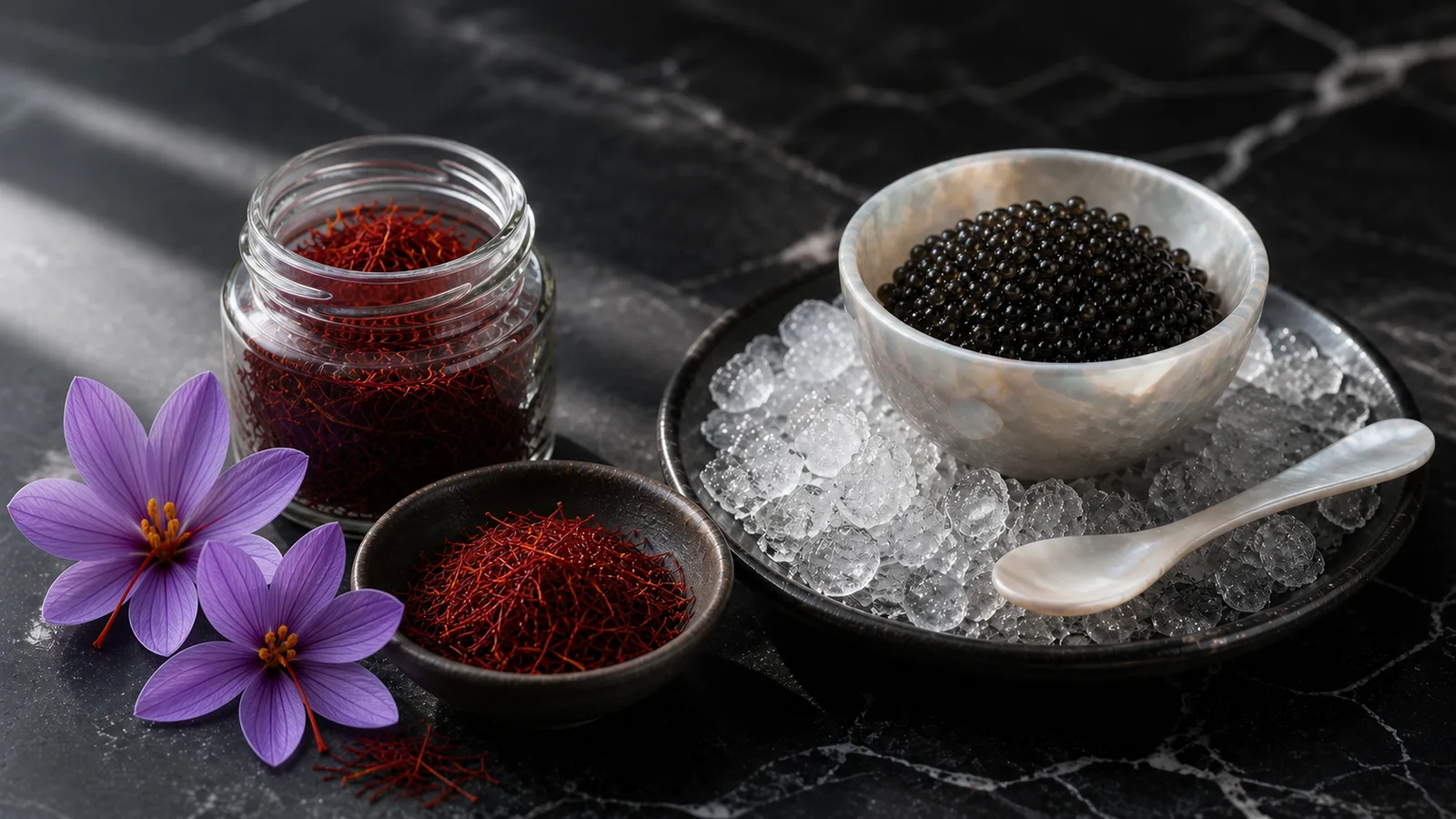
2 Iranian food among the 100 most expensive foods in the world is the title of a historical list in which Iranian saffron and caviar appeared beside bluefin tuna, Alba white truffles, Coffin Bay oysters, kopi luwak coffee and edible bird’s nest. The headline survives because the two Iranian ingredients genuinely can be valuable. The “top 100” claim does not: the original article supplied no publisher, date, method or common price basis for such a ranking.
There is no stable worldwide league table for expensive food. A record auction fish, one kilogram of spice, a restaurant serving and a seasonal truffle quotation are different kinds of prices. Currency, grade, origin, scarcity, harvest, animal-welfare rules and whether a figure is wholesale, retail or charity-auction all change the comparison.
Why this old expensive-food list needs context
The source was attributed to the market desk of the Journalists’ Club and ended with a YJC credit. Its Persian text referred to a list of ten natural foods, while the translated title said 100. It contrasted naturally costly ingredients with headline-grabbing ice cream or chocolate decorated with gold. Those details tell us it was a popular-interest list, not a reproducible market survey.
The safest way to keep its meaning is to review the seven foods it actually named and separate durable facts from old promotional prices. The two Iranian entries were number six, saffron, and number seven, caviar.
Does Persian food have to be expensive?
No. Persian home cooking includes many economical dishes built around rice, legumes, vegetables, herbs, yoghurt and modest amounts of meat. A particular Persian meal becomes expensive when it uses scarce ingredients, large quantities of meat, long preparation, imported goods or a high-cost restaurant setting. Saffron is used in small amounts, so its high price per kilogram does not make every saffron dish a luxury purchase.
The question “why is Persian food so expensive” therefore needs a more precise answer: cuisine is not one price category. Ingredient quality, location, labour and portion size explain a bill better than the word Persian. A fair comparison uses similar dishes, portions and service levels rather than a rare-ingredient list.
1. Bluefin tuna sashimi
The old translation called this “Bluefin Sachs Fish,” described a tuna heavier than a car and quoted more than $100,000 at Tokyo’s Tsukiji market. It then said the species was nearing extinction but that a farmed version was available, and made a confused comparison between the fat and taste of wild and cultured fish.
Bluefin tuna can be very large and exceptional New Year auction bids in Japan generate global headlines. An auction record is not a normal per-kilogram market price. Conservation status and fishing rules also vary by species and stock; a blanket statement that “bluefin is extinct” is inaccurate. For example, NOAA manages Atlantic bluefin through changing quotas, minimum sizes and retention limits. Aquaculture and tuna fat content are separate questions that need a named species, production method and sample.
2. Alba white truffle
The intended item was the white truffle associated with Alba in Piedmont, Italy, not an “Alba white mushroom.” It is Tuber magnatum, a highly prized subterranean fungus. The article contrasted it with France’s Périgord black truffle, called a “black diamond,” and quoted €7,000 per kilogram. It also described the white truffle’s intense aroma as sulphurous and unpleasant-looking, which is a matter of sensory language rather than a quality defect.
Truffle prices move with season, size and supply. The National Centre for Truffle Studies’ official Alba quotations for medium 15–20 gram pieces averaged €400–€500 per 100 grams during the published 2025 dates—roughly €4,000–€5,000 per kilogram before differences in size or transaction. That current example shows why an undated €7,000 figure should remain historical rather than become a permanent fact.
3. Coffin Bay “king” oyster
The source referred to oysters from Coffin Bay in South Australia, mistranslated as “Cuffin Bay” and “King of the Australian Bay Gulls.” It said oysters had once been food for poorer people, then described an 18-centimetre, one-kilogram specimen offered for $100 at luxury hotels, with edible flesh amounting to little more than a mouthful.
Coffin Bay is a recognised South Australian oyster-growing region. Very large “king” oysters have been marketed as special restaurant products, but the original page gave no producer, menu, year or currency for its $100 claim. Ordinary Coffin Bay oysters and an unusually aged display-sized oyster cannot be assigned the same price. The size and dollar figures are therefore retained as an old promotional description, not a current market quote.
4. Kopi luwak coffee
Kopi luwak is made from coffee cherries eaten by Asian palm civets; beans recovered from their droppings are cleaned and processed. The old page called the animal a “Zabad cat,” said it selected the largest and ripest fruit, described digestion as changing the bean’s protein structure, and named Sumatra, Java and Bali. It quoted $3,000 per kilogram and called it the world’s rarest and most expensive coffee.
Those superlatives and the price were not sourced. More importantly, modern buyers must distinguish genuinely wild collection from captive production. A peer-reviewed survey of 29 civet-coffee tourism plantations found that no assessed civet met all five welfare freedoms and concluded that welfare and trade-law enforcement were needed. Another review cautions that flavour differences attributed to digestion may partly reflect coffee species and cherry selection. “Rare” is not enough reason to ignore provenance or animal treatment.
5. Edible bird’s nest
Edible bird’s nest is made largely from the hardened saliva of certain swiftlets and is traditionally prepared as soup. The article described red, yellow and white nests, called red the most expensive, said nests traded for thousands of dollars per kilogram, and claimed the food had many health properties including prolonging life.
Colour is not a simple health or quality scale. Processing conditions and contaminants, including nitrite, can influence nest colour and safety. Scientific reviews describe long-standing cultural use and ongoing laboratory research, but they do not establish that eating bird’s nest extends human life. The longevity claim is removed as unsupported; authentication, hygiene and contaminant control are the relevant purchase questions.
6. Iranian saffron
The first Iranian product was saffron. The old article said spices could be worth more than gold in medieval medicine and cooking, quoted Iranian saffron above $1,000 per kilogram, praised dark-red threads dried “with love,” and warned that any cheap sample must have been mixed with turmeric.
Saffron is expensive because each Crocus sativus flower provides only three stigma branches, flowers are picked during a concentrated season, and the stigmas are separated and dried with considerable hand work. It has culinary and historical importance, but the “more than gold” comparison needs a date, place and unit to mean anything. The old $1,000 figure is not a current price guide.
A low price is a reason to check a product, not proof of turmeric. Saffron can be adulterated with plant material, dyes or other substances, especially in powder, but visual inspection cannot identify every case. Codex CXS 351-2022 requires characteristic colour, aroma and flavour, prohibits adulteration and sets chemical and physical quality criteria. Laboratory analysis and traceable packaging are stronger evidence than a dramatic price claim.
7. Iranian caviar
The second Iranian product was caviar. The source called rare caviar a “black diamond,” referred to beluga or “Almas” caviar as pale like an Iranian diamond, and quoted more than $5,000 per kilogram. It said caviar came from “ozone fish,” a mistranslation of sturgeon, claimed those fish existed only in the Caspian Sea, then acknowledged Russia and Azerbaijan as exporters while praising fish from Iran’s side of the Caspian.
True caviar is salt-cured sturgeon roe. Beluga caviar comes from Huso huso; “Almas” is a trade term usually associated with exceptionally pale roe, not a separate proof of origin or quality. Sturgeons live in the Caspian basin and other freshwater, coastal and inland-sea systems, and modern caviar also comes from aquaculture outside the Caspian. FAO records the historic importance of both Iran and the former Soviet states while documenting the pressure on wild stocks and the development of aquaculture.
The old nutrition sentence—“25% of caviar fat is cholesterol and 75% lecithin”—is not a coherent nutrient analysis. Its amino-acid list also mixed arginine, isoleucine, lysine and a likely mistranslation of methionine with histamine. Caviar contains protein and fat, but product-specific laboratory data are needed for percentages. Rarity, species, farming or catch source, processing, CITES-compliant traceability and cold-chain handling matter more than the word “diamond.”
Why saffron and caviar remain the two Iranian examples
Saffron and caviar belong in a discussion of costly Iranian ingredients for different reasons. Saffron compresses a great deal of seasonal hand labour into a light, shelf-stable spice. Caviar depends on slow-growing sturgeon, controlled production, careful processing and refrigerated distribution. Both can carry origin and craft value, and both need traceability because prestige creates an incentive for vague or misleading claims.
The responsible conclusion is narrower than “two fixed members of the world’s top 100.” A historical YJC list selected Iranian saffron and caviar among seven rare foods it discussed. They remain internationally recognised premium ingredients, but any current comparison must specify grade, quantity, source, date and type of sale. Without that information, a ranking is entertainment rather than market evidence.
Sources reviewed: NOAA Fisheries, Atlantic bluefin fishery status and limits; Centro Nazionale Studi Tartufo, official Alba white-truffle quotations; peer-reviewed civet-coffee welfare research; reviews of edible bird’s nest evidence and residual contaminants; FAO, Sturgeons; and FAO/WHO Codex CXS 351-2022 for saffron. All accessed 25 August 2026.

![Exporting Saffron to Turkey + Price Guide [Complete 0 to 100]](https://img.rowhanisaffron.com/20260827003933/saffron-export-turkey-quality-inspection.webp)



