


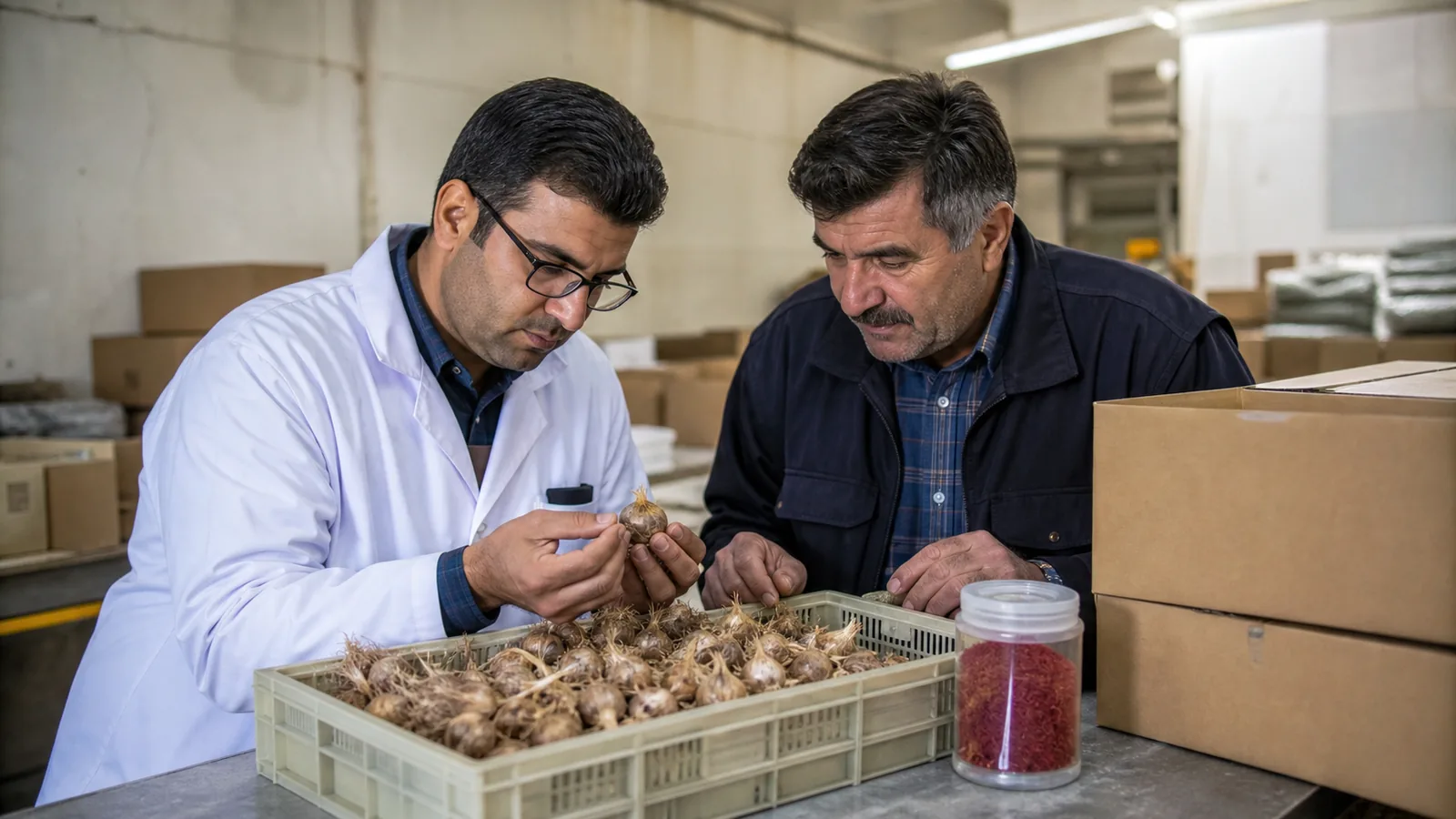
The debate over Iran’s saffron officials and smuggling was never about one problem alone. In the historical interview behind this article, National Saffron Council member Ali Hosseini connected alleged saffron-corm smuggling with unstable prices, weak export data, bulk sales through intermediaries, limited branding and a lack of coordinated support for growers and exporters.
His comments captured real pressures in the value chain, but they also included forecasts, opinions and figures that need careful labels. The discussion of saffron smuggling in Iran was an attributed industry warning, not an enforcement finding. Some numbers were badly mistranslated; others conflict with contemporaneous official data. This article preserves what was said while separating a documented statistic from an industry estimate or allegation.
The production forecast behind the warning
Hosseini described Iran as the world’s largest saffron producer and argued that production support, market management and fewer export barriers were needed if the country was to turn that scale into a stronger export position. The Food and Agriculture Organization still describes Iran as the global production leader, so the central point was sound.
He predicted that national production could reach 500 tonnes within ten years. He also said the saffron area in Razavi and South Khorasan, then described as about 80,000 hectares, could rise to 120,000 hectares by Iranian year 1400. These were projections from the interview, not guaranteed outcomes.
A contemporaneous FAO/Codex paper using Iran Ministry of Agriculture-Jahad data gives a firmer baseline for 2014–15. It records 69,407 hectares and 218.348 tonnes in Razavi Khorasan, plus 14,727 hectares and 48.019 tonnes in South Khorasan. Together, that is 84,134 hectares and about 266.4 tonnes.
The old page states that the two provinces produced “300 thousand tonnes.” That cannot be true: it conflicts with both the official table and the same interview’s 500-tonne national forecast. The intended figure may have been around 300 tonnes, but without a corrected primary transcript it is safer to identify the unit error than silently rewrite it as an exact statistic.
Corm multiplication does not triple farmland automatically
One translated sentence says a hectare of saffron “increases to three hectares” because its bulbs reproduce. Saffron grows from corms, and daughter corms do multiply underground. That can provide planting material for a larger area after lifting, grading and replanting. The original hectare does not expand by itself, and not every daughter corm is healthy or large enough to establish a productive new field.
Hosseini cited prevailing yields of roughly three to five kilograms per hectare and called for training to raise output toward eight kilograms per hectare. The contemporaneous official table reported provincial averages of 3.1 kg/ha in Razavi Khorasan and 3.4 kg/ha in South Khorasan, which supports the lower part of that range. Eight kilograms should be treated as a management target for suitable fields, not a universal expectation.
The interview also claimed that each square metre of saffron could earn two US dollars in foreign exchange. That is not a stable farm calculation. Yield, grade, exchange rate, export price, processing loss and who captures the final sale value all change the result. It remains part of the speaker’s economic case, but it should not be used as a current return forecast.
What the export figures actually show
The old translation says customs recorded more than 130,000 tonnes of saffron exports. Again, the unit is impossible. The FAO/Codex table, citing the Iran Customs Office, records 121.573 tonnes exported in 2015, worth about US$165.3 million; for 2014 it records 158.794 tonnes worth about US$227.6 million. A reference to “130 thousand” almost certainly lost its kilogram basis or gained the wrong unit during publication.
Hosseini said annual export earnings were US$300 million and forecast at least US$1 billion within ten years. Those were the council member’s estimate and ambition. They do not match the cited customs value for 2015, which is exactly why his request for consistent Ministry and Customs data was important. Exporters cannot plan confidently when area, volume and value are reported in incompatible units.
He also argued that Iran sold too much saffron in bulk through intermediaries, particularly via the United Arab Emirates, where it could be repacked under another national or commercial identity. The official 2015 table supports the importance of that route: the UAE was listed as the largest destination by weight, followed by Spain. The table does not, by itself, prove what happened to every shipment after import.
The time-specific claim about the United States
During the period when the JCPOA was being implemented, Hosseini said the United States had returned as a direct customer after 15 years and that Iranian traders had shipped 100 kilograms. He estimated US saffron use at 50–60 tonnes a year and argued that Iran could supply all of it. Those consumption and market-share statements were not supported by a source in the article and should remain attributed claims.
They are also historical, not guidance on present trade. Sanctions rules, authorized transactions, financial channels and designated parties can change. Anyone considering a transaction now needs current legal advice and the latest official US Treasury OFAC Iran sanctions material; a 2010s interview is not a compliance document.
Price volatility and the “false bubble” claim
Hosseini blamed insufficient market oversight and speculative dealing for severe price fluctuations. At the time of the interview, he placed saffron at about 5.5–5.6 million tomans per kilogram and described roughly one million tomans of that price as a “false bubble.” He said the price had previously reached seven million tomans in Farvardin, and elsewhere described a rise from 4.5 million to six million tomans that discouraged foreign buyers.
These are dated nominal prices and the speaker’s interpretation of them. They say nothing about today’s market. The article does not identify a grade, transaction size or price series that independently proves the alleged bubble. It also says exports stopped from Dey through the end of Esfand, but provides no customs series to verify whether this meant all exports, the speaker’s sales channel or a sharp slowdown.
The broader warning is more durable. If a sudden price rise prompts uncontrolled planting while export demand, processing and quality assurance lag behind, later supply can put growers under pressure. Stable growth requires saleable quality and reliable routes to market, not acreage expansion alone.
What was alleged about saffron-corm smuggling
The interview alleged that surplus saffron corms would be smuggled in luggage or through intermediaries to neighbouring countries if they were not used in new Iranian fields. Hosseini predicted activity within the following 20 days and said some traders would also hoard harvested saffron at home to disrupt the market.
Those statements were allegations and predictions from a named industry representative. The stored report includes no seizure record, named destination, corm quantity, court finding or enforcement data. It would be wrong to present the claims as a proven shipment or to repeat the “20 days” as though it refers to the present.
Corm movement can still matter for more than national competition. Planting material can carry pests and disease, while ungraded corms create uneven fields. A credible control system would document origin, plant health, grade and legal movement rather than relying on rhetoric about suitcases.
Branding is not only a package design
Hosseini said Iran exported saffron to fewer than 50 countries and should build the infrastructure to reach at least 150. The numbers were ambitions, but the underlying concern was clear: being the largest producer does not guarantee that origin, quality and value remain visible through the final sale.
Effective branding begins before a label is printed. It requires traceable lots, consistent grading, authenticity testing, hygienic processing, protected storage and documentation that a buyer can trust. In 2025, FAO and Iran’s Ministry of Agriculture-Jahad held a national workshop focused on authenticity, quality assurance and saffron value-chain governance. That direction addresses the substance of the old criticism more directly than a country-count target alone.
The useful conclusion from a flawed historical report
The neglect of Iran’s saffron officials and smuggling is best understood as an industry critique from its time. It raised five linked issues: agricultural productivity, data quality, price stability, control of planting material and the ability to sell Iranian saffron with its origin and value intact.
Not every number in the interview survives verification. The production and export figures printed in thousands of tonnes are demonstrably wrong, US-market assertions were time-specific, and the smuggling claims were not accompanied by enforcement evidence. Preserving the article’s value means keeping those topics and attributions while removing false precision. The strongest long-term answer is dependable data, healthy traceable corms, verified quality, lawful trade and an export system in which growers and processors can plan beyond the next price swing.

![Exporting Saffron to Turkey + Price Guide [Complete 0 to 100]](https://img.rowhanisaffron.com/20260827003933/saffron-export-turkey-quality-inspection.webp)



