


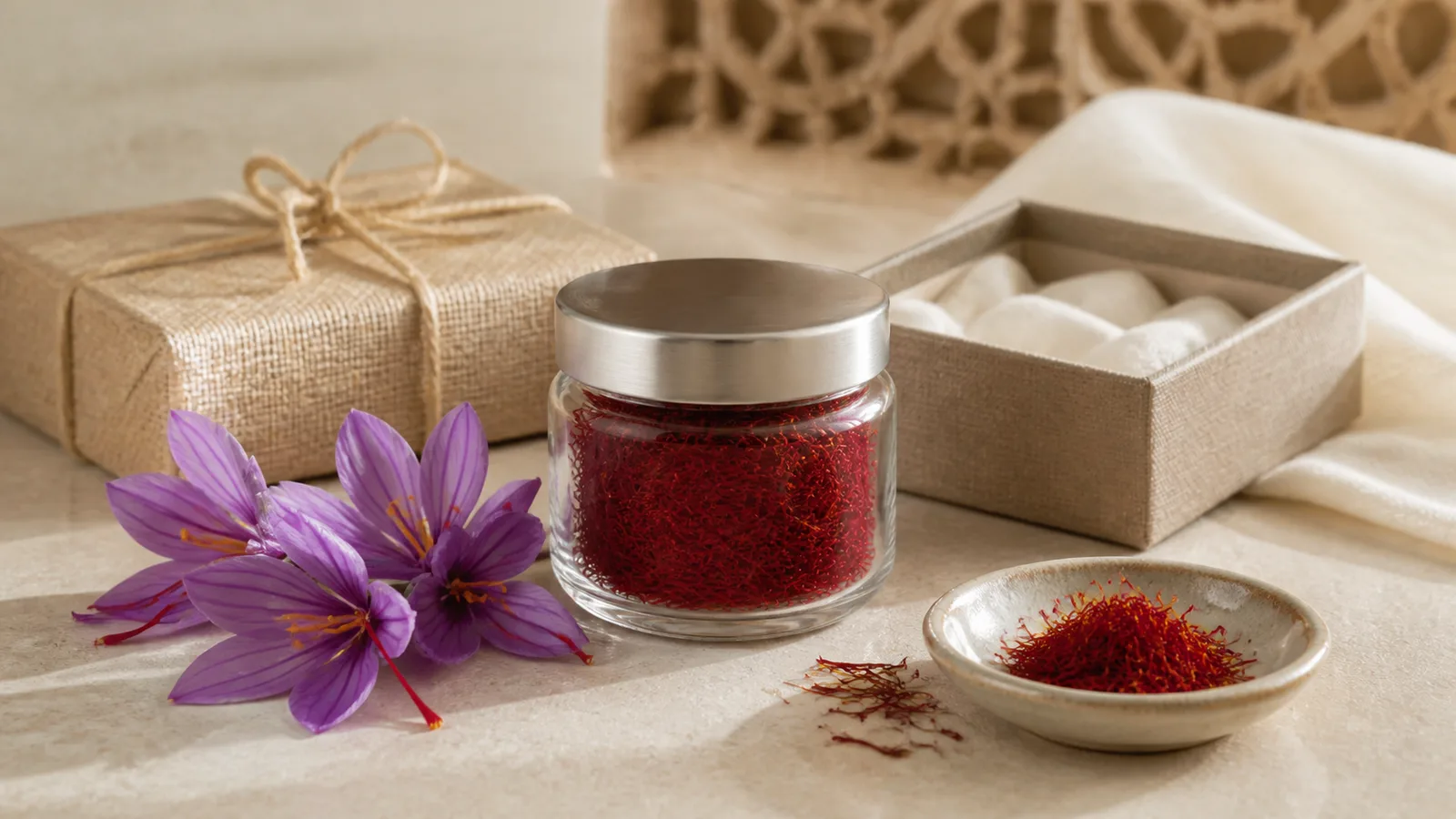
Saffron souvenirs! The idea makes sense: genuine saffron carries the colour, aroma and food culture of the place where it was grown, yet a useful amount fits into a very small package. For travellers and gift buyers, the best choice is not the most ornate box. It is saffron that is clearly identified, properly sealed and easy for the recipient to use.
Khorasan is closely associated with Iran’s saffron trade, and the spice is often called “red gold” because so much careful field and hand work is concentrated into a few grams. That value also attracts vague labels and adulteration. A souvenir should therefore tell a credible story on the label, not merely look expensive.
Why saffron works so well as a souvenir
The commercial spice is made from the dried red stigma branches of Crocus sativus. Each flower supplies only three. A scientific review estimates that roughly 150,000 flowers are needed for one kilogram of dried saffron, which is equivalent to about 150 flowers per gram. The precise number varies with stigma size, trimming and drying, so the old figure of 147,000 flowers per kilogram is best read as an illustration rather than a fixed conversion.
Once dried correctly, saffron has a high value relative to its weight. It can travel without refrigeration, and a small amount is enough for several dishes. Those practical qualities help explain why visitors choose it as a gift from a saffron-growing region.
The attraction is sensory as well as economic. Crocin-related compounds contribute the golden colour, picrocrocin contributes bitterness, and volatile compounds including safranal shape the familiar aroma. Saffron has long been used in food, colouring, fragrance and traditional practice, but a souvenir package should not promise that the spice treats a disease.
The old translation called saffron a medicinal and industrial plant and referred broadly to food, pharmaceutical and chemical products. Those labels describe areas in which saffron or its compounds have been studied or used; they do not turn a culinary package into a medicine or substantiate a health claim.
What to look for in a saffron gift
A trustworthy package makes the product identifiable after the ribbon is gone. The current Codex standard covers whole filaments, cut filaments and powder. It requires the country of origin or harvest to be stated; a production region and harvest year may also be shown. Look for a producer or packer, a net weight, a lot or batch identifier and intact food-grade packaging.
- Choose traceability over decoration. A plain sealed jar with a clear lot and origin is more useful than an elaborate unlabelled case.
- Inspect whole threads when possible. They should show recognisable red stigma material rather than a uniform dyed dust. Powder can be legitimate, but its identity is harder to judge by sight.
- Do not use colour alone as proof. Thread shape, aroma and packaging offer clues, while laboratory testing is what verifies purity and quality.
- Ask what was tested. ISO 3632-1:2025 specifies requirements for dried saffron in filament, cut-filament and powder forms. A seller citing a standard should be able to identify the test or certificate, not just print “premium.”
- Buy an amount the recipient will use. Several small sealed portions can retain quality better than one large container opened repeatedly.
For a closer look at thread shape and common warning signs, use our guide to the features of authentic saffron.
Khorasan is part of the gift’s meaning
The source was presented as a Mashhad Reporters Club item and ended with a YJC attribution. It connected saffron’s value with Khorasan’s farms and families rather than with a specific shop or tourist attraction.
The historical article behind this page described saffron as an important source of household income in South and Razavi Khorasan. It named Torbat Heydarieh, Qaenat, Ferdows, Gonabad, Bajestan, Sarayan, Birjand and Kashmar among the communities connected with the crop. It also referred to planting, field care, flower picking, transport and export earnings. Those are genuine parts of the value chain, although the old statement that more than 100,000 households depended on saffron did not identify a year or dataset and should not be treated as a current count.
The report said cultivation created many job opportunities and that transporting a lightweight, high-value spice was comparatively inexpensive. Both are plausible economic advantages, but actual employment and transport costs depend on the harvest, labour arrangements, distance, packaging and market. They should be measured, not assumed from the phrase “red gold.”
Saffron can suit dry regions, but the old claim that it needs water only twice—once before flowering in early November and again at the end of harvest in early December—cannot be applied everywhere. Irrigation timing depends on local climate, soil, corm development and the production system. Rain and snow may help carry a field into spring in some Khorasan conditions; they are not a universal water plan.
The production figures in the earlier translation are also historical and internally inconsistent. One passage gave Iran an average of 100 tonnes and Spain 25 tonnes; another described 230 tonnes worldwide, more than 170 tonnes in Khorasan and about 172 tonnes in Razavi Khorasan, followed by a malformed “5, 75 percent” share. It additionally listed India, Greece, Morocco and Afghanistan alongside Russia, Singapore, Malaysia, Japan, Taiwan, China, France, Italy, Germany, Australia and an unclear “Spuron Islands.” Because no common year or source was supplied, these numbers and that list should not be quoted as a present production ranking.
The history is richer than a single origin claim
Saffron has a deep cultural history in Iran, but cultural importance and botanical origin are different questions. The old account said Iran was the plant’s original home and connected saffron with Achaemenid bread, Parthian trade to Greece and Rome, Sassanian cultivation around Qom, writing ink, costly paper, celebrations, weddings and welcomes in which saffron and rose water were used.
It also told a migration story in which Iranian exiles under Muawiyah carried saffron cultivation to the Levant, followed by North Africa, Andalusia and Sicily, with groups translated as the Rustamids and Banu Tabari helping to spread the practice. That is a traditional historical narrative from the earlier report, not a verified route map.
Modern botanical and genetic evidence is more cautious. Kew treats Crocus sativus as a cultigen associated with Greece, and a review combining ancient art and genetics argues for domestication in ancient Greece. The same review notes cultivation across ancient Greece, Persia and other Mediterranean cultures for more than three millennia. A good Iranian saffron souvenir can celebrate Iran’s long cultivation, cuisine and trade without claiming that a debated question has only one answer.
What the saffron plant actually looks like
The plant grows from a corm, not a true onion or bulb. Because cultivated saffron is a sterile triploid, farmers propagate it through corms and the daughter cormlets they produce. Corms may look flattened, rounded or broadly oval, with differences in neck width and base shape. Those variations are more accurately described as planting-material traits than as a consumer grade for the finished spice.
Narrow leaves emerge from the base and can vary in length and thickness with growing conditions. A flower has six petal-like tepals, three yellow stamens, a style and three orange-red stigma branches. The dried stigma material is the saffron sold for cooking. The older translation confused petals with sepals, style with “cream,” stigma with a “hat,” and corm with “bacon,” “bowl,” “soup” or onion; those are translation errors, not additional plant parts.
That text also listed Khazari, Zagros, white, purple, “beautiful” and Jow Qasem as varieties without a taxonomic source. They should not be treated as internationally accepted cultivars on the strength of that list alone. Kew recognises the crop species as Crocus sativus.
Fresh stigmas can look vividly red, while careful drying changes their moisture, texture and perceived depth of colour. A darker thread is not automatically older or better, and a bright red product is not automatically fresh. Origin records, handling and testing matter more than a colour adjective.
How to present and store saffron souvenirs
Keep the original sealed package for travel and place it inside a rigid outer box if the container is fragile. At home, protect saffron from moisture, direct light, heat and repeated exposure to air. A small airtight glass or food-grade metal container kept in a cool, dark cupboard is usually practical.
Do not put loose threads into a decorative pouch, and avoid a refrigerator unless moisture and condensation are rigorously controlled. Label any divided portions with their origin and purchase or harvest information. Our detailed saffron storage guide explains how light, air and moisture affect the spice.
The most convincing gift is simple: traceable Crocus sativus threads, an honest weight, sound packaging and enough context for the recipient to know why the spice matters. That preserves what makes Khorasan saffron memorable without relying on unsupported health promises, impossible production rankings or decoration that says nothing about the product inside.
Sources reviewed: FAO/WHO Codex Alimentarius, CXS 351-2022; ISO 3632-1:2025; Kew Plants of the World Online, Crocus sativus; and the peer-reviewed reviews Saffron: phytochemistry, significance and omics-based biology and Ancient artworks and crocus genetics both support saffron’s origin in early Greece. All accessed 25 August 2026.

![Exporting Saffron to Turkey + Price Guide [Complete 0 to 100]](https://img.rowhanisaffron.com/20260827003933/saffron-export-turkey-quality-inspection.webp)



