


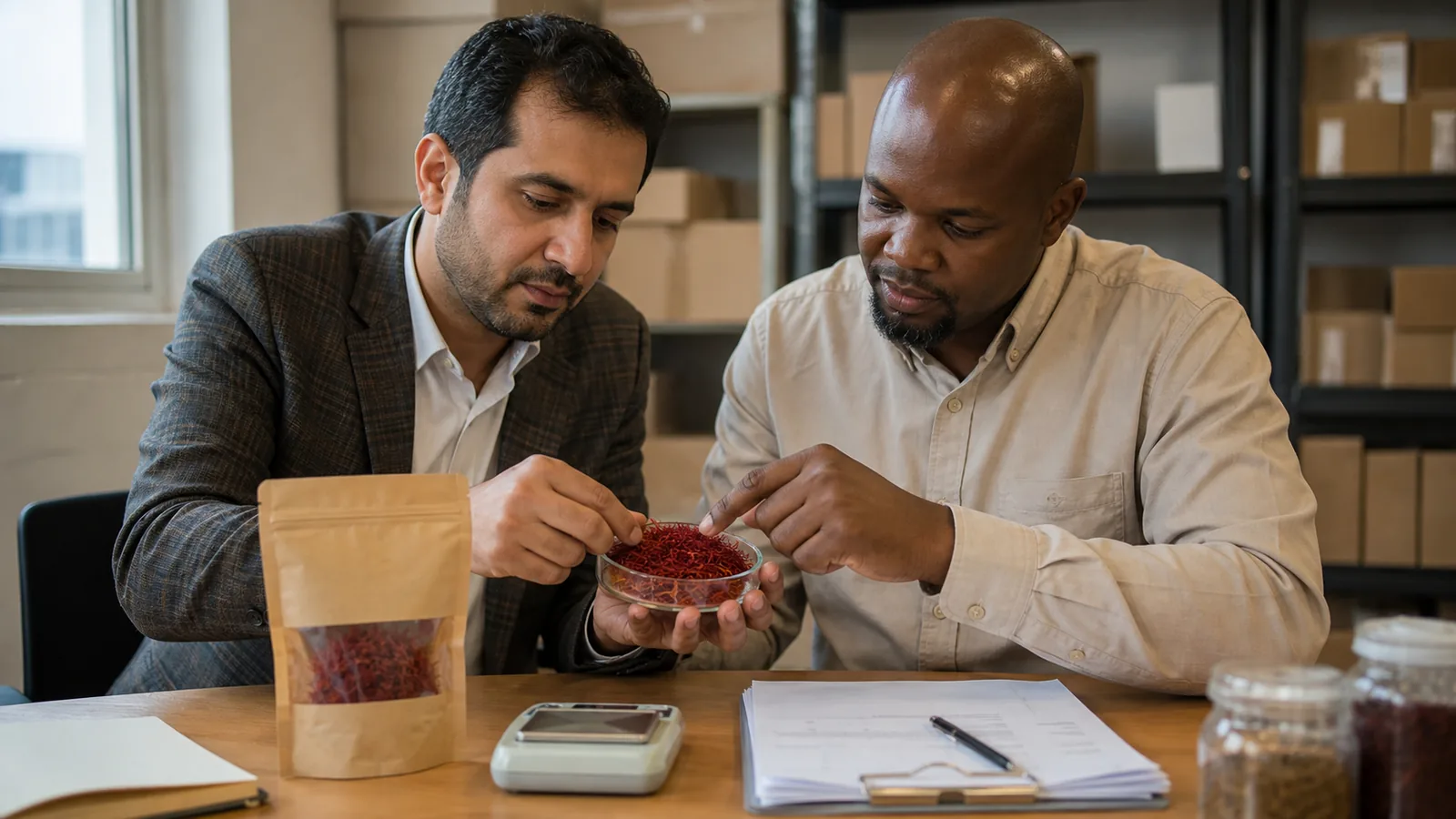
The historical report behind “Khorasan saffron imports to South Africa” recorded interest, not a completed shipment. It said South African traders wanted to buy saffron from South Khorasan and that the province’s producers were ready to build trade relationships. That is useful evidence of an opening, but it is not proof of a current contract, today’s import volume or an active government programme.
For a Khorasan supplier, the practical question is what turns that interest into an order that can clear South African customs and satisfy the buyer after delivery. The answer starts with a defined lot, a real buyer specification and a quotation whose product, packaging, documents and delivery terms are all clear.
What the South Khorasan meeting actually reported
The page, published here in 2015 and attributed to IRIB, described a meeting between South African representatives and entrepreneurs and traders in South Khorasan. It names William Whitehead as South Africa’s ambassador and reports him saying that some South African traders were interested in importing saffron. In his account, the quality of South Khorasan saffron could support a good commercial relationship.
The interest was wider than red gold. The ambassador also mentioned South African demand for honey, ceramic tiles and ceramics, products that South Khorasan could supply. He spoke about innovation in trade, a trade and business committee, and an Iran–South Africa Business Council that was being formed. The report said a framework had been prepared for the two governments.
A representative of the South Khorasan Chamber of Commerce then pointed to Iran’s existing date exports to South Africa. He said Tabas, in South Khorasan, produced high-quality dates and could use commercial ties with South Africa to develop that trade. The same speaker, identified in the old translation as Mr Ehtesham, said the province was prepared to send delegations to identify opportunities and expand trade relations. South Khorasan’s rubber industry was named as another possible field.
Those details belong in the record because they show the scope of the meeting. They should not be mistaken for later results. The article does not supply a contract number, shipment date, quantity, buyer name or customs record. It also does not establish whether the proposed committee, business council framework or delegations produced a saffron sale.
Interest, an order and an import are three different things
A buyer enquiry can be serious without yet being commercially complete. The buyer may still be comparing origins, checking local demand or working out whether a small retail pack, a food-service pack or bulk threads suit the intended channel. An exporter should therefore ask what the saffron will be used for, who will import it, what evidence the buyer needs and what quantity can realistically be sold.
A purchase order should identify the product form, grade or agreed specification, harvest or packing information, lot size, pack format, price basis, delivery term and documents. A shipment becomes a South African import only when it follows the required customs and food-control process and is accepted into the country. Keeping those stages separate prevents a promising meeting from being reported as trade that never occurred.
Market research needs the same discipline. Saffron has its own six-digit customs classification, HS 0910.20, in the South African Revenue Service tariff system. That code is more useful than broad figures for “spices,” which can combine saffron with products that sell in much larger volumes. Even an exact-code total may include several origins, qualities and routes. It shows recorded trade, not retail demand for a particular Khorasan lot.
Reading the South Africa saffron market before quoting
The phrase “South Africa saffron market” covers several different customers. A restaurant distributor may value reliable small wholesale packs and quick replenishment. A spice retailer may need shelf-ready labels and a story it can substantiate. A food manufacturer will usually care more about repeatable strength, documentation and lot-to-lot consistency. An online seller may begin with a modest quantity but expect strong packaging and traceability.
That means an exporter should not start with one generic offer for the whole country. A short conversation with a real importer can establish the intended channel, pack sizes, annual or seasonal use, delivery point and acceptable price range. Samples then need to represent the lot that would actually be supplied. A beautiful display sample followed by a different commercial batch damages trust quickly.
Historical interest from traders is a lead worth testing, not a forecast. Current import data, conversations with buyers and repeat orders are stronger signals. When those signals disagree, the smaller trial order is usually the more sensible first step.
Who is responsible for the South African import?
South African customs formalities need an identified party on the importing side. SARS states that a person importing goods into South Africa must register as an importer. A foreign importer must nominate a registered agent in South Africa, and the customs requirements differ according to who files the declaration. The SARS importer guidance should be checked by the buyer or its customs representative before shipment.
The commercial agreement should say who is the importer of record and who pays freight, insurance, clearance costs, inspection charges and any taxes or storage caused by delay. An Incoterm is helpful only when the named place and version are stated and both parties understand the responsibilities behind it. “Delivered price” without those details is not a reliable comparison.
Plant-health rules may also apply to dried plant material. South Africa’s official procedure for importing plants and plant products tells importers to establish the phytosanitary conditions and obtain a permit or certification where required. The precise treatment of a finished saffron consignment can depend on its form, processing, origin and intended use, so the local importer should confirm the current requirement for that shipment rather than relying on a previous consignment or a seller’s assumption.
Quality has to be translated into a specification
“South Khorasan quality” is a useful origin proposition, but it is not a complete buying standard. Two lots from the same province can differ because of flower handling, separation of the stigmas, drying, storage, age and the amount of yellow style or foreign matter. The buyer needs evidence for the batch being offered.
The international Codex standard CXS 351-2022 for dried saffron provides a useful baseline for product identity, styles, quality, contaminants, hygiene and labelling. A commercial specification can build on that baseline with the thread style, physical purity, moisture, agreed analytical measures, microbiological or contaminant tests, packaging material and shelf-life evidence required by the customer.
Laboratory results should identify the tested lot and the method used. They are not a permanent certificate for every future shipment. The sample seal, batch code, packing record and commercial invoice should connect the result to the goods that arrive. Where origin is part of the sale, the traceability record must support that claim instead of depending on a red-and-gold package or a picture of a crocus field.
The same caution applies to price. A quotation for long red threads cannot be compared fairly with one for a mixed cut or powder unless the buyer has asked for the same product. Freight, insurance, testing, pack size and payment timing can outweigh a small difference in the ex-works price. The site’s discussion of building a resilient saffron export offer explains why repeatable evidence matters more than confidence based only on production scale.
Packaging and labels should be agreed before production
A bulk food-service pouch and a retail jar have different jobs. Both should protect saffron from moisture, strong light, odours and avoidable handling, but the retail pack also has to carry information suitable for sale in South Africa. The exporter should send the proposed artwork, pack construction and label copy to the local importer before a print run.
South Africa’s Department of Health maintains the country’s food-control and labelling resources. Its rules cover food manufactured, imported and sold in the country, while draft changes and product-specific requirements can alter what must appear. Rather than treating a copied internet checklist as legal approval, the parties should verify the current requirements for the product and channel. Product name, ingredients where applicable, net quantity, lot identification, date information, storage directions, country of origin and responsible business details all need to be reviewed in that process.
Claims need particular care. “Pure,” “organic,” geographical-origin and health language require appropriate support and may trigger additional rules. Saffron can be sold as a food ingredient without promising that it treats disease. A clean label that tells the truth about the actual lot is more valuable than ambitious copy that a regulator or buyer cannot verify.
A practical route from a sample to a repeat order
- Identify the South African buyer, its sales channel and the registered importer or agent responsible for clearance.
- Confirm HS classification, current customs, plant-health, food-control and label requirements with the relevant local professionals.
- Agree one written saffron specification and provide a representative, traceable sample from the intended lot.
- Quote the same product, pack and delivery basis the buyer requested, including the named place and responsibilities.
- Approve the label and documents before printing or dispatch, then begin with a quantity the channel can absorb.
- After arrival, review clearance time, product condition, customer response and replenishment demand before increasing volume.
A trade delegation can open the door and a business council can make introductions, but neither replaces this work. The supplier still has to turn a broad promise about Khorasan saffron into a controlled batch that fits a South African customer’s use and arrives with the right evidence.
The wider trade ideas should remain separate
The old meeting also discussed honey, tiles, ceramics, dates from Tabas and the rubber industry. Those opportunities help explain why the participants were talking about a broader South Khorasan–South Africa relationship. They do not prove demand for saffron, and the compliance, buyers and logistics for each product are different.
Keeping the sectors separate makes the saffron proposal stronger. A buyer looking for red gold needs a focused answer about threads, testing, pack format and delivery, not a catalogue of unrelated provincial products. The historical report’s most durable point is therefore modest: South African traders expressed interest, and South Khorasan was willing to develop the relationship. The next step is evidence—first for the market, then for the lot, and finally for a shipment that can become a repeat order.
The William Whitehead, IRIB, trader-interest, honey, tile, ceramics, committee, business-council framework, Tabas dates, Mr Ehtesham, delegation and rubber-industry statements are retained as claims from the historical report published on this site in 2015. They are not presented as current programmes or completed transactions. SARS, South African food-control, plant-import and Codex sources were reviewed on 29 August 2026; the importer must confirm requirements applicable to the actual consignment.

![Exporting Saffron to Turkey + Price Guide [Complete 0 to 100]](https://img.rowhanisaffron.com/20260827003933/saffron-export-turkey-quality-inspection.webp)



