


Saffron will be developed in Khorasan Razavi was the promise behind a provincial development programme reported in 2015. The aim was not simply to plant more land. Officials wanted growers to raise yield, reduce production costs, improve processing and packaging, and receive a fairer share of export value.
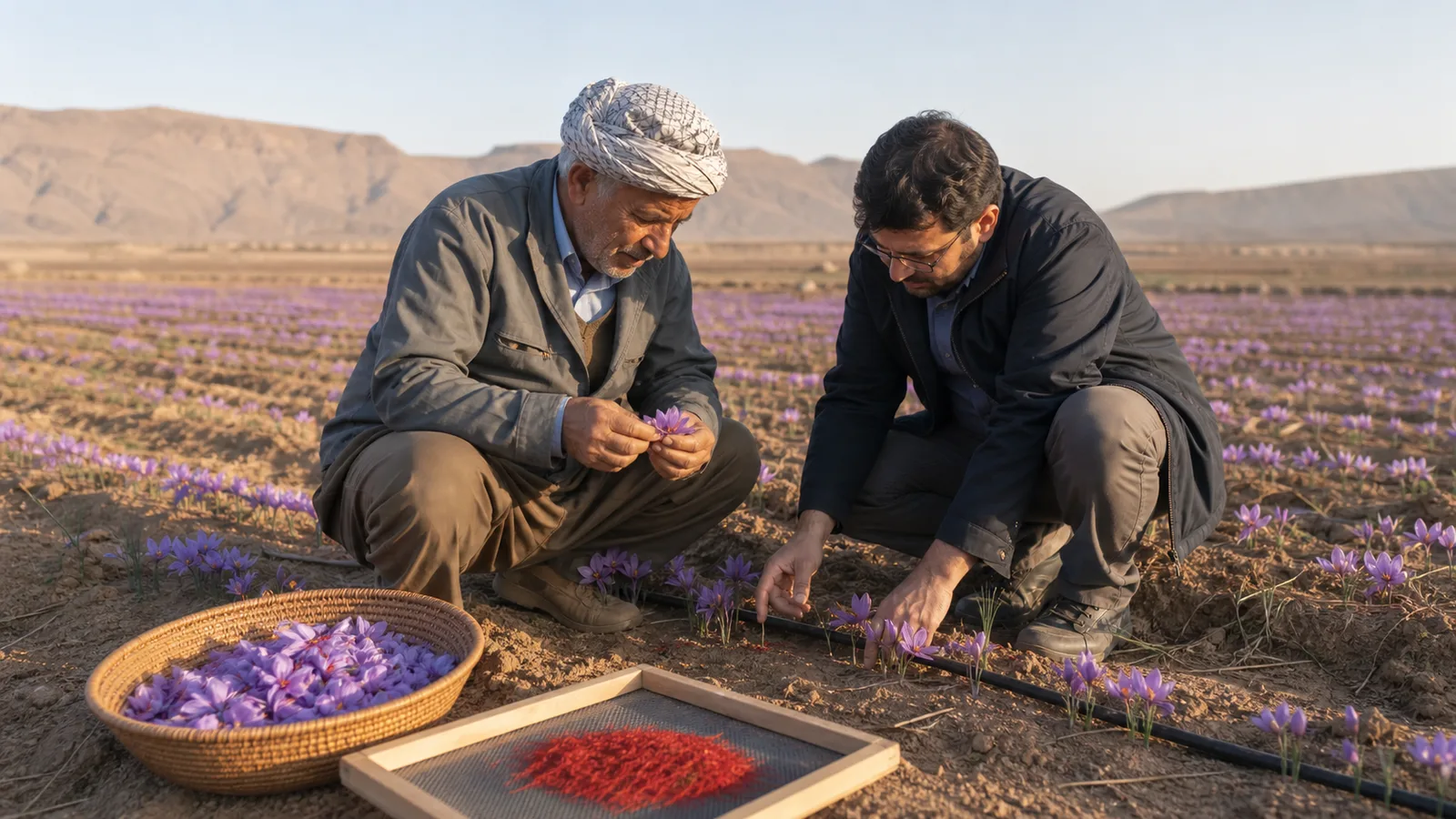
The original targets now belong to a historical plan, so they should not be read as current forecasts or confirmed achievements. They still explain an important question: how can Iran’s main saffron-growing province increase farm income without allowing extra acreage, weak quality control or an inefficient sales chain to absorb the gain?
A development plan built around yield
Ramin Esmi, then head of the saffron unit at the Khorasan Razavi Agricultural Jihad Organization, put the provincial average at about 3.5 kilograms of dried saffron per hectare. The programme’s ambitious goal was to lift average yield above 8 kilograms per hectare.
That distinction matters. If the same crop can be produced on less land, expansion is not the only route to growth. Better corm selection, field preparation, nutrition, irrigation timing, flower collection and post-harvest handling can all be examined before more hectares are planted. Our practical saffron planting guide explains the cultivation cycle in more detail.
The 2015 report associated the plan with provincial production of roughly 250 tonnes and a target of 500 tonnes by the Iranian year 1404, which ended in March 2026. That was a target, not proof that the province later produced 500 tonnes. The same report referred to a comprehensive programme approved in 1391 and to an estimated 300 billion tomans in credit needs through 1393 for production, processing and trade.
How dominant is Khorasan Razavi?
A second archived market report said Khorasan Razavi accounted for more than 80% of Iran’s saffron area and output. It placed the province at about 70,000 cultivated hectares, up from 69,000, and said 218 tonnes had been harvested in the previous season with approximately 240 tonnes forecast for the next one. Its average yield estimate was around 4 kilograms per hectare.
Those figures are consistent with the historical agricultural statistics Iran submitted to the Codex Committee on Spices and Culinary Herbs: the table lists Khorasan Razavi at 69,407 hectares, 218.348 tonnes and 3.1 kilograms per hectare for that reporting period. The official Codex paper is useful because it anchors the old article’s scale to a dated primary record.
The province remains central to the sector, but its current scale is different. A later Ministry-linked provincial report put Khorasan Razavi’s saffron area near 91,000 hectares. Because acreage, yield and output vary by crop year, figures from different years should not be combined into a new production estimate.
The historical harvest and price snapshot
The two archived accounts also preserve conditions from a specific season:
- Provincial production in Iranian year 1393 was reported more than 15% below 1392, while exports in 1393 were said to have risen 27%.
- Exports of stored saffron in Farvardin 1394 were reported 29% above the same month a year earlier.
- A Gonabad grower said the producer price had moved from 22,500 to 26,000 tomans per mesghal.
- The market-regulation director quoted Negin saffron above 63 million rials per kilogram.
These are nominal historical quotations, not today’s wholesale or retail prices. They use different units and may refer to different grades, points in the supply chain and transaction sizes. Converting one into the other without a date, grade and exchange-rate basis would create false precision.
Why farmers’ share of exports was part of the plan
Both reports were concerned about brokers and speculative buying. Intermediaries can perform legitimate work: aggregating small lots, testing quality, storing product, financing inventory, arranging packaging and finding buyers. The problem described by officials was not the existence of every intermediary; it was a chain in which growers carried cultivation risk while too much of the final margin accumulated elsewhere.
Seyed Hamid Javadi, then director of market regulation and agricultural business development in the province, said a new programme was being prepared to give farmers and producers a direct share in saffron exports. He also argued that the market needed clearer private-sector stewardship and organised purchasing rather than uncontrolled dealing.
A workable producer-share programme needs more than a slogan. Lots must be traceable to farms, quality must be tested consistently, payments must be transparent, and growers need enough storage or finance to avoid selling every flower under harvest pressure. Cooperatives, processors and exporters can then add value without obscuring who produced the crop or how its grade was established.
Water, climate and the cost of higher yield
Saffron suits many dry regions because its irrigation demand is lower than that of numerous summer crops, but it is not independent of water. The Gonabad grower in the original article described land preparation and irrigation beginning around early Mehr, harvest starting near mid-Aban, and picking continuing for roughly 25 days. Timing varies with location and weather.
Summer heat, drought, untimely irrigation and unsuitable water can reduce flowering or weaken a field over successive seasons. Modern irrigation may improve control and labour efficiency, but pumps, pipes and field work require capital. That is why the development proposal paired higher-yield methods with low-interest, longer-term finance rather than expecting farmers to fund every upgrade from one harvest.
Quality and Iranian identity after harvest
The earlier programme treated processing, trade and packaging as part of production development. That remains sensible. Higher field yield has limited value if stigmas are dried poorly, mixed across untraceable lots, exposed to moisture or sold without credible testing.
The old article warned that Iranian saffron sold without an identifiable Iranian pack could lose both value and identity farther along the trade chain. Today, the issue is better framed as traceability and authenticity rather than a claim that packaging alone prevents fraud. In 2025, the FAO and Mashhad University of Medical Sciences began work on more advanced authenticity testing and practical post-harvest guidance. The programme complements international ISO 3632 testing and aims to protect colour, flavour and aroma from farm to buyer.
FAO’s current overview places Iran at roughly 85–90% of world saffron production, not the 95% figure repeated in the 2015 article. Its 2025 value-chain report also identifies Khorasan Razavi and South Khorasan as major centres supporting hundreds of thousands of smallholders.
What development should mean now
For Khorasan Razavi, development should be judged by more than tonnes. The useful measures are yield that does not exhaust soil or water, income retained by growers, verified quality, safe working conditions during the short harvest, efficient processing, transparent prices and buyers who can identify the origin of a lot.
That is the lasting meaning of the old promise that saffron will be developed in Khorasan Razavi. The province already had scale. The harder task was, and remains, turning that scale into dependable quality and a value chain in which growers benefit from the reputation their crop has created.

![Exporting Saffron to Turkey + Price Guide [Complete 0 to 100]](https://img.rowhanisaffron.com/20260827003933/saffron-export-turkey-quality-inspection.webp)



