


Red gold production in Iran Roof’s is a 2015 report about saffron farming in the high, mountainous province of Chaharmahal and Bakhtiari. The unusual English headline refers to the province’s elevated landscape—the “roof” idea—and to saffron’s familiar nickname, red gold. At the time, cultivated area had risen sharply and officials hoped the crop would create income, jobs and a new regional souvenir.
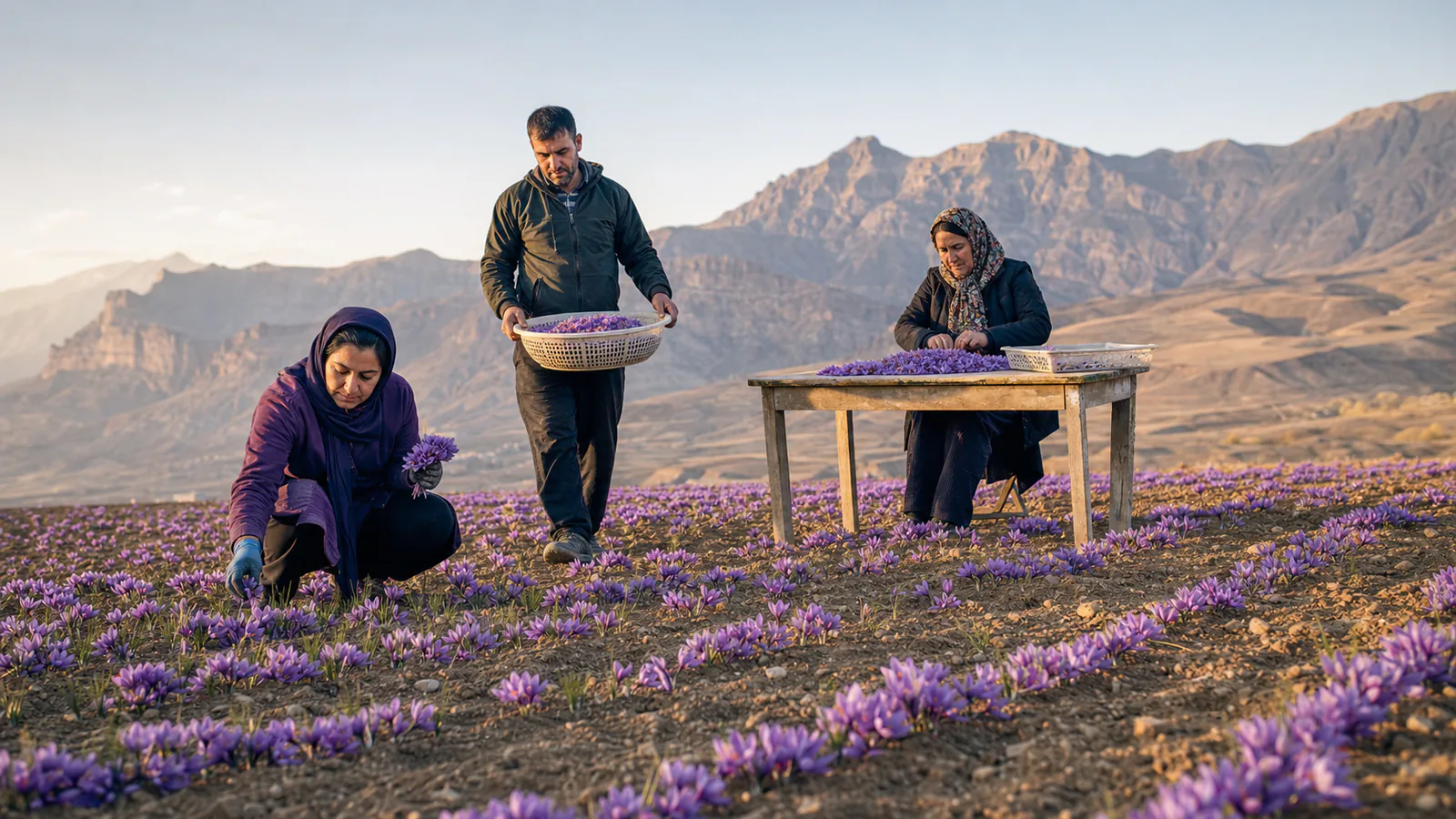
Why growers tried saffron on Iran’s high plateau
Mehr News Agency described Chaharmahal and Bakhtiari as a four-season province with varied climates, fertile areas and a long association with valuable plants. Farmers had begun testing saffron on small plots, then expanded as the crop appeared able to flower under local conditions.
The article said planting began in early autumn and harvesting started in Aban, the Iranian month spanning roughly late October to late November. Saffron’s seasonal cycle can suit places with dry summers and cool autumns, but a broad provincial label cannot prove that every field is suitable. Drainage, temperature, irrigation timing, corm health and labor availability still need to be assessed parcel by parcel.
Saffron is often called a low-water crop. That means it can require less irrigation than some alternatives; it does not mean the plant can produce without water. Corm growth, flower initiation and yield remain sensitive to when water is available.
The 2015 production figures
Seyed Taher Noorbakhsh, then the provincial Agricultural Jihad Organization’s horticulture director, told Mehr that Chaharmahal and Bakhtiari had about 80 hectares under saffron. The report placed the average harvest at 3.5 kilograms of dried saffron per hectare.
It also said cultivated area had risen from 43 hectares in the previous year to 80 hectares—almost doubling. Iran’s national output was given as 254 tonnes. These are historical figures from the report’s period, not current acreage or production statistics.
Yield per hectare is not a guarantee. Field age, corm size and density, weather, soil, irrigation, flower-picking capacity and drying losses can all change the final weight. A current plan should use several years of verified local results rather than one provincial average.
What farmers said about income and work
A grower identified as Hosseini said saffron had first attracted attention on small farms and later spread to more holdings. In his experience, the crop produced useful income and created work for members of his family.
The report valued saffron at five million tomans per kilogram at that time. The old automated translation incorrectly rendered this as dollars. Even the corrected figure should not be used for present budgeting: currency value, saffron grade, inflation and buyer terms have changed since 2015.
“Red gold” can also hide costs. Establishing a field requires healthy corms, soil preparation and irrigation. Harvest concentrates into a short period, with each flower picked and its three red stigmas separated by hand. Drying, testing, packaging and selling continue after the visible field work ends.
Does altitude automatically mean better saffron?
Farmers interviewed for the article believed the province’s altitude gave their saffron particularly high quality and strong market appeal. Another grower, Kavoosi, said Chaharmahal and Bakhtiari saffron had found a favorable place in the market.
Altitude can affect temperature, rainfall and flowering conditions, but it is not a quality grade. Research has found that cultivation site and weather interact with corm origin to influence yield and the compounds used to assess saffron color, taste and aroma. Harvest timing and post-harvest drying matter as well.
The reliable way to support a “higher quality” claim is to test a representative batch under a recognized method such as ISO 3632. A province’s elevation or reputation cannot replace analytical results and traceability.
Cultivated saffron versus wild crocuses
The 2015 story called the province an early habitat of wild saffron. That wording needs care. Wild Crocus species may grow in a region, but they are not automatically the cultivated saffron crocus.
Modern genetic research identifies Crocus sativus as a sterile triploid crop that is propagated clonally by corms. One genome-wide study traced it to wild Crocus cartwrightianus near Athens. A local wild crocus should therefore be identified botanically before anyone connects it to the origin of commercial saffron.
What makes saffron a useful regional souvenir
By 2015, some farmers were packaging their own harvest for market, and the article described saffron as an emerging souvenir of Chaharmahal and Bakhtiari. That idea has more value when origin is documented rather than treated as a decorative claim.
A credible regional pack should identify the grower or lot, harvest year, production area, net weight, storage guidance and the business responsible for packing. Testing can support grade and authenticity. These records allow buyers to connect the finished threads with the highland fields in which the flowers grew.
Health claims were not evidence for the farming case
The original article called saffron “anti-cancer” as a reason for rising demand. That was too strong. Laboratory research on saffron compounds does not show that eating saffron prevents or cures cancer, and a provincial production story cannot establish a medical benefit.
The agricultural case should stand on measurable ground: whether local fields produce a traceable crop of consistent quality, whether growers can manage water and labor, and whether buyers will pay enough to cover the full cost.
The lasting meaning of “red gold” on Iran’s roof
The 2015 report captured a crop in transition. Chaharmahal and Bakhtiari had moved beyond a few trial plots, acreage had nearly doubled, and growers saw family income and a regional product taking shape. Officials offered cultivation training and called for further farmer support.
Its figures and price belong to that year. Its useful lesson is still current: high terrain may create an opportunity, but sustainable red gold production depends on verified field suitability, healthy corms, skilled harvest, controlled drying, honest quality claims and a market that preserves the crop’s local identity.

![Exporting Saffron to Turkey + Price Guide [Complete 0 to 100]](https://img.rowhanisaffron.com/20260827003933/saffron-export-turkey-quality-inspection.webp)



