Crocin saffron cell culture was produced for the first time in Iran, according to a laboratory announcement reported in 2015. Dr. Seyed Mahdi Ziaratnia of Iran’s Research Institute of Food Science and Technology described the result as the country’s first laboratory-scale production of saffron crocin through plant cell culture. It was an early research milestone, not evidence of a commercial factory or a replacement for harvested saffron.
What the Iranian team actually reported
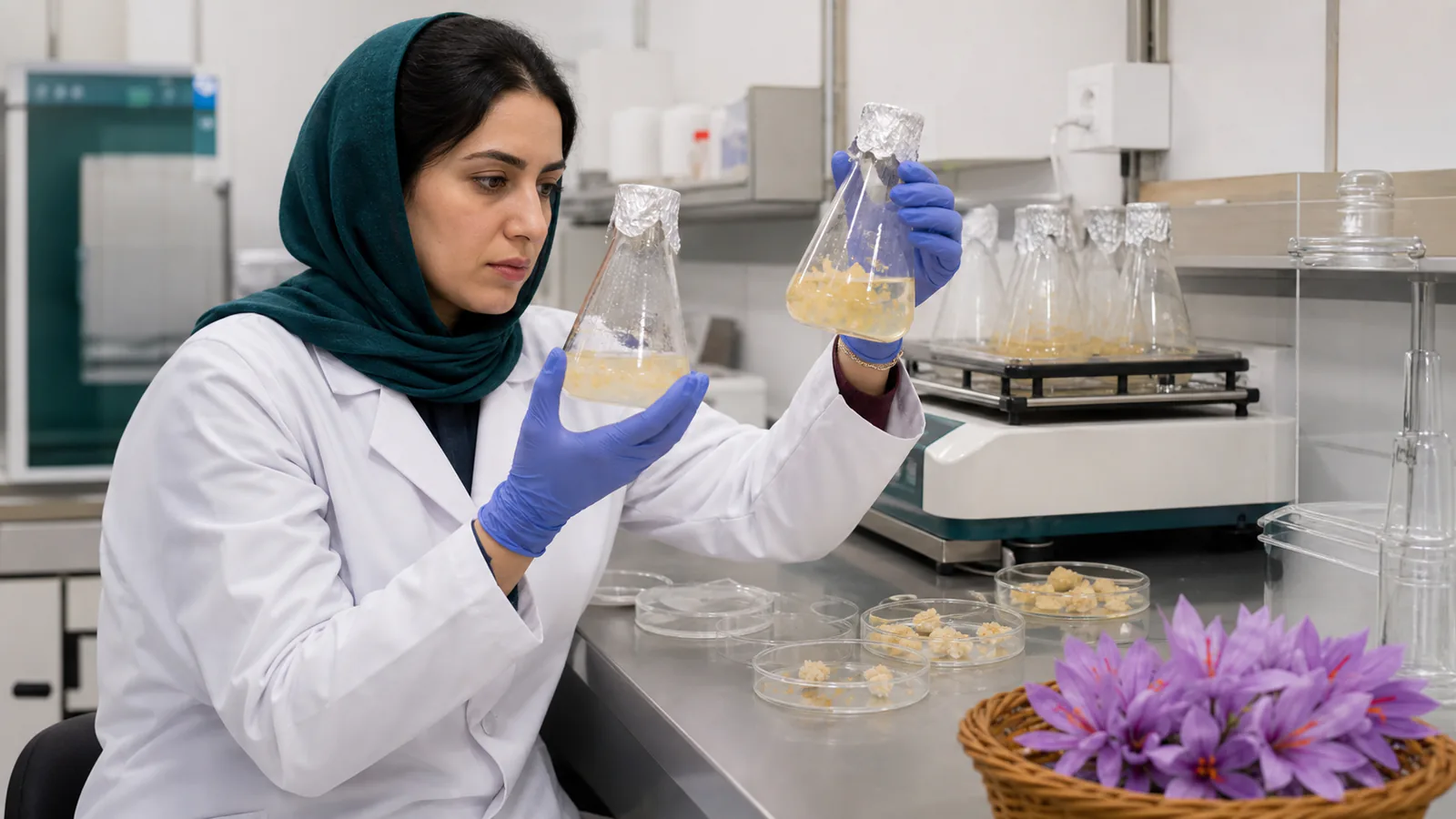
Mehr News Agency quoted Ziaratnia as saying that the institute had produced crocin at laboratory scale using cell culture. The idea was to grow saffron-derived cells under controlled conditions and encourage them to make the target pigment without waiting for flowers in a field.
The announcement argued that this approach could avoid weather limitations and some of the labor involved in conventional saffron farming. It also suggested potential value for food, pharmaceutical, cosmetic and hygiene industries.
Those were proposed advantages. The 2015 article did not provide a measured yield, purity profile, batch-to-batch variation, production cost, safety assessment or regulatory status. “More economical” was therefore a research goal, not a demonstrated commercial result.
Crocin is a component, not the whole spice
Crocin is the name commonly used for a family of water-soluble, carotenoid-derived pigments that give saffron much of its color. Dried saffron also contains other compounds, including picrocrocin and volatile aroma compounds such as safranal.
A cell culture that makes crocin has not produced complete saffron. It has produced one class of compounds associated with the spice. The distinction matters for labeling, food use and any comparison with genuine dried Crocus sativus stigmas.
Our separate technical explainer covers the broader production of saffron crocin by cell culture. This page focuses on what the Iranian “first” claim meant and how the work developed.
Was it the first cell-culture crocin anywhere?
No. The claim was specifically “for the first time in Iran.” Plant-cell production of crocin had been studied elsewhere before 2015. A 2003 peer-reviewed experiment used a two-stage culture of saffron callus and reported 0.43 grams of crocin per liter under its laboratory conditions.
That earlier work does not invalidate the Iranian milestone. Establishing a local saffron cell line, culture process and analytical capability can be meaningful. It does prevent the headline from being misread as the first such result in the world.
How plant cell culture makes crocin
Researchers usually begin with sterile plant tissue and induce it to form callus, a mass of relatively undifferentiated cells. Suitable cells can then be transferred to a liquid suspension. The medium supplies sugars, minerals and plant growth regulators, while the team controls variables such as temperature, light, pH, mixing and oxygen transfer.
Producing more cells does not necessarily produce more crocin. Conditions that favor biomass can differ from those that favor a secondary metabolite. The researchers therefore have to optimize both growth and pigment accumulation, then extract and identify what the culture produced.
What later work by the researchers showed
A 2022 paper co-authored by Ziaratnia moved the project from a simple announcement to published process data. The team tested saffron cell growth and crocin production in flasks and a stirred bioreactor. According to the FAO AGRIS record, culture-medium buffering, sucrose supply, pH behavior and aeration affected the outcome.
The authors reported up to 2 milligrams of total crocin per gram of cell dry weight under the tested non-constant-pH, non-aerated bioreactor conditions. They also found that aeration could increase cell growth when evaporated water was replaced, yet did not increase crocin production at the tested level.
This follow-up supports the continuity of the Iranian research. It also shows why scale-up is difficult: a change that helps biomass may not help the target metabolite.
What the laboratory result did not prove
The original article made broad statements about crocin and disease prevention. Laboratory production does not establish that crocin prevents cancer or cardiovascular disease in people. A biological compound, a cell experiment and an approved treatment are three different things.
Before cell-cultured crocin could enter a commercial food or pharmaceutical product, a manufacturer would need a reproducible process, defined composition, contaminant controls, stability data and the approvals required for the intended use. Health claims would need their own high-quality human evidence and regulatory authorization.
Why the 2015 announcement still matters
The result showed that Iranian researchers were exploring a second route to saffron-derived color compounds: controlled plant-cell production alongside field cultivation. Later bioreactor work turned that idea into measurable process research.
The careful conclusion is narrow but useful. Crocin was produced from saffron cell culture at laboratory scale in Iran; the work continued and improved. It did not produce whole saffron, prove medical benefits or demonstrate an economical industrial process.