


Hamedan saffron dried in Khorasan describes a supply-chain problem recorded in 2015. Hamedan growers could raise the crop, but they depended on Khorasan for planting corms, specialist labor, drying or sale. The journey did not make the saffron “Khorasan-grown”; it showed that a new production region needed post-harvest skills and infrastructure as well as suitable fields.
Why Hamedan relied on Khorasan
Rahim Bayat, then a deputy horticulture official in Hamedan Province, told Mehr News Agency that about seven hectares of saffron were cultivated in Hamedan city. One early constraint was planting material. Local corm supplies were limited, so growers brought corms from Khorasan.
The report estimated that establishing one hectare could require three to five tonnes of corms. Bayat also described a formal letter process for moving planting material from Khorasan to another province. The purpose was control and traceability, not a claim that any corm could be moved safely with a letter alone.
A corm lot should be correctly identified as Crocus sativus, healthy, undamaged and appropriate in size. Moving infected planting material can spread rot, mites or viruses into a clean field. Current growers should follow the plant-health and transport rules that apply now rather than relying on a 2015 administrative practice.
A short and labor-intensive harvest
The historical Hamedan season was described as a concentrated 20-day harvest, from the beginning to the twentieth of Aban—roughly late October into mid-November. Flowering dates vary with weather, irrigation, elevation and field conditions, so the calendar is a local record rather than a universal schedule.
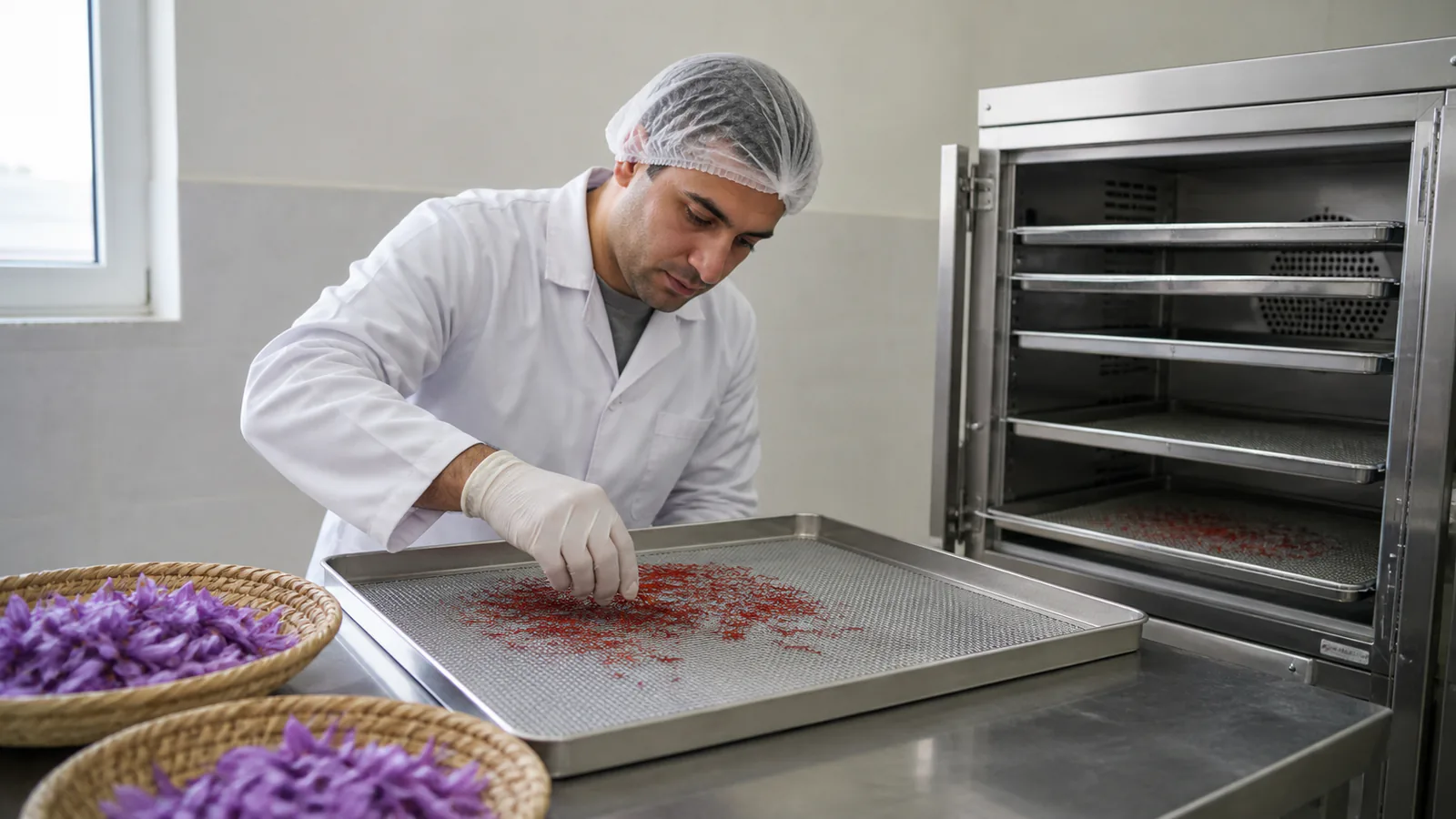
During that short window, flowers need to be picked promptly and handled without crushing. The red stigmas are separated by hand, and the fresh material must then be dehydrated. Hamedan farmers told Mehr that locally experienced saffron workers were scarce, whereas Mashhad had a deeper pool of skilled labor.
That skills gap affects more than speed. A worker must recognize the usable stigma, avoid excessive yellow style, keep batches clean and move the separated material to drying before quality deteriorates.
Drying changes the finished spice
Fresh stigmas are not shelf-stable saffron. Dehydration removes most of their water and creates or preserves the sensory profile buyers expect. The process influences crocins associated with color, picrocrocin associated with taste and safranal associated with aroma.
Research confirms that time, temperature and airflow can change those compounds. One controlled drying study found markedly different pigment and aroma retention under different temperature and airflow treatments. There is no responsible single temperature to copy without specifying the dryer, batch depth, starting moisture, airflow and validated endpoint.
The current ISO 3632-1:2025 specification covers dried saffron and includes recommendations for storage and transport. A professional local facility should work to a documented process, test moisture and product quality, and keep each grower’s batch identifiable.
What “dried in Khorasan” meant for origin
If flowers were grown in Hamedan but the stigmas were dried in Khorasan, the agricultural origin remained Hamedan. Drying location is still relevant information because post-harvest handling affects quality and traceability. A clear record should distinguish where the flowers grew, where stigmas were separated, where they were dried and where they were packed.
The original article also says Hamedan lacked packaging capacity and enough local buyers, so one interviewed grower took production to Khorasan for sale. Drying, packing and selling are separate steps; a lot may pass through all three in another province or only one of them.
Other problems the growers reported
The interviews identified several connected constraints:
- high corm purchase costs and dependence on distant suppliers;
- limited skilled harvest and stigma-separation labor;
- expensive or difficult fertilizer supply;
- water shortage that weakened corms and reduced flowering;
- lack of local drying, packaging and buying capacity; and
- too little practical training for new growers.
The original translation attached an unclear currency figure to fertilizer. It is not reliable enough to repeat. The useful fact is the growers’ reported cost pressure, which would need a dated invoice or official price series before any precise amount could be used.
One grower also said corms should be lifted and redistributed after about seven or eight years to renew field density. That is not an automatic schedule. The decision depends on crowding, disease, yield trend, soil and the intended field cycle.
Storage and adulteration concerns
After drying, the grower recommended sealed containers kept away from light, moisture and heat. Those principles remain sound. Food-contact materials should be clean, inert and suitable for the product; a current producer should not copy the old suggestion of any particular metal, lined wood or glass container without checking hygiene and packaging standards.
The interview also warned that high prices encouraged adulteration, including mixing ground saffron with red soil. Buyers should prefer intact, traceable threads from a responsible supplier and use laboratory testing for commercial lots. Color alone cannot prove authenticity.
What Hamedan needed to keep more value locally
The neighboring article on saffron cultivation on the Alvand slopes explains why the fields were considered promising. This page owns the next part of the story: what happened after farmers decided to grow.
Local value depended on healthy corm supply, trained harvest teams, hygienic stigma separation, controlled drying, testing, packaging and buyers. Agricultural supervision and training were among the remedies requested in 2015. Together, those capabilities would let Hamedan sell a traceable finished product instead of sending a fragile crop elsewhere because essential steps were missing.

![Exporting Saffron to Turkey + Price Guide [Complete 0 to 100]](https://img.rowhanisaffron.com/20260827003933/saffron-export-turkey-quality-inspection.webp)



