


Alvand slopes prone to cultivating red gold describes a 2015 assessment of saffron farming around Hamedan, Iran. Local agricultural officials believed parts of the Alvand foothills had the cold winters, dry climate and workable soils needed for saffron. The report also identified the weakness that could undo a good harvest: growers lacked nearby professional drying equipment and were sending flowers or separated stigmas to Khorasan.
Why the Alvand foothills were considered suitable
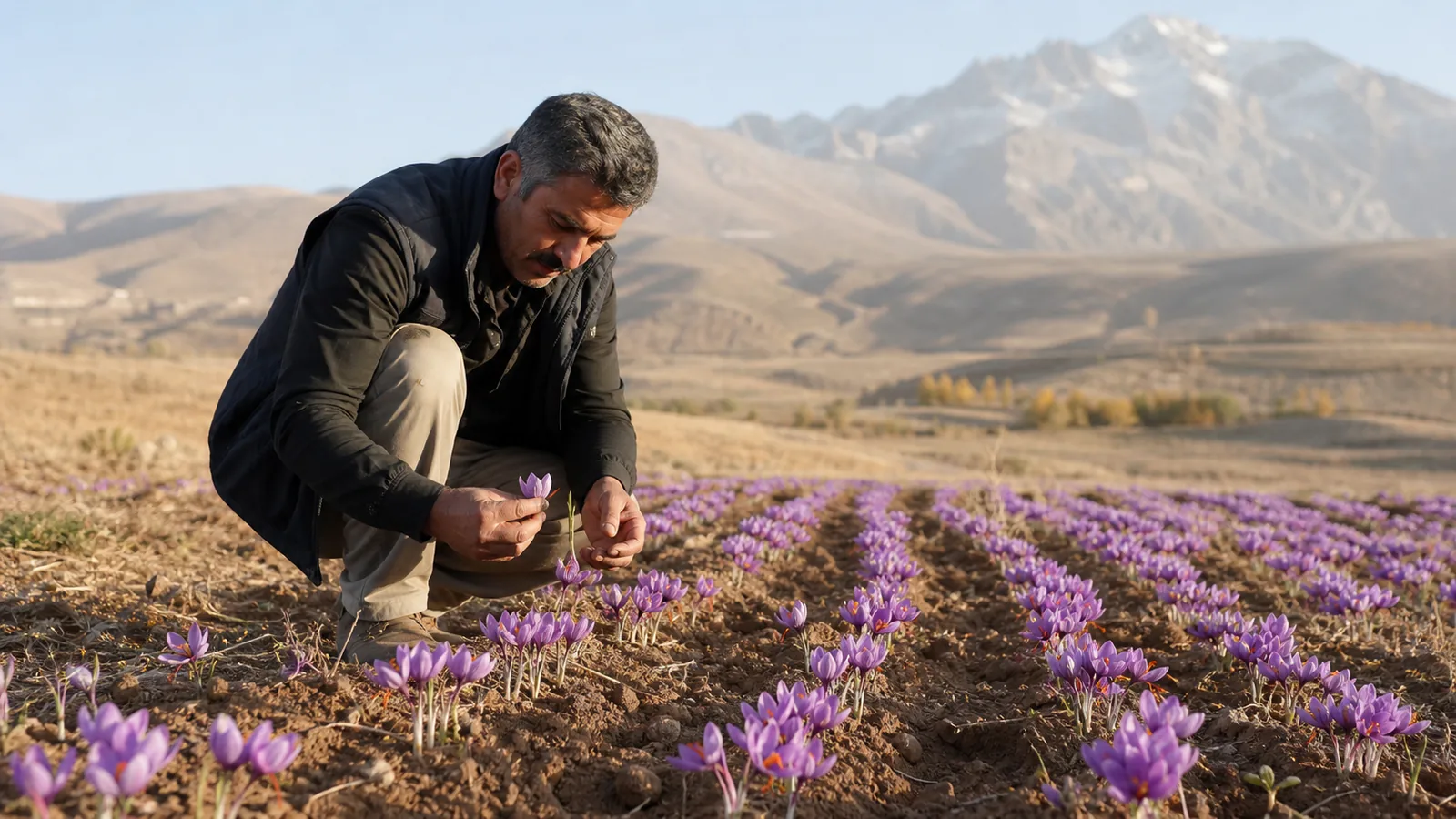
The original Mehr News Agency report focused on Hamedan Province, where the Alvand mountain range creates cold winters and comparatively dry growing conditions. Rahim Bayat, then a deputy horticulture official in the provincial Agricultural Jihad Organization, said saffron had already been cultivated in Hamedan and could tolerate the region’s winter cold.
Saffron, Crocus sativus, is a short perennial plant that grows from an underground stem called a corm. Farmers often call it a bulb, but “corm” is the botanically accurate term. The plant remains dormant through part of the warm season and produces flowers in autumn under suitable conditions.
Cold tolerance alone does not make every slope suitable. A field still needs well-drained soil, a planting depth appropriate to local conditions, healthy corms and reliable irrigation at critical stages. Waterlogging and compacted soil can damage corms even in a climate that otherwise fits the crop.
The cultivation method described in 2015
Bayat said planting in Hamedan began in Shahrivar, the Iranian month spanning roughly late August to late September. The report described irrigation after planting and again in Mehr, roughly late September to late October. These dates recorded local practice at that time; they are not a universal calendar for every field or season.
The provincial guidance called for enough soil to place about 15–20 centimeters above the corms. Planting depth affects temperature, moisture, flowering and corm multiplication, so a grower should adapt it to soil texture, corm size, machinery and local agricultural advice rather than copying one number blindly.
The report’s description of saffron as undemanding in soil needs similar context. The crop can grow in relatively low-input environments, but it is not indifferent to drainage, salinity, fertility or disease history. Research on Iranian saffron shows that geography, weather, farming practice and biotic stress can influence both yield and quality.
Harvesting before heat damages the flowers
Workers were advised to collect flowers early in the morning, preferably while they were still in bud and before strong sunlight warmed them. The flowers then had to reach a home or workshop quickly so the red stigmas could be separated.
This is demanding seasonal work. Flowers do not wait for a convenient schedule, and the valuable part of each bloom consists of only three stigmas. Delays, crushing, contamination and poor handling can reduce the quality of the final dried saffron.
Clean hands and surfaces, shallow ventilated containers and rapid transfer matter more than decorative packaging at this stage. Flowers should not be compressed in deep sacks or left in a warm vehicle.
What the historical yield figures show
For newly established fields, the report mentioned around two kilograms of dried saffron per hectare. It said production might rise from the third year to four or five kilograms per hectare, with six or seven kilograms possible in some fields. These were local estimates, not guaranteed yields.
Acreage, corm density, corm health, weather, irrigation, labor availability and drying loss all affect the final weight. The article’s statement that four or five kilograms could be financially worthwhile also depended on the saffron price and production costs of that period. A current business plan needs current local yields, labor rates, water costs, quality grades and buyer terms.
Hamedan’s small-farm challenge
The 2015 account placed national Iranian output at about 250 tonnes and said Hamedan had 175 saffron producers. Officials believed the real number was higher because many farmers worked small, fragmented plots.
Small plots can make experimentation practical, but they also make shared infrastructure important. Individual farmers may not be able to justify a controlled dryer, testing equipment or specialist packaging on their own. Cooperatives or local service centers can spread those costs while giving growers a consistent post-harvest process.
The missing link was local drying capacity
The article did not present Hamedan’s cultivation story as complete. It said the province lacked a saffron dryer, forcing growers to move their product to saffron-producing provinces in Khorasan to prevent spoilage. That journey added time and made it harder to improve local performance.
Drying is not a cosmetic finishing step. It removes moisture, stabilizes the stigmas and helps preserve the compounds responsible for color, aroma and taste. Excess heat can damage quality, while slow or uneven drying can leave too much moisture. A dryer also needs cleaning, temperature control and batch records; simply owning a machine does not guarantee a good result.
A realistic reading of the Alvand opportunity
The lower slopes of Alvand offered a plausible environment for saffron, and Hamedan growers had already demonstrated that the crop could flower there. The 2015 report’s real lesson, however, was that field suitability and a finished marketable product are different achievements.
A sound local programme would test fields before expansion, use healthy corms, train growers in harvest timing and create nearby controlled drying and quality-testing capacity. Without that chain, more planted land could still produce inconsistent saffron or lose value after harvest.

![Exporting Saffron to Turkey + Price Guide [Complete 0 to 100]](https://img.rowhanisaffron.com/20260827003933/saffron-export-turkey-quality-inspection.webp)



