


Saffron production problems do not stop at the edge of the field. A grower can raise a sound crop and still lose value through hurried harvest, uneven drying, weak lot records, an unsuitable sales channel or a buyer who cannot verify origin. The historical report on this page made the same broad point: Iran’s production scale had not automatically produced the export position, recognition or farmer returns that the writer expected.
Its figures and allegations belong to an earlier period, so they need dates and evidence rather than repetition as current fact. The useful task now is to separate farm constraints from post-harvest, market and governance problems, measure each one, and choose a remedy that does not merely move cost or risk to another part of the saffron chain.
What the 2015 report identified as saffron production problems
The page, published in 2015 and attributed to Eghtesad Dan quoting Econews, described Iran as the world’s largest saffron producer. It called saffron a strategic agricultural product and an important non-oil export, arguing that producers needed support, export barriers needed attention and the market required better management.
Producer support was tied to more than export volume. The writer described saffron as a source of foreign-exchange earnings, rural income and employment, especially for farming communities, and argued that this made the crop worthy of greater attention.
Its customs passage said exports in packs of more than 30 grams totalled “0.1 thousand tonnes” and earned US$84.1 million in the previous year. Read literally, the first figure is 100 tonnes. The report does not provide a Gregorian year, a customs table or a precise period, and the translated decimal spacing is damaged. Those numbers are retained as an attributed historical snapshot, not converted into a current statistic.
The next comparison used Iranian calendar years 1392 and 1391. It said production increased by 25 percent while exports fell by about 15 percent. The writer treated this divergence as evidence that saffron had left Iran through unofficial channels. That is one possibility, but the two percentages alone cannot prove it. Production and export series may use different crop and calendar periods, while inventory, domestic sales, product codes, reporting thresholds and delayed shipments can also make them move in opposite directions.
The report alleged that Iranian saffron was sold under foreign brands or represented as the product of another country. It singled out Afghanistan, claiming that Iranian saffron was moved there and re-exported as Afghan, and said saffron corms had also crossed the border. One cited estimate placed corm smuggling in Iranian year 1388 at about three tonnes a day.
No method or enforcement record accompanies those claims. They remain part of the historical debate but should not be turned into a statement about every Afghan producer or shipment. Afghanistan grows saffron in its own right, and legal trade between Iran and Afghanistan has also appeared in reported customs data. Origin fraud has to be established lot by lot from records and testing.
The article also claimed that more than 93 percent of the world’s saffron was produced in Iran while Iranian saffron remained poorly recognised and other origins received the credit. That production-share figure is historical, and recognition cannot be measured from tonnage alone. Its underlying concern—losing identity and value after the product leaves the farm—can be tested through origin records, brand ownership and buyer research.
Production, exports and value are different measurements
Dry saffron produced on farms is not the same as saffron exported during the same year. Some crop can remain in farmer, trader or processor inventory. Some can enter domestic use. Exports can include stock from an earlier harvest. A country can also import, pack and re-export product, so its outward shipment is not automatically its own agricultural production.
Weight and value answer different questions. Export value can fall while tonnage rises if the product mix, destination, currency or unit value changes. Small retail packs and bulk consignments do not create the same value per kilogram, and the historical page itself restricted one customs figure to packs over 30 grams. Any comparison must keep that threshold consistent.
The safest modern trade check uses saffron’s HS 0910.20 code and names the reporter, partner, flow, year, quantity unit and value unit. For example, the World Bank’s WITS presentation of UN Comtrade records shows Iran’s reported saffron exports in 2020, including recorded shipments to Afghanistan. That dated table does not settle what happened in 2013 or describe the market today; it demonstrates why a testable customs record is stronger than inferring a route from two percentages.
The site’s completed guide to Iran saffron export statistics explains how to keep production, exports, re-exports and mirror data apart. Without those denominators, a large production share can become a slogan rather than a management tool.
Field problems have to be diagnosed before expanding acreage
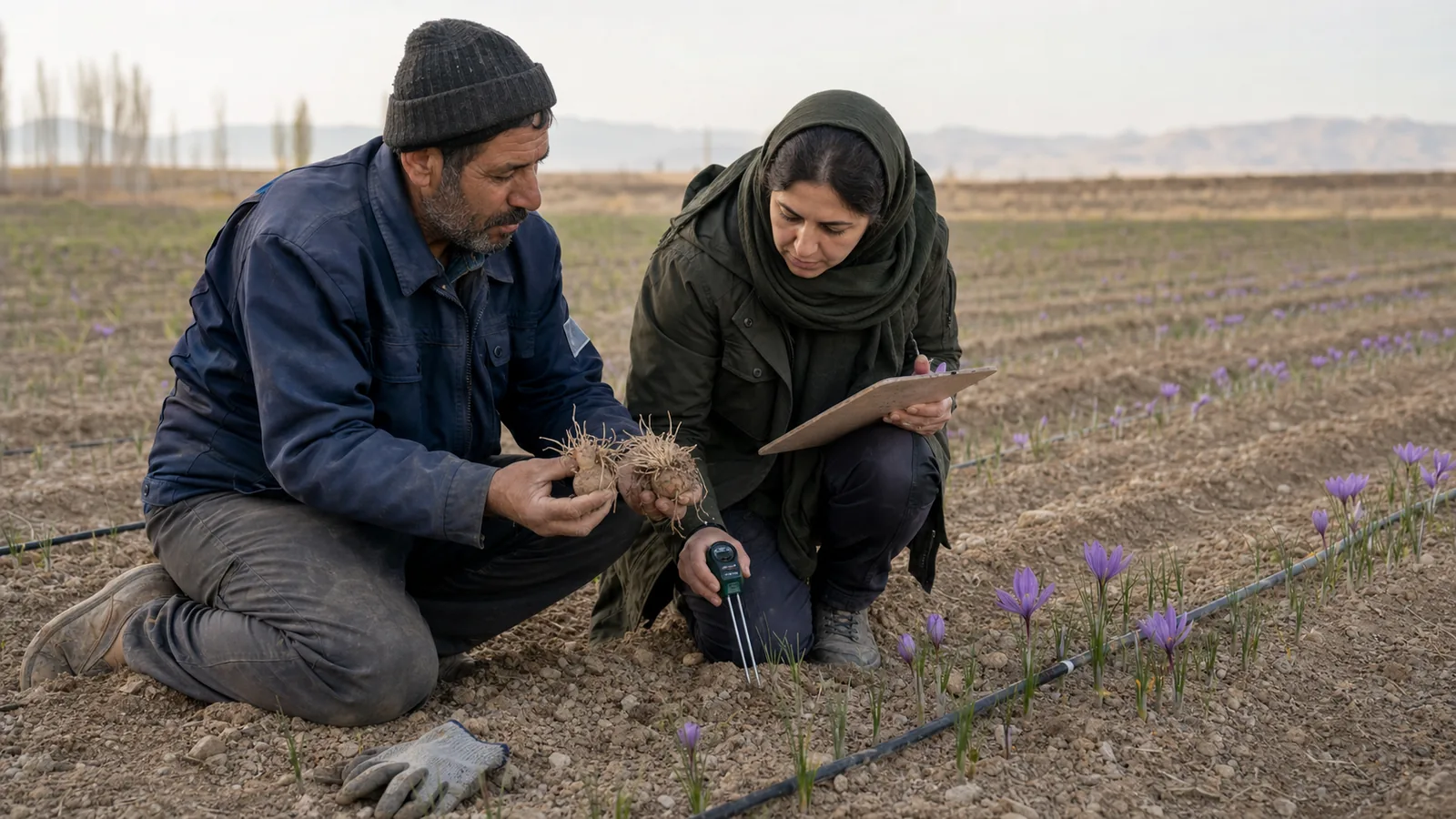
More planted land does not guarantee more saleable saffron. A farm can lose yield through unsuitable or diseased corms, uneven planting, an ageing field, poor drainage, salinity, weeds, rodents, badly timed irrigation, weather stress or a shortage of labour during the brief flowering period. The limiting factor differs between fields, and several can act together.
Water scarcity is especially important in arid production areas, yet calling saffron drought-tolerant does not mean it is independent of water. Crop timing, soil moisture and drainage still affect corm growth and flower formation. FAO’s current Iranian saffron work identifies climate pressure and water scarcity alongside production practice, post-harvest handling and market competition.
A useful field record connects each plot to corm source and grade, planting date and density, irrigation and rainfall, field age, pest or disease observations, labour hours, flowers collected and dry saffron recovered. Yield should be calculated from measured dry product and actual area, not from a best-looking row. If the weak point is corm health or drainage, advertising and export support will not repair it.
Moving corms outside formal controls introduces another risk beyond lost intellectual or economic value: planting material can carry pests and pathogens into new fields. Legal status, plant-health documentation, source identity and physical quality should therefore be checked before movement. An unverified historical smuggling estimate is not a substitute for border or phytosanitary evidence.
Harvest and post-harvest handling can erase good field work
Saffron flowers arrive in a compressed season and cannot be treated like a durable dry commodity. Delayed collection, compressed containers, dirty contact surfaces, slow stigma separation, uncontrolled drying or poor storage can reduce consistency and increase contamination risk. Speed matters, but only when the workflow remains gentle and hygienic.
The operation needs a daily plan for picking, transport, separation, drying, cooling, packing and lot release. Capacity should be matched across those stages. Doubling field collection without enough clean separation tables or dryer space merely creates a queue of warm flowers.
Codex CXS 351-2022 for dried saffron provides an international baseline for product identity, styles, quality, contaminants, hygiene and labelling. Meeting one laboratory grade does not prove origin or eliminate every form of adulteration. Sampling, chain of custody and the link between the result and the shipped lot matter too.
That gap is now being addressed directly. In 2025, FAO and Mashhad University announced work on stronger saffron authenticity and post-harvest methods. FAO noted that routine ISO 3632 tests are widely used for grading but may not capture subtle quality differences or sophisticated adulteration. The project combines advanced chemical fingerprinting with practical handling guidance. It should not be misread as saying routine tests have no value; it shows that grade and authenticity are related but separate controls.
Foreign packaging is not automatically origin fraud
A foreign company can legally buy Iranian saffron, pack it under its own brand and identify the country of origin truthfully. Private label, brand ownership, place of packing and agricultural origin are four different facts. The problem begins when a label, document or sales message makes a false or misleading origin claim.
Protecting Iranian identity therefore requires more than insisting on an Iranian brand on every retail shelf. Exporters need lot-level origin records, credible testing, contracts that govern label claims and enough visibility through the distribution chain to detect substitution. Geographic names should be used only when the lot qualifies for them.
The 2014 UNIDO diagnostic study of Iran’s saffron value chain found a divided chain of farmers, collectors, processors, packers and exporters with different levels of formalisation and market access. Its figures are historical, but the structure explains why national production leadership does not guarantee that a farmer controls the final brand or retail margin.
FAO’s 2025 quality-integrity workshop similarly brought farmers, processors, cooperatives, traders and experts together around production, safety, traceability, marketing and branding. That whole-chain approach is more useful than blaming one intermediary category. A broker can provide aggregation, finance and market access; an opaque chain becomes harmful when nobody can trace the product, explain the price or take responsibility for a complaint.
Packaging has to follow a buyer and a channel
The historical article recommended international marketing, advertising and suitable packaging. Those can add value, but a decorative pack is not a market strategy. A restaurant distributor, industrial food maker and gift retailer need different quantities, materials, labels, documents and delivery schedules.
Before printing, the exporter should know the destination’s food rules, required language, responsible business details, quantity and date conventions, origin statement, claim restrictions and recycling or packaging obligations. The pack must protect the threads from moisture, strong light, odours and handling while remaining economical for the buyer’s order size.
Marketing should make verifiable promises: what the product is, where the lot came from, how it was tested, what pack is supplied and how consistently it can be replenished. “World leader” is less useful to a buyer than a reliable specification, clean documents and a sample that matches delivery.
The commodity exchange is one channel, not a complete solution
The old report described Iranian red gold as lacklustre on the commodity exchange. It said direct market purchasing was easier and exchange paperwork discouraged producers and traders. That observation belongs to the system available at the time.
The market later changed. In 2017, saffron commodity-deposit certificates were launched with approved warehouses, quality assessment and trading through authorised brokers. An agriculture-news record of the launch explains how deposited product received a warehouse receipt and could enter a transparent order book. A 2025 Rural Cooperative Organisation offering shows continued use of the exchange channel, although rules, warehouses, costs and eligibility can change.
An exchange can standardise a tradable specification and improve price visibility for accepted lots. It does not create export demand, verify every geographical-origin claim or guarantee that participation is economical for a small farmer. Direct contracts, cooperatives, processors and warehouse receipts can coexist. The dedicated guide to saffron sales through agricultural commodity exchanges explains the warehouse, testing and price-discovery logic in more detail.
A practical production-problem review
- map each plot’s corm, water, soil, field-age, pest, labour and dry-yield evidence;
- measure losses and waiting time from flower collection through separation, drying and storage;
- assign one lot identity that follows the product through testing, packing and shipment;
- compare customs data only when flow, year, code, pack threshold, quantity and value units match;
- separate legal private-label trade and re-export from an origin claim that evidence shows is false;
- choose direct sale, cooperative, processor or exchange routes from net return, risk and service—not ideology;
- track complaints, rejections, repeat orders and the share of final value reaching the producer.
Iran’s production scale is an advantage, not a cure. The durable response to saffron production problems is a chain in which field decisions, handling, testing, origin, prices and export records can be checked. That gives farmers and buyers something stronger than a percentage: a product whose value and identity survive from corm to customer.
The Eghtesad Dan/Econews attribution, pack-over-30-grams, 0.1-thousand-tonne, US$84.1-million, 25-percent production rise, 15-percent export fall, informal-route, Afghanistan/re-export, corm-smuggling, three-tonnes-per-day, 93-percent share, foreign-brand, commodity-exchange, producer-support, marketing and packaging statements are retained as historical claims from the report published here in 2015. Missing dates, source tables and methods are not invented, and no allegation is represented as a current established fact. Sources were reviewed on 29 August 2026.

![Exporting Saffron to Turkey + Price Guide [Complete 0 to 100]](https://img.rowhanisaffron.com/20260827003933/saffron-export-turkey-quality-inspection.webp)



