


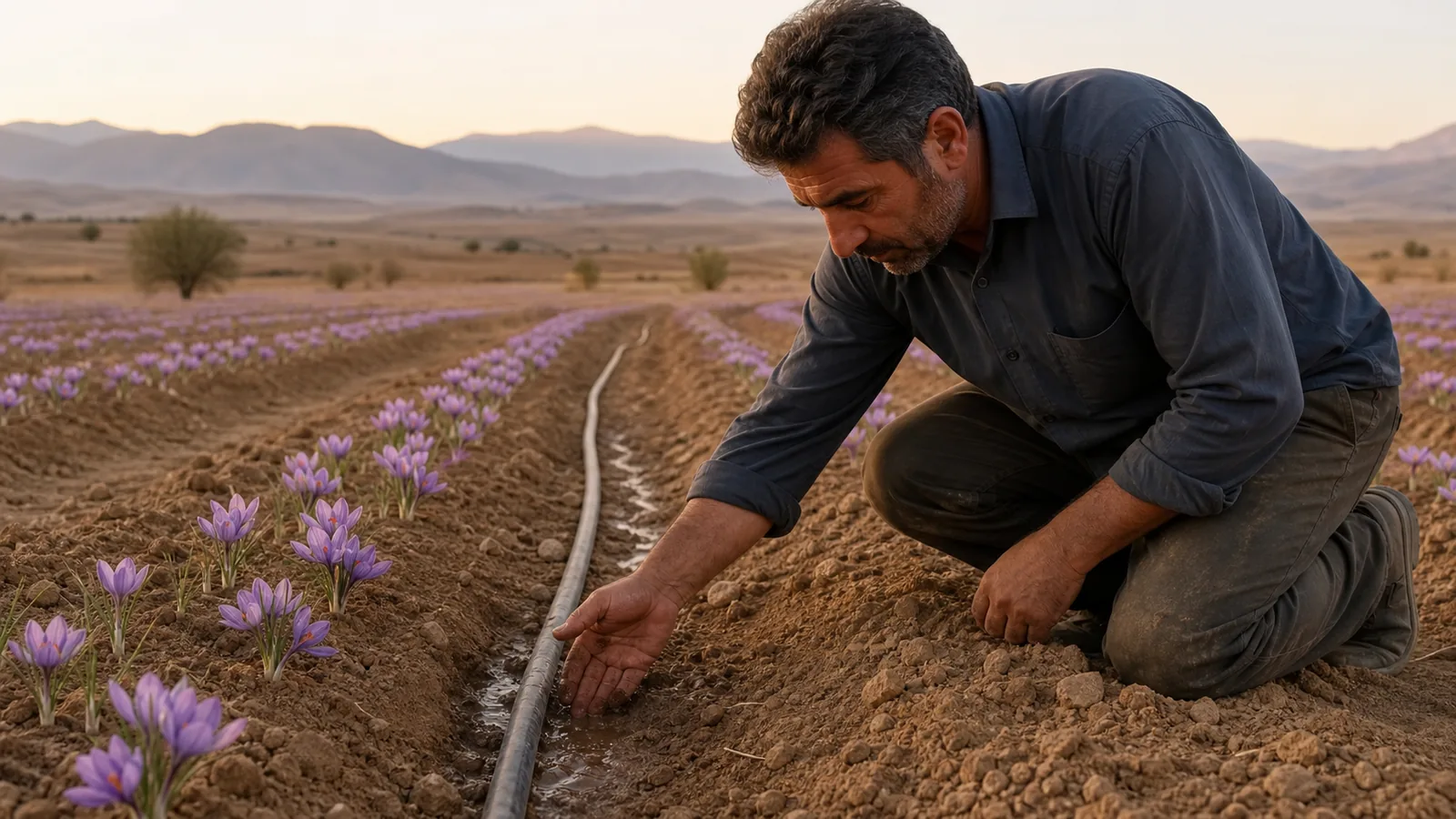
Saffron, a plant for water scarce regions, can be a sensible crop where summer water is limited because its corms are dormant through the hottest part of the year. That does not make saffron a no-water crop. Flower emergence, autumn growth and the following spring’s corm development still depend on moisture arriving at the right time.
This distinction was missing from the site’s short 2014 report from East Azerbaijan. The agricultural official quoted there was right to draw attention to saffron’s unusual seasonal cycle. A farmer deciding whether to plant it, however, needs to look beyond the phrase “drought tolerant” and ask whether the field, water quality, rainfall pattern and irrigation capacity fit the crop.
Why saffron fits some dry farming regions
Crocus sativus grows on a calendar that is almost the reverse of many summer crops. After its leaves finish feeding the replacement corms in spring, the above-ground growth dries and the plant enters summer dormancy. It is not supporting a green canopy during the months when heat and evaporation are usually most demanding.
Flowering starts after dormancy, generally in autumn, and leaves remain active through the cooler season. In suitable regions, part of the crop’s water demand can therefore coincide with rain and lower evaporative demand. The FAO describes the qanat-based saffron system in Gonabad as an adaptation to an arid and semi-arid area with severe water shortages, supported by a dependable traditional water source.
That is the useful case for saffron in a water-scarce region: low summer demand, a small high-value dried product and a growth season that can make use of cooler-weather moisture. It is not permission to plant anywhere dry.
Summer dormancy does not mean zero water demand
Ayoub Irani Fam, identified in the original translation as an East Azerbaijan agricultural production official, told the Iranian Students News Agency (ISNA) that saffron “goes to sleep” in summer and does not require irrigation then. That captures the traditional cycle, but the word “then” matters.
Pre-flowering irrigation can be decisive where autumn rain does not arrive in time. Moisture also supports leaf growth after flowering and the development of daughter corms that carry the next crop. Too little water at those stages can reduce current flowers or weaken the following season. Too much water, poor drainage or badly timed summer irrigation can create a different problem around dormant corms.
A three-year field experiment in arid Qaen, South Khorasan, recorded seasonal crop evapotranspiration between 330.7 and 356.5 millimetres under the treatments studied. Its comparison of basin, furrow, sprinkler and drip irrigation also found that yield and water-use efficiency responded to irrigation method. Those numbers describe one experiment, soil and climate; they are not a universal prescription for East Azerbaijan or another country.
Water should be planned around crop stage
A water budget built around a fixed number of irrigations is fragile. The useful questions are what stage the plant has reached, how much usable moisture is already in the root zone, what rain is forecast and whether the soil can drain.
For most field decisions, the calendar can be divided into four working periods:
- Before flowering: the soil needs enough moisture for timely emergence, but the date depends on local temperature and rainfall rather than a national rule.
- Flowering and post-harvest leaf growth: avoid both water stress and saturated soil while the leaves support new corms.
- Late spring: follow the crop as its leaves yellow naturally; green leaves should not be cut merely to end irrigation early.
- Summer dormancy: routine irrigation is usually avoided in traditional Iranian systems, but any intervention must follow local evidence, disease risk and soil conditions.
Our detailed guide to saffron irrigation timing explains those stages and the checks needed before setting dates. The point here is simpler: saffron shifts water demand away from high summer, but it still needs a reliable plan for the active season.
Not every dry field is suitable
Water scarcity is only one part of site selection. A field that holds water around the corms can be a poor choice even if the district itself is dry. Soil texture, structure, slope, drainage, salinity and the depth of the prepared bed all change how long water remains available and how much aeration the corm receives.
Temperature matters too. The crop needs the seasonal signals that support dormancy, flower initiation, emergence and leaf growth. A site can be arid yet too warm at the wrong stage, exposed to an unsuitable freeze, or unable to supply the cool-season moisture the plant uses.
Before converting land, a grower should check:
- a soil analysis, including texture, salinity, pH and nutrient status;
- the field’s drainage after a real irrigation or heavy rain;
- water quantity and quality through the active growth period;
- local temperature and rainfall records rather than a regional average alone;
- the history of corm diseases, weeds and previous crops;
- access to labour for the short flower harvest and prompt stigma separation;
- a buyer and quality specification before planting area is expanded.
A small local trial is more informative than copying a distant farm’s irrigation volume. It exposes problems with emergence, drainage, corm health and labour while the financial risk is still limited.
What the 2014 East Azerbaijan figures mean
The original article attributes two production figures to Irani Fam. It says an average unit of land produced five kilograms (5 kg) of dried saffron and then gives a damaged sentence involving 167 flowers and dried saffron.
The English translation renders the land unit as an “acre.” That may be correct, or the source may originally have used a hectare and lost the unit in translation. The underlying Persian ISNA report was not available for verification during this review, so the five-kilogram figure should be preserved as a historical quotation, not converted into a modern regional yield benchmark.
The 167 figure appears to mean that about 167 flowers were needed for one gram of dried saffron, rather than 167 grams being obtained from one flower. That reading fits the biology: each flower supplies only three red stigmas. It is still an interpretation of a broken sentence. Flower size, stigma length, the amount of yellow style retained and final moisture all change the conversion.
Modern field evidence shows why one average can mislead. A six-season experiment in southwest Iran compared irrigation depths, water salinity and basin versus furrow planting. Its long-term results for saffron yield and water productivity show that the year of peak yield and the later decline depended on the treatment and planting method. Yield belongs to a place, season, field age and management system—not to the crop name alone.
High value per gram is not guaranteed farm profit
Saffron is commonly described as the world’s most expensive spice by weight. The 2014 official made the same point: the crop can hold considerable value in a small finished weight. That is one reason it attracts attention where water and freight capacity are limited. A few kilograms of dried spice can represent the harvest from a substantial area.
Price per kilogram is not the same as profit per hectare. Corm purchase, land preparation, irrigation infrastructure, hand picking, stigma separation, drying, testing, storage and marketing all have costs. Yield often changes as a field ages. A grower may also face a brief harvest peak when labour is expensive or unavailable.
A realistic budget should use several yield and price cases rather than the best figure quoted by a supplier. It should separate fresh-flower sales from dried-saffron sales, account for rejected or lower-grade product, and include the years before the field reaches its expected production. Water productivity is valuable only when the finished crop has a viable market.
Can the rest of the flower create value?
Irani Fam also spoke about possible uses for small corms, leaves, sepals, petals and stamens in activities such as livestock production, beekeeping and dyeing. This was an argument for using more of the crop rather than discarding everything except the red stigma.
Some saffron by-products do have research value as colourant or plant material, and flowering fields can attract pollinators. That does not make every plant part safe or economical for every use. Feed requires a proper safety and nutritional assessment; residues may contain soil, moisture, pesticides or biologically active compounds. Small or diseased corms should not be passed into another field as planting stock merely to avoid waste.
A by-product plan should begin with separation. Keep petals and other flower material away from dried stigmas, identify how the crop was grown, prevent mould and confirm the intended user’s specification. If there is no tested outlet, potential value should not be entered as guaranteed income.
A better way to judge saffron under water scarcity
Saffron can fit a dry-region farm because its summer dormancy avoids the period when many green crops place their heaviest demand on irrigation. It also produces a light, valuable commodity. Those advantages are real, and they help explain why the crop became part of Iran’s qanat landscapes.
The limits are equally real. Saffron still needs well-timed moisture, suitable soil and drainage, healthy corms, labour and a market. Drought can reduce flowering and the daughter corms that determine future yield. Our review of how drought threatens saffron production follows those immediate and delayed effects.
For a water-scarce farm, the sound decision is not “saffron needs no water.” It is: compare the crop’s seasonal demand with the water that can actually be supplied, verify the field through a local trial, and protect the few stages when moisture has the greatest effect. That is how summer dormancy becomes an agronomic advantage instead of a misleading slogan.
The East Azerbaijan statements are preserved from the site’s December 2014 report. Agronomy sources and links were reviewed on 28 August 2026.

![Exporting Saffron to Turkey + Price Guide [Complete 0 to 100]](https://img.rowhanisaffron.com/20260827003933/saffron-export-turkey-quality-inspection.webp)



