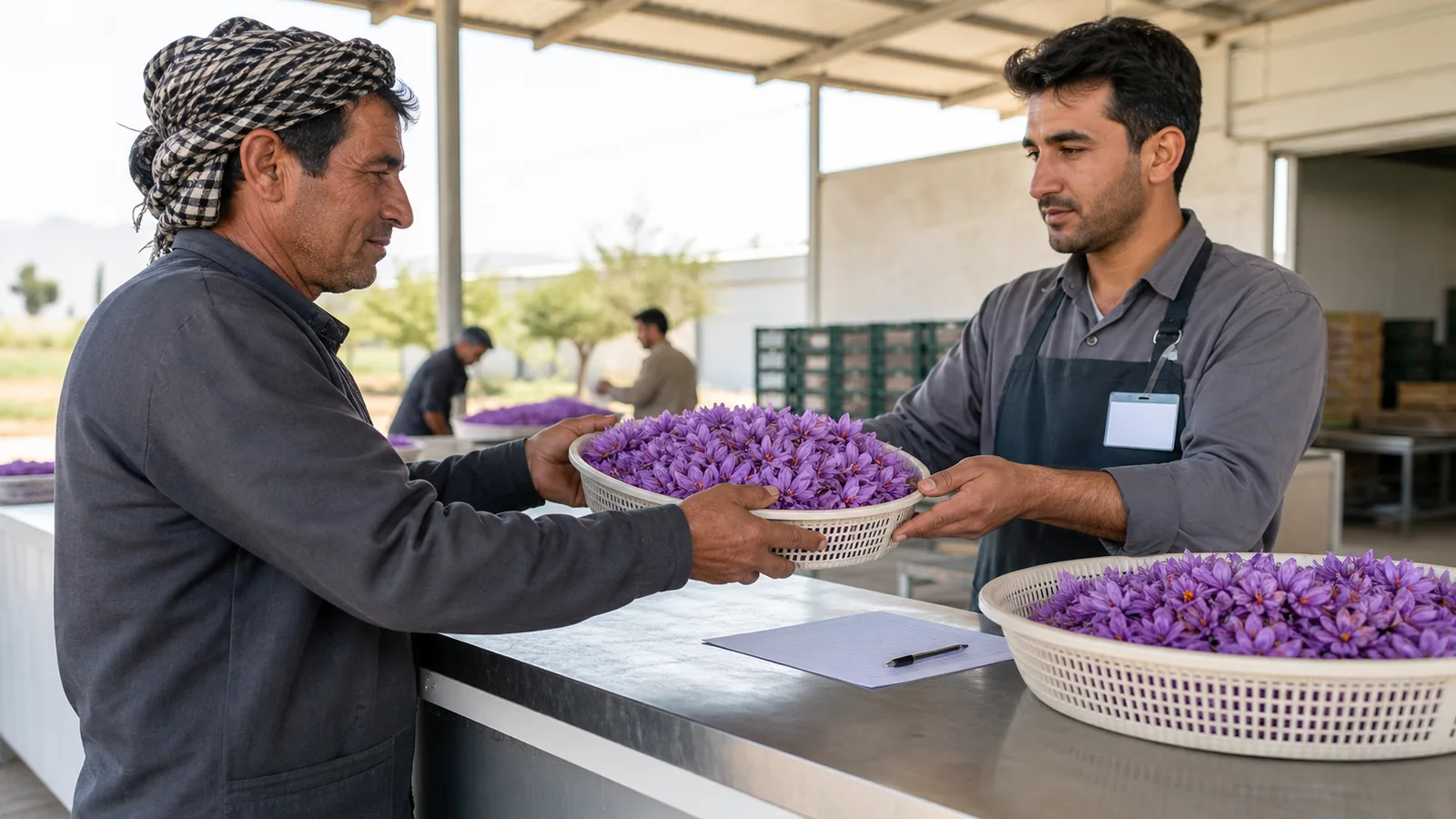
The “medical supply unit” in this article was not a clinic or a medical sales counter. It was a supervised market proposed in 2014 for the sale of fresh saffron flowers in Torbat Heydariyeh, Iran. The aim was practical: move flowers away from an informal roadside market, identify sellers and buyers, record where each lot came from, and get this very perishable crop into clean processing without delay.
The phrase rendered in the old English text as “training Heydariye” refers to Torbat Heydariyeh, one of Khorasan Razavi’s important saffron-growing areas. Its original title and wording survive as a record of a difficult translation, but the programme itself concerned hygienic handling and traceable trade.
Why a supervised saffron-flower market was proposed
Ali Hosseini, described in the 2014 report as vice-president of the Association of South Khorasan Saffron Producers and Exporters, said that fresh flowers had been sold beside the Torbat Heydariyeh passenger terminal in previous seasons. Flowers were sometimes placed or handled in poor conditions, while speculators or poorly identified intermediaries bought from farmers without a consistent record of the field, harvest time or next processing step.
The National Saffron Council therefore announced a dedicated pavilion, organised with agricultural and municipal authorities. Buyers could still purchase flowers from farmers, but the sale would take place under defined hygiene and identification rules. The surviving report calls the flowers “surplus.” In this context, that means harvested flowers offered for sale by growers who were not separating and drying all the stigmas themselves. It does not mean that saffron petals and stigmas are interchangeable products.
The model was also intended to protect the reputation of Iranian saffron. That concern is reasonable, although a supervised stall cannot guarantee the quality of the finished spice on its own. Flower condition, the time before separation, drying, storage and later testing all affect what eventually reaches a buyer.
What the 2014 plan required
According to the announcement, people buying and selling flowers at the pavilion would wear a common uniform so they could be distinguished from other traders. Buyers would carry special identification cards, and stalls were expected to meet basic hygiene conditions.
The flower containers were not to sit directly on the ground. The report specified a raised mesh or platform about 20 centimetres above it. That measurement records the local arrangement proposed at the time; it should not be mistaken for a universal food-safety law. The lasting principle is more important: keep flowers on a clean, stable, food-contact surface, away from soil, dirty footwear, standing water, fuel fumes and other sources of contamination.
The programme also called for each purchase to identify the farmer’s field and the time of harvest. That simple record creates the beginning of traceability. If a processor later finds a wet, overheated or contaminated lot, the flowers can be traced back instead of being confused with every other delivery received that day.
The article named the Ministry of Health and Medical Education, the Ministry of Agriculture, the municipality and the National Saffron Council as bodies involved in oversight. These are details from a 2014 announcement, not a statement of the licensing system currently in force. A grower or buyer using a market today should confirm the present rules with the relevant local authorities.
Fresh flowers are the beginning, not the finished spice
A newly picked saffron flower is delicate plant material. The valuable spice is made from the three red stigmas inside it. Those stigmas still need to be separated with clean hands and equipment, dried under controlled conditions, protected from moisture and then graded or tested for the intended market.
Flowers should therefore move through a sales pavilion in shallow, clean containers rather than being compressed into a deep, warm heap. Shade matters. So does time. If a buyer has no realistic capacity to separate and dry the lot promptly, buying more flowers can turn a commercial opportunity into a quality problem.
A useful receiving routine is straightforward:
- identify the farmer, field or village, harvest date and approximate picking time;
- keep each lot separate until it has been accepted and recorded;
- inspect for soil, excess water, decay, foreign material and unusual odour;
- use clean, shallow containers and keep them off the ground and out of direct sun;
- send accepted flowers to separation and drying without an avoidable wait;
- record which finished batch came from each accepted lot.
These steps do not replace a processor’s food-safety plan. They give that plan a reliable starting point. The World Health Organization and FAO’s work on microbiological hazards in spices and dried aromatic herbs explains why contamination controls matter throughout the chain, even though the report is not a rulebook for one Iranian market.
Clean handling at the stall
A tidy-looking booth is not enough. The people handling the crop need clean hands, clean clothing and utensils reserved for the job. Containers that once held chemicals, fuel or non-food materials should never be repurposed for saffron flowers. Anyone who is ill or has an uncovered wound should not handle an open lot.
The WHO’s Five Keys to Safer Food are broad, but several apply directly here: keep clean, separate the crop from possible contamination and use safe water where water is needed for cleaning equipment or hands. Washing the flowers themselves is a separate processing decision and should not be improvised at a market stall, because added moisture can make later handling harder.
Clean does not mean sealed without ventilation. Fresh flowers release heat and moisture. A processor needs containers and transport suited to the crop, the journey and the ambient temperature. There is no single safe holding time that can be promised without knowing those conditions, so “process promptly” is more honest than an unsupported number of hours.
Buyer cards, uniforms and records
The most interesting part of the Torbat Heydariyeh model was not the uniform. It was the connection between an identifiable buyer and a recorded lot. A badge or card gives a farmer someone accountable to deal with. A lot record gives the processor a way to investigate a problem. Used together, they also make it harder to mix anonymous flowers into a consignment after inspection.
That does not mean every intermediary is harmful. A capable collector can combine small farm lots, provide transport and connect growers with a properly equipped processor. The risk comes from anonymous handling, excessive delay and mixing without records. Licensing and traceability should make a useful intermediary visible rather than pretend that the trade can operate without one.
Price and weight records belong in the same process. Farmers should be able to see the measured weight, agreed basis of sale, buyer identity and date. Those commercial details are separate from quality grading, but clear documentation reduces later disputes.
Training at the point of sale
Hosseini said the pavilion and associated processing centres would also provide training for people unfamiliar with correct flower handling and processing. That was a sensible place to teach: growers and buyers were already bringing real lots through the same point, so advice could be tied to a visible problem rather than delivered as a distant lecture.
Useful training would show how to pick without crushing the flower, keep soil out of the container, separate lots, recognise deterioration and prepare a clean workspace for stigma separation. It should also make one boundary clear. A market can improve the condition of incoming flowers; it cannot certify the chemical quality or authenticity of dried saffron by appearance alone.
For the work that follows receipt, our guide to saffron flower drying methods explains separation, drying controls and the limits of one-size-fits-all recipes. The broader saffron grower’s seasonal responsibilities puts harvest handling alongside irrigation, weed control and corm care.
How the pavilion fits modern saffron quality control
The current Codex standard for dried saffron, CXS 351-2022, covers the product made from dried Crocus sativus stigmas. It addresses matters such as identity, quality classes, contaminants, hygiene, packaging and labelling. The standard appears in the Codex standards register.
Codex does not retrospectively approve the 2014 pavilion, nor does its dried-saffron standard prescribe a particular Torbat Heydariyeh stall layout. It does show why early care matters: the clean, correctly identified spice expected at the end of the chain begins with flowers that have not been mixed, soiled or left to deteriorate.
A well-run fresh-flower market should therefore pass forward more than a bag of flowers. It should pass forward a lot identity, harvest timing, acceptance record and a crop kept in suitable condition for prompt separation. The processor then takes responsibility for drying, batch control, storage and whatever laboratory or buyer specifications apply.
What the Torbat Heydariyeh model got right
The 2014 plan responded to a real weakness in the local trade: fresh saffron flowers were being sold beside a passenger terminal under conditions the organisers considered unsanitary. Its proposed answer combined a dedicated place, raised displays, identifiable traders, buyer cards, farm and harvest records, agency supervision and practical training.
Those measures cannot prove that every resulting saffron lot is safe or high grade. They can remove several avoidable hazards before processing begins. More importantly, they replace anonymity with a chain that a farmer, market manager and processor can follow.
The picking season mentioned in the report was expected to begin the following week. That timing, the named officials and the 20-centimetre platform belong to the historical announcement. Anyone organising the sale of fresh saffron flowers now should treat them as lessons from an earlier programme, then check current municipal, agricultural and food-safety requirements before opening a stall.
Historical programme details come from the site’s August 2014 report. Food-safety and Codex resources were reviewed on 28 August 2026.