


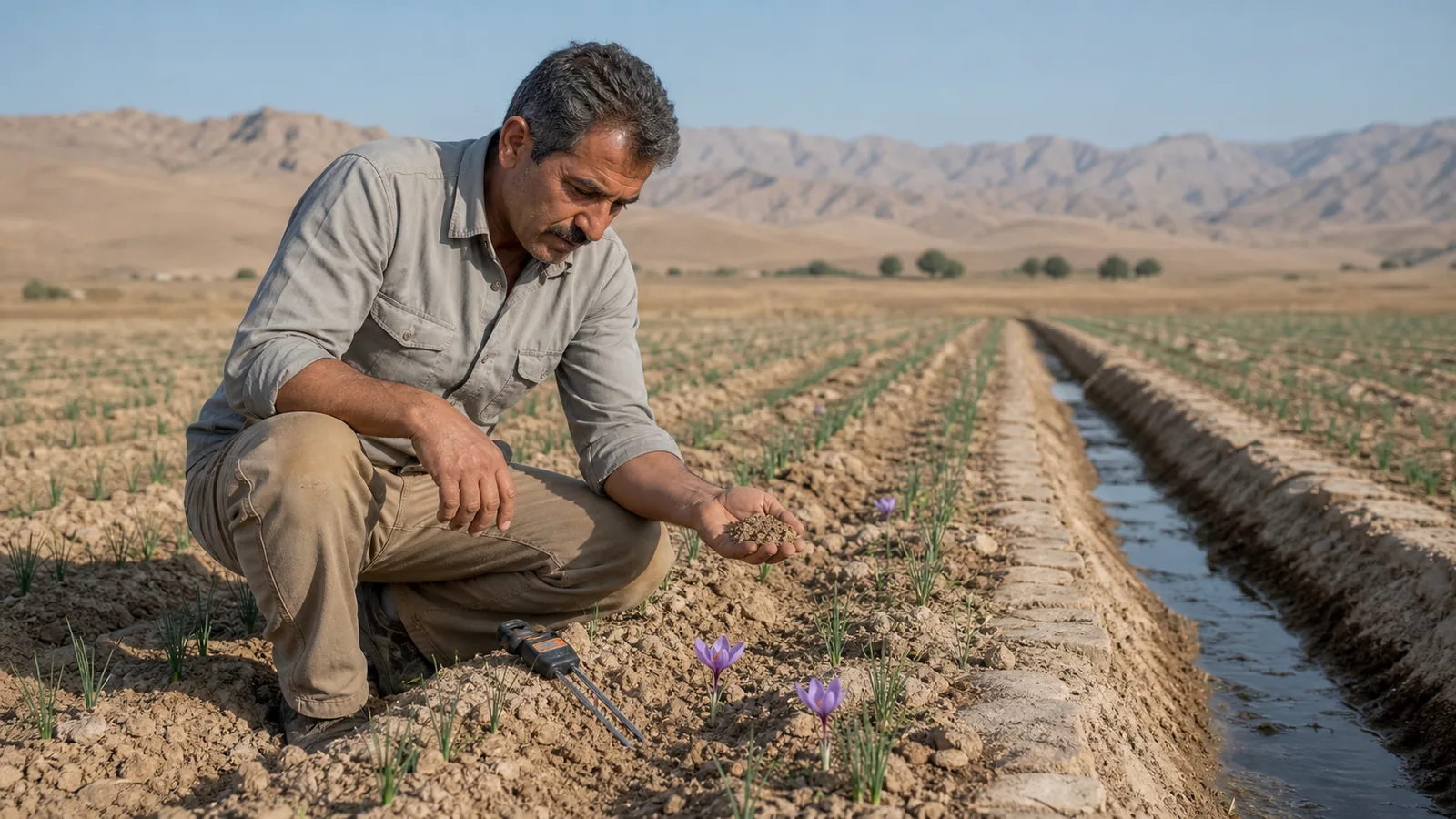
Drought threatens saffron production even though saffron is well adapted to dry regions. The crop uses less water than many alternatives, but “drought tolerant” does not mean that flower yield, daughter-corm growth or the following season’s crop are protected when usable water becomes scarce.
That was the concern raised by Gholamreza Miri in a 2014 interview about Iran’s saffron market. He warned that water scarcity was already forcing some farms to receive water by tanker. At the same time, he said it was too early to forecast national output because saffron corms were still underground and visible growth would not begin until autumn.
What the 2014 warning actually said
Miri, then vice-chairman of Iran’s National Saffron Council, was discussing production alongside first-quarter exports. Customs had released only April data, he said, while figures for May and June were still expected. That reporting delay matters: his comments describe market conditions and crop concerns at a particular point in 2014, not a complete annual export result.
He believed exports were following their normal route but said currency fluctuations made saffron transactions risky. The wider recession also affected demand. Industrial buyers continued to purchase, while customers treating saffron as a decorative or discretionary product were more likely to cover basic needs first.
The surviving English text contains several damaged price lines. It refers to daily slippage of “300 to 400 dollars,” movements of “10 to 30 thousand” over days or weeks, a figure of $250 and “Red Gold” moving between four million and five million 400 thousand. The currency, weight basis and market unit are missing. Those numbers are retained as part of the old report, but they cannot support a current saffron price or a defensible historical unit-price calculation.
Drought tolerance has limits
Saffron’s seasonal rhythm makes it suitable for arid and semi-arid farming. The plant is dormant through the hottest part of summer, then flowers in autumn and develops leaves and daughter corms through winter and spring. Iran’s qanat-based saffron system in Gonabad is recognised by FAO precisely because a reliable, carefully managed water supply supports a high-value crop under severe water scarcity.
That system also shows the important qualification. Saffron survives dry summers partly because the corm is dormant, not because the crop can complete its active cycle without moisture. Water availability and timing affect emergence, flowering, leaf growth and the replacement corms that carry the next crop.
A long-term Iranian field study of irrigation depth, salinity and planting method found different saffron-yield and water-productivity outcomes across six growing seasons. The lesson is not to copy one irrigation volume. Soil, field age, planting method, salinity, rainfall and the stage of growth all change the result.
Why a dry year can affect more than one harvest
A saffron field is perennial. Each mother corm supports the current cycle and produces daughter corms, which become next season’s planting material in place. When water stress restricts leaf function or daughter-corm growth, the visible loss may appear later as fewer or smaller flowering corms.
This delayed response explains why a field can look empty in summer while its production potential is already being shaped underground. It also explains why one year’s flower count is an incomplete drought measure. Farmers need to follow corm condition, leaf duration and the next autumn’s emergence as well as the current dry stigma yield.
Water quality can deteriorate alongside quantity. A falling well or stressed source may become more saline, and salts accumulate differently according to soil, drainage and irrigation method. Giving a field more of poor-quality water is not automatically a solution. Source volume and electrical conductivity should be recorded together.
Why Miri would not predict production in summer
The old article put autumn sprouting in October. In many Iranian fields, the first irrigation, soil temperature and local weather help determine when emergence and flowering begin. Before then, a surface inspection reveals little because the corm and developing buds remain underground.
A credible pre-harvest forecast therefore needs more than a tour of bare fields. At minimum, it should combine:
- cultivated and productive area, separated by field age;
- rainfall and irrigation records from the previous active season;
- water-source reliability and salinity;
- representative corm-size and health observations;
- autumn emergence and flower counts from sampled plots;
- harvest labour and drying capacity;
- final dry stigma weight measured on a consistent basis.
Until autumn sampling is available, an estimate based mainly on planted hectares can miss drought damage below ground. It can also overstate productive area by counting newly planted, abandoned or weak fields in the same way as established fields.
Can expansion across provinces offset drought loss?
Miri said saffron cultivation had expanded into about 20 provinces. He hoped that the larger planted area could compensate nationally for lower efficiency or losses in drought-affected producing regions.
It is possible for national output to hold steady while yield falls if more hectares enter production. That does not mean drought damage has disappeared. A farmer can lose output and income even when the national total rises, and expansion creates its own demand for sound corms, labour, water and drying facilities.
Nor is every dry location automatically suitable for saffron. The crop still needs appropriate winter conditions, soil drainage, water of usable quality and a reliable autumn-to-spring moisture plan. An open-access ecological-modelling study of saffron suitability combined climate and environmental variables rather than treating annual rainfall alone as a site decision.
Expansion should therefore be reported in three parts: new planted area, mature productive area and yield per hectare. Combining them into one headline can hide whether production improved because farms became more efficient or simply because the crop covered more land.
Protect the stages that make the next crop
There is no safe universal drought-irrigation schedule for every saffron field. A sensible response begins by mapping the limited water against crop stage, root-zone moisture and forecast conditions rather than watering by habit.
Before autumn, inspect channels, emitters, storage and field levelling so scarce water reaches the intended area. Our guide to preparing ground for saffron explains how drainage, compaction and soil structure affect what happens after water is applied.
At first irrigation and flowering, record timing, volume and the field’s response. Uneven emergence can reveal poor distribution, variable planting depth or differences in corm condition. After flowering, protect healthy leaves long enough to support daughter-corm development; do not assume the important work ended when the stigmas were harvested.
The article on timely saffron irrigation covers stage-based decisions in more detail. Any change still needs a local soil and water assessment. A schedule developed for one Khorasan soil can be wasteful or damaging in a heavier, shallower or more saline field.
Measure drought loss without guessing
A drought record should distinguish four things that are often blended together:
- water shortage: the source delivered less usable water than planned;
- crop exposure: the shortage occurred during an active and sensitive stage;
- field response: emergence, leaves, flowers or daughter corms changed;
- economic loss: saleable dry saffron or its value fell after other causes were considered.
This prevents every production change from being attributed to drought. Corm density, field age, frost, disease, weeds, harvest labour, drying losses and market rejection can also reduce the recorded total. Conversely, stable national output can conceal serious water stress if expansion masks a lower yield per hectare.
Production risk and export risk are connected but different
The 2014 interview moved between drought, delayed customs figures, currency volatility and recession. All can affect the saffron business, but through different mechanisms. Drought threatens physical output and future corm capacity. Exchange-rate movements affect contracts and the local value of export income. Recession changes buyer demand. A customs delay changes what analysts can see, not what farms have produced.
Recent official discussion still recognises the underlying pressure. In November 2025, FAO and Iran’s Ministry of Agriculture-Jahad identified climate pressure and water scarcity among the emerging challenges facing the saffron value chain. They also described saffron as climate-resilient. Both descriptions can be true: resilience makes the crop valuable in dry regions, while severe or badly timed scarcity can still reduce production.
Miri’s caution was therefore more durable than the corrupted market numbers around it. Drought threatens saffron production when it weakens the active crop or the daughter corms on which a later harvest depends. The sensible response is to measure water, crop stage and field performance together, then report the result by area and yield rather than making a summer prediction from bare soil.
Water and crop evidence reviewed 28 August 2026. Irrigation amounts and timing must be based on local soil, climate, water quality, field age and authorised agricultural guidance.

![Exporting Saffron to Turkey + Price Guide [Complete 0 to 100]](https://img.rowhanisaffron.com/20260827003933/saffron-export-turkey-quality-inspection.webp)



