


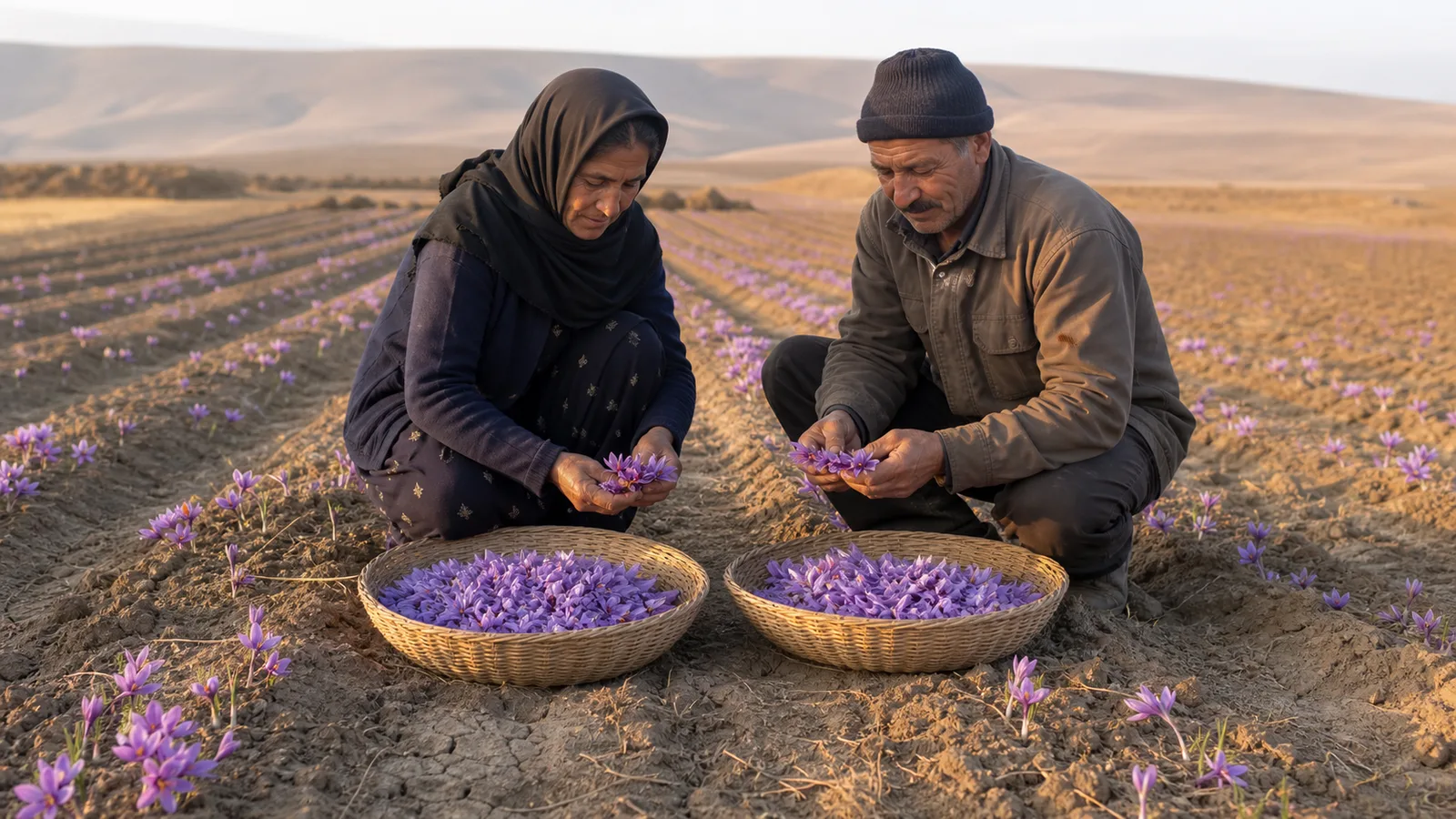
A historical agricultural report forecast more than 2 tonnes of saffron from North Khorasan Province, with most of the planted area concentrated around Faruj. A separate report from Boshruyeh County in South Khorasan recorded a larger planted area, a previous 3.5-tonne harvest, and about 1,700 people working in saffron cultivation.
The reports concern different provinces, counties, and seasons. Their figures are retained as dated local snapshots, not current production estimates. Read together, they show why hectares alone do not explain a saffron economy: productive field age, yield, labor, corm supply, extension advice, and market value all matter.
North Khorasan forecast: about 2.5 tonnes
Heydar Namvar, identified in the archived destination as a provincial horticulture official, forecast approximately 2 tonnes and 500 kilograms of dried saffron for North Khorasan during the reported year. The machine-translated article rendered the opening sentence poorly, but the headline and quantity establish the intended forecast.
Namvar put the area under saffron at about 600 hectares, with most fields in Faruj County. The stored translation says “acres,” yet Iranian agricultural reports in this collection consistently use hectares, and the article’s context supports hectares as the intended unit. Because the original-language release is not preserved in the post, the unit remains attributed rather than presented as independently verified.
If all 600 hectares were productive, a 2.5-tonne harvest would equal about 4.17 kilograms of dried saffron per hectare. That is a calculated average, not a figure quoted by Namvar. Young fields, fallow plots, and uneven yields could make the productive-area average different.
Faruj’s role in North Khorasan
Faruj was described as the province’s main concentration of saffron fields. A local cluster can make training and harvest organization more efficient because growers face the same short flowering window and can share access to labor, corm knowledge, drying experience, and buyers.
The older article contains a broken sentence about production in the previous two years, ending with an isolated “78.” There is no recoverable unit or complete comparison, so that fragment is not turned into a statistic. The 2.5-tonne forecast and 600-hectare area provide the usable North Khorasan evidence.
Official Iranian statistics submitted to the FAO/WHO Codex Committee provide useful historical context. For 2014–15, North Khorasan was recorded at 635 hectares, 2.64 tonnes, and 4.9 kg/ha. Those values are close in scale to the archived local forecast but belong to a specified earlier season.
Corm supply was a constraint
Namvar identified access to saffron planting material as a problem for growers. Saffron is normally propagated from corms, sometimes loosely translated as bulbs or onions. The report said local growers were beginning to produce their own corm supply in response.
Local multiplication can lower transport dependence and help farmers select material adapted to their conditions. It also requires discipline. Corms should be healthy, traceable, appropriately sized, and inspected before movement. Multiplying an infected or weak lot reproduces the problem along with the planting material.
The destination’s final translated sentence appears to say that seasonal planting activity had begun, but it does not provide a clear method or reliable calendar. That ambiguity is not converted into planting advice. Timing depends on local climate, field preparation, dormancy, and the production system.
Saffron in Boshruyeh, South Khorasan
The assigned source shifts south to Boshruyeh County. Its headline states that 1,100 hectares of agricultural land were under saffron, although one machine-translated paragraph again substitutes “acres.” The report attributed the figure to a local rural-livelihood administrator and consistently framed it as the county’s cultivated area.
For the preceding year, the official reported a 3,500-kilogram harvest worth 65 billion Iranian rials. Dividing those figures gives an average stated value of approximately 18.6 million rials per kilogram across the reported crop. That arithmetic does not reveal the farm-gate price for every grower, the grade mix, or the timing of sales.
The source said around 1,700 people were active in Boshruyeh saffron farming. A garbled translation turns the phrase into “face possible death penalty,” which is plainly unrelated to the Persian agricultural context and has been discarded.
The Boshruyeh forecast was lower than the prior harvest
The Boshruyeh official forecast 2,200 kilograms from supervised lands for the next reported harvest. Compared with the previous 3,500 kilograms, that is a reduction of 1,300 kilograms, or about 37%. The source does not explain the reason, and it is not clear whether the forecast covered exactly the same area.
If 2,200 kilograms came from all 1,100 reported hectares, the implied yield would be two kilograms per hectare. The preceding 3,500-kilogram crop would imply about 3.18 kg/ha. Both calculations assume the full area was productive, so they should be treated as scale checks rather than measured field averages.
A lower forecast could reflect field age, water, weather, acreage counted, or caution early in the season, but the report does not let us choose among those explanations. Preserving uncertainty is more accurate than supplying a cause after the fact.
Extension priorities in Boshruyeh
The source described extension measures intended to improve crop quantity and quality, including weed or shrub control and timely micronutrient nutrition where sufficient water was available. These are sensible categories of farm management, but they are not a universal recipe.
Weed control should match the weed, crop stage, and legal local options. Micronutrients should respond to soil or tissue evidence; applying them without a deficiency can waste money or create toxicity. Irrigation timing and amount depend on soil, rainfall, field age, and plant development.
The useful role of extension is to turn those broad policies into field-specific decisions, demonstrate safe methods, and record whether yield or quality actually improves. The same support can help growers coordinate harvest labor, drying, storage, testing, and sale.
Why the two Khorasan reports differ
North Khorasan and South Khorasan are separate provinces within the wider Khorasan saffron region. Faruj’s reported 600 hectares and Boshruyeh’s 1,100 hectares should not be added to create a current regional total because the reports are historical and may not cover the same year.
The yield calculations also show local variation. North Khorasan’s forecast implied roughly 4.17 kg/ha if the full area was productive, while Boshruyeh’s forecast implied two. Differences in field maturity and reporting scope can matter as much as province-wide climate.
For a broader view of national area, production, and the continuing dominance of Greater Khorasan, see our updated guide to saffron cultivation in Iran.
What these historical figures tell us
The destination’s phrase “natural saffron” does not describe a recognized production grade. The useful subject is regional saffron production: how much land was planted, how much dried stigma was forecast or harvested, and what farmers needed to sustain it.
Faruj’s concentration and Boshruyeh’s 1,700-person workforce show saffron as a local agricultural system rather than an isolated luxury product. Reliable corms, realistic yield expectations, field-specific advice, rapid post-harvest work, and transparent market records determine whether hectares translate into durable rural income.

![Exporting Saffron to Turkey + Price Guide [Complete 0 to 100]](https://img.rowhanisaffron.com/20260827003933/saffron-export-turkey-quality-inspection.webp)



