


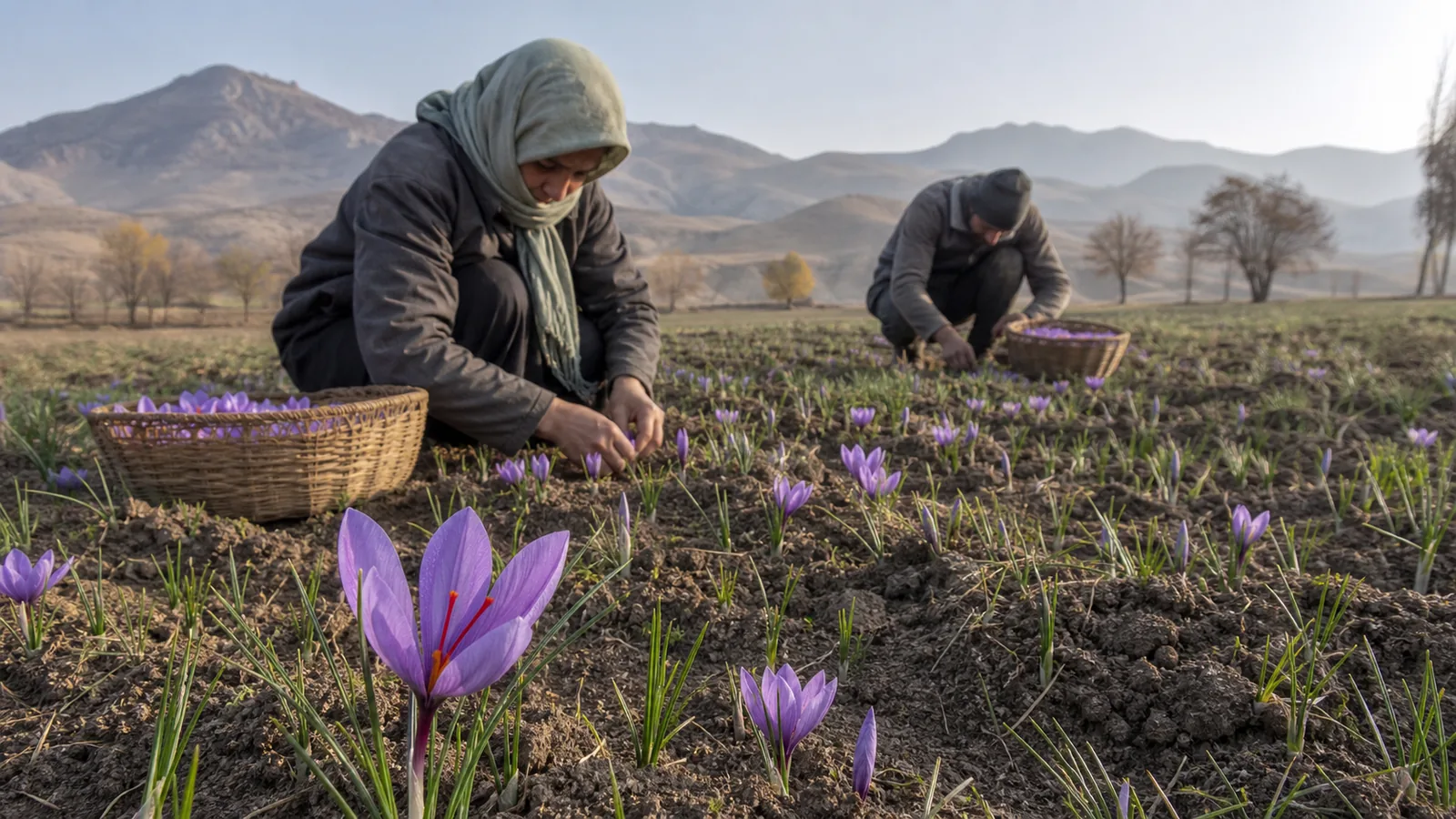
The forecast of 172 kg of saffron production in Hamedan belonged to the 2014 crop year. It was a provincial estimate, not a current figure and not Iran’s national output. The original news report expected Hamedan’s planted area to grow from 48 to 53 hectares and its dried-saffron production from 162 to 172 kilograms.
Read together, those numbers imply a forecast yield of about 3.25 kilograms per hectare. That is a more useful way to understand the announcement: Hamedan was a small, emerging producer compared with Khorasan, and the projected rise came mainly from a larger planted area rather than an extraordinary jump in yield.
What Hamedan’s 172 kg forecast included
The figures were reported by ISNA’s Hamedan service and attributed to Rahimi Bayat, then a horticulture official in the province’s Agricultural Jihad organisation. The surviving English translation calls the date the “fifth Sunday of August”; the precise Persian calendar wording was lost in translation, so the safe date is the article’s publication period in August 2014.
Bayat said the previous season had produced 162 kilograms from 48 hectares. For the new season, officials expected 53 hectares and 172 kilograms. The five additional hectares represented roughly 10 percent growth in area, while the production forecast was about six percent higher.
Neither number should be presented as a measured harvest until a final provincial record is found. A forecast can change with flowering, labour availability, weather, corm condition and drying losses. It does, however, document the stage at which commercial saffron cultivation had reached Hamedan at the time.
Hamedan was outside Iran’s main production centre
The old article placed 78 percent of Iranian saffron production in Razavi Khorasan and 18 percent in South Khorasan, leaving about four percent for provinces including Kerman, Isfahan, Hamedan, North Khorasan and Fars. Its wording is rough, but the larger point is sound: Khorasan dominated national saffron production, while Hamedan belonged to a much smaller group of developing regions.
An official Iranian proposal submitted to Codex provides a clearer nearby benchmark for 2014–15. It recorded 218.348 tonnes from 69,407 hectares in Razavi Khorasan and 48.019 tonnes from 14,727 hectares in South Khorasan. Isfahan, North Khorasan, Kerman, Fars and Yazd each accounted for much smaller totals. Hamedan was not listed among the principal provinces in that table.
The 2014 Hamedan story also referred to roughly 79,000 hectares of saffron nationally in Iranian year 1391. Its English version says those hectares produced “60 tons,” but that output conflicts with the surrounding shares and period data and is likely a damaged translation. It is preserved here as an unresolved line from the source, not repeated as a reliable national statistic.
How the forecast yield compares with Iran
The implied Hamedan forecast of 3.25 kg per hectare sits close to several period estimates for Iran. The Codex proposal’s 2014–15 provincial table reported 3.1 kg/ha in Razavi Khorasan and 3.4 kg/ha in South Khorasan. A later agronomy study, citing Iran’s Ministry of Agriculture for 2018, reported a national average of 3.62 kg/ha. Anyone comparing saffron yield per hectare in Iran should therefore match the kg figure to its province and year.
That does not mean every Hamedan field should produce the same amount. A recent peer-reviewed study of saffron density and planting depth summarised traditional country averages from 2 kg/ha in Morocco and Spain to 8.18 kg/ha in Italy, with Iran near 4 kg/ha. Climate, corm size and density, field age, irrigation, soil, nutrition, harvest handling and the way dry stigma yield is measured all contribute to that variation.
The original Hamedan article described five to six kilograms per hectare as an attainable yield and said good farm management could raise output towards ten. It also compared that upper figure with Afghanistan. Those values are better treated as management aspirations or selected-field results, not provincial guarantees. A forecast, an average and the best field in a programme answer three different questions.
Saffron’s crop cycle in Hamedan conditions
Saffron is Crocus sativus, a member of the iris family, Iridaceae. The old translation incorrectly placed it among lilies. It is sterile and is propagated by corms, which produce daughter corms during each annual cycle.
The translation also scrambled the producer-country order, repeating China and mixing Iran, Morocco, Pakistan, Italy, Afghanistan, America, Argentina and Myanmar into one sentence. Contemporary botanical reviews consistently identify Iran as the dominant producer and list India, Afghanistan, Greece, Morocco, Spain and Italy among the established cultivation countries. The old list is retained as evidence of what the report tried to cover, not as a reliable ranking.
Bayat described a field remaining productive for five to ten years, with three to seven years preferred for performance. Research comparing cultivation systems notes that Iranian saffron fields commonly follow a six-to-eight-year cycle, although local soil, disease pressure, corm crowding and farm economics determine when replanting makes sense.
The annual pattern is equally distinctive. Shoots emerge and flowers normally appear in autumn. Leaves develop from autumn through spring while daughter corms grow below ground. The crop then enters dormancy from late spring through summer. The source’s claim that saffron is “lush” only in autumn and winter misses the active spring leaf period.
For Hamedan, the report placed flower harvest from early to late November. That is useful as a local planning window, not a fixed date for every year. Temperature and the timing of autumn irrigation can move flowering, sometimes enough to create a serious labour problem if crews and drying space are not ready.
Corm quantity, field life and the first-year cost
The 2014 account said planting required three to five tonnes of corms per hectare and identified corm purchase as the main first-year expense. It also noted the advantage of daughter-corm multiplication. Those points describe the economics of a perennial field, but the tonnage is not a universal prescription.
Planting density and mother-corm size change both early flowering and later crowding. An open-access study of saffron corm multiplication describes corms as the most expensive planting input and gives an example of about 500,000 ten-gram corms per hectare—roughly five tonnes—at 20 by 10 centimetre spacing. That example broadly matches the old Hamedan range, but it is not a universal prescription. A grower still needs the target density, corm size, field duration and soil conditions before converting tonnes into a planting plan.
Use sound, correctly identified corms from a traceable lot. Inspect for damage, rot and pests before planting. The old instruction to disinfect every corm with pesticides and fungicides is too broad to follow safely: any treatment must be authorised for that use, based on an identified risk and applied according to local agricultural guidance. Our practical corm-selection guide explains the checks that come before treatment.
Soil and climate need field evidence
The report described temperate to semi-warm conditions, relatively mild winters, hot summers and light-textured soil as favourable. Hamedan’s colder landscape makes site selection more specific than that summary suggests. A field should be assessed for winter exposure, drainage, soil depth and texture, irrigation access and prior disease history.
“Sandy” and “clay” are not recommendations on their own. A very sandy soil may drain quickly but hold too little water and nutrition; a heavy clay can remain saturated and restrict emergence. The useful target is a workable, well-drained root zone that can be irrigated evenly without prolonged waterlogging.
The claim that no part of Hamedan province faced a cultivation restriction should also be read as promotional language, not a site assessment. The article mentioned cultivation around the provincial capital, Malayer and Tuyserkan, and said Malayer had reached about 20 hectares. One additional district name was corrupted into “Skinheads” by translation and cannot be identified safely from the surviving English text.
It also linked Hamedan saffron with the region’s Median history and place names such as Zafaranieh and a location near Tuyserkan. These are interesting local claims, but a place name is not proof of continuous saffron cultivation over several thousand years. Archaeological or documentary evidence would be needed before presenting that origin story as fact.
Harvest and drying determine saleable production
Picking saffron requires concentrated labour because flowers must be gathered during a short bloom and handled promptly. The older report described harvest as family work. That remains realistic for a small Hamedan holding, provided clean containers, separation space, drying capacity and worker hygiene are planned before flowering.
The source contrasted a “Spanish” drying method completed in 30 to 60 minutes with a traditional process lasting eight to 12 days. Rapid, controlled drying can protect quality, but neither country name nor time alone defines a safe method. Load depth, temperature, air movement, starting moisture and the dryer all matter. Eight to 12 days under uncontrolled conditions creates an obvious risk of contamination and quality loss.
Codex’s current standard for dried saffron, CXS 351-2022, focuses on the finished spice and its quality and safety characteristics rather than endorsing one national drying tradition. Producers need a repeatable process, clean contact surfaces and lot records, followed by checks appropriate to the intended market.
The article also said much of Hamedan’s crop was used locally, while some Iranian saffron travelled to Spain for packaging and resale. Repacking and re-export did occur in the wider trade, but this report did not provide customs data showing how much Hamedan-grown saffron followed that route. Our overview of Iranian saffron producers explains why farm origin, exporting country and the consumer-facing brand must be kept separate.
What remains unknown in the 2014 report
The English version gives agricultural-support figures as five million dollars, later rising to 10–15 million US dollars. The original currency, unit and programme are not clear enough to verify, so these should not be used as evidence of current loans or farm costs.
The durable facts are narrower. In August 2014, a provincial official forecast 172 kilograms of saffron from 53 hectares in Hamedan, after reporting 162 kilograms from 48 hectares the year before. The story documented saffron’s expansion beyond its Khorasan centre and identified the practical constraints that still matter: suitable sites, sound corms, realistic yield expectations, timely harvest labour and controlled drying.
Agronomy and statistical sources reviewed 28 August 2026. Historical Hamedan figures remain dated to the original report; growers should use current provincial records and local technical advice for planting and crop-protection decisions.

![Exporting Saffron to Turkey + Price Guide [Complete 0 to 100]](https://img.rowhanisaffron.com/20260827003933/saffron-export-turkey-quality-inspection.webp)



