


To save saffron as a durable source of value, Iran’s industry has to protect more than the flower. Farmers need workable production methods, scarce water must be managed carefully, and dried saffron has to reach buyers with its origin and quality intact. Those concerns were the heart of the South Khorasan report first preserved on this page in 2015. They still provide a useful way to understand where value can be lost between field and market.
This is a historical industry article, not a current production or price bulletin. Figures from the original report are identified as 2015-era estimates so they are not mistaken for today’s statistics. Newer evidence is used to explain the larger issues.
Why saffron matters in a dry farming region
South Khorasan’s climate makes every crop choice consequential. The original report described saffron as a high-value export crop suited to arid and semi-arid land, but it did not claim the plant could grow without water or good management. Drought, declining water flow and poorer water quality were all named as pressures on farmers.
That balance is also visible in the FAO’s account of the qanat-based saffron system in Gonabad. FAO describes saffron as comparatively drought resistant and valuable where water is scarce, while stressing that reliable irrigation, local knowledge and careful resource management support the system. “Low water use” should therefore mean using limited water intelligently, not treating water scarcity as solved.
The crop also supports a much wider rural economy. Corm production, field preparation, flower picking, stigma separation, drying, grading, packing and trade all create work. FAO’s current material says Iran remains the world’s largest producer, with more than 90% of global production, and that the value chain supports hundreds of thousands of smallholders. That scale is why safeguarding quality and farmer returns matters beyond a single harvest.
What the 2015 South Khorasan report recorded
The archived report quoted provincial agriculture official Hashem Vali-Pour Motlagh and economic activist Mohammad Reza Kafashi. Its figures belong to that reporting period:
- about 14,900 hectares in the province were reported under saffron cultivation, with a forecast harvest of roughly 50 tonnes;
- the preceding year was reported at about 14,287 hectares and 47 tonnes;
- more than 40,000 farming households were said to participate in the provincial saffron economy; and
- Iran was described as supplying about 95% of world saffron at the time.
These numbers are retained because they show the scale and reasoning of the original article, not because they should be reused as current statistics. Acreage, yield, employment and market share change. A present-day commercial decision needs dated figures from the relevant agricultural and customs authorities.
The report also described the corm cycle. It said corm lifting in South Khorasan ran from June through September, affected roughly 15–20% of planted area in a year, and could produce around 15–20 tonnes of corms per hectare from an established field after about five years. These were reported local estimates. Actual results depend on field age, corm density, soil, irrigation, disease control and the grower’s purpose.
Modernisation should solve a defined problem
The original call to “modernise” saffron farming was broader than buying machinery. It covered planning, training and better timing across cultivation and harvest. That distinction matters. A tool is useful when it reduces a specific bottleneck without bruising flowers, mixing lots or lowering stigma quality.
Mechanisation can help with operations such as land preparation, bed formation, corm handling or controlled processing. Harvest remains difficult to automate because flowers open over a short period and the valuable stigmas are delicate. The sensible question is not whether every stage looks modern. It is whether a change improves labour efficiency, consistency, traceability or safety on the farm where it will be used.
Farm size also affects the answer. A study of Iranian saffron production found different environmental performance across small, medium and larger farms, with fertiliser and diesel among the important impact sources. That does not mean “larger is always better.” It shows why machinery, input use and field organisation should be assessed together rather than promoted as a universal package. See the peer-reviewed life-cycle study for its boundaries and findings.
Smallholders need systems that work at small scale
Fragmented landholding was one of the original report’s clearest concerns. Small plots can make equipment expensive per hectare and complicate scheduling. Rural migration can leave fields short of labour exactly when soil preparation or flower picking must happen.
Cooperative access to equipment, shared drying facilities, practical extension training and coordinated harvest labour can address those constraints without forcing every grower into the same model. The objective is timely work and consistent quality. Any programme should be judged by what reaches the farmer: lower avoidable cost, less crop loss, safer handling and a clearer route to market.
Quality can disappear after the flower is picked
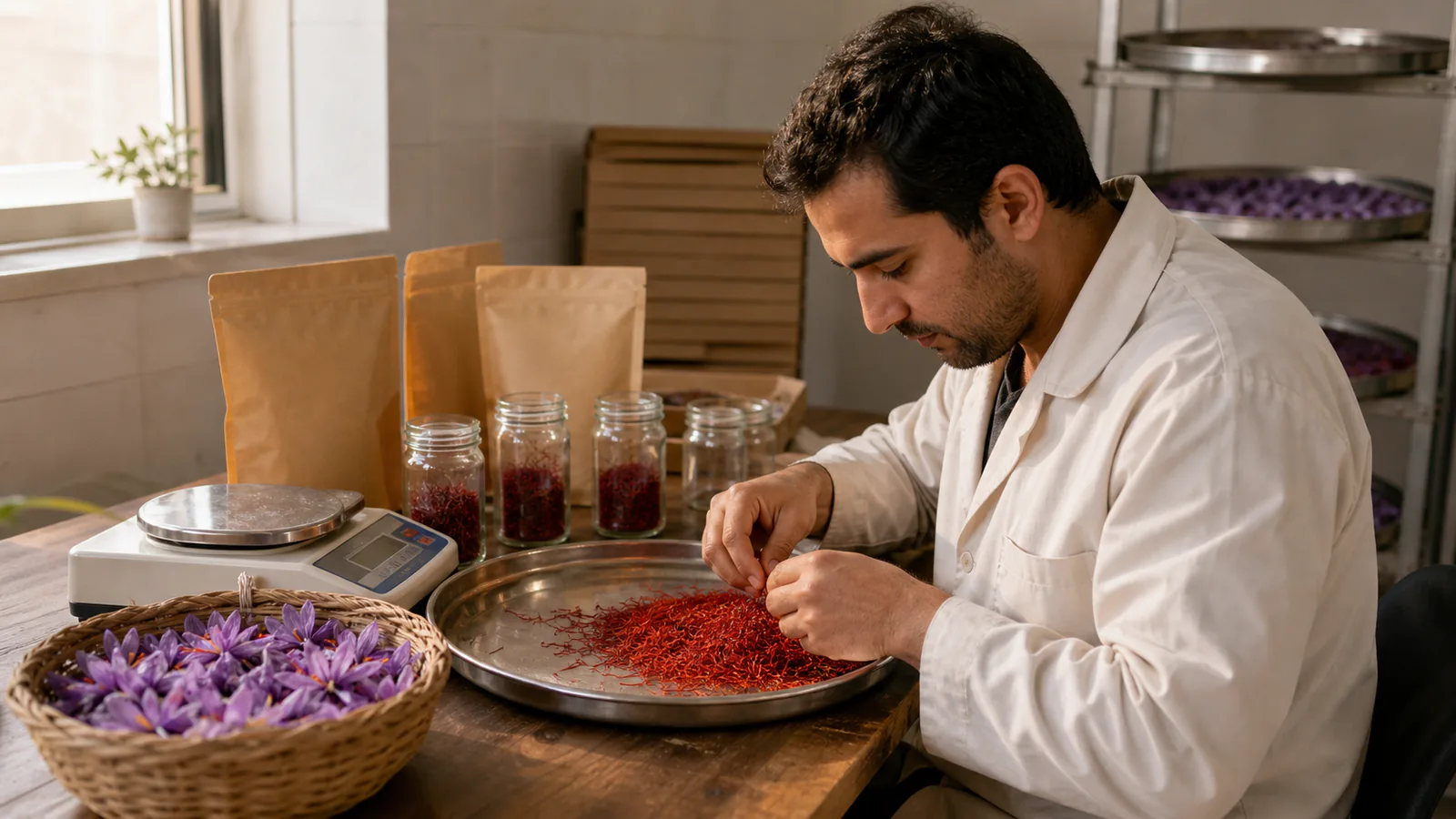
A strong crop can still lose value during separation, drying, storage or packing. Moisture, heat, light, contamination and poor lot control can weaken aroma, colour strength or buyer confidence. Careful processing therefore belongs in the same conversation as cultivation.
Packaging is not merely decoration. It should protect the threads, identify the producer or packer, preserve lot information and suit the rules of the destination market. The product presentation can change for different buyers, but its origin should not become obscure. The FAO’s 2025 work on Iran’s saffron value chain likewise puts authenticity, quality assurance, traceability and market access together. Its quality-integrity programme reflects the same problem the 2015 article was trying to express.
Before planting for a commercial market, growers and traders need to know the expected grade, form, pack size, labelling rules, testing needs and likely route to sale. Our guide to choosing an Iranian saffron exporter explains the practical quality documents and checks a buyer can request.
Price and export volume are not the whole measure
The archived report linked unstable prices and irregular exports with weak returns. Those problems cannot be read from a single headline number. A high retail price abroad does not reveal what a farmer received, and higher export tonnage does not automatically mean that origin, branding or margin stayed with the producing community.
A healthier value chain makes the product easier to verify and harder to substitute. It rewards careful cultivation and processing, gives buyers consistent specifications, and keeps records that connect a finished pack to its lot. This is also why bulk sales and branded sales should not be treated as moral opposites. Each can serve a legitimate market, but both need honest origin, dependable quality and commercial terms the parties understand.
Responsible claims are part of protecting saffron
The 2015 text ended with a long list of medical promises, including claims about depression, digestion, bronchitis, blood pressure, memory, diabetes and hepatitis. Repeating those statements as established treatments would not protect the product. It would misrepresent a mixture of traditional use, laboratory findings and small clinical studies.
Research on saffron extracts is real, but it is condition-specific and does not turn culinary saffron into a medicine. A systematic review of trials involving diabetes or metabolic syndrome found limited evidence of a possible effect on fasting blood glucose, while results for blood lipids and blood pressure were inconclusive and many studies were poor quality. The authors called for better research. Read the systematic review, not a treatment claim built from it.
Traditional use can be described as history. It cannot prove that saffron treats hepatitis, diabetes, bronchitis, seizures, depression or Alzheimer’s disease. Saffron should not replace diagnosis, prescribed treatment or professional advice. Concentrated extracts and supplements also differ from the small amount used to flavour food, so trial results should not be transferred casually to tea or cooking.
What “save saffron” means in practice
The industry does not need one dramatic intervention. It needs connected decisions: conserve water, improve field work where the evidence supports it, give smallholders usable training and shared capacity, dry and store the threads correctly, document each lot, package for the actual buyer and describe the product honestly.
That is the durable meaning of “Save saffron.” Preserve the farming knowledge that suits the region, test improvements under local conditions, and carry the value of a good flower all the way to the person who opens the pack.

![Exporting Saffron to Turkey + Price Guide [Complete 0 to 100]](https://img.rowhanisaffron.com/20260827003933/saffron-export-turkey-quality-inspection.webp)



