


Saffron Market Development matters most when it improves the choices available to the small farms that grow much of Iran’s crop. A commodity exchange can help by publishing comparable prices, defining grades and allowing eligible saffron to be stored and traded through warehouse receipts. Those tools can reduce some disadvantages of an opaque wholesale market, but they do not guarantee a higher price or remove every barrier a farmer faces.
The comments behind this article came from Deputy Agriculture Minister Hossein Shirzad during an earlier phase of Iran’s exchange programme. He described the exchange as a way to organise traditional trading, improve standards and give small-scale producers better access to financial tools. The mechanisms remain useful to understand, although the announcement’s figures and policy ambitions should not be mistaken for current contract terms.
Why small saffron farms can struggle in a traditional market
Saffron is harvested during a short, labour-intensive season. A grower may need cash soon after picking and drying the stigmas, just as a large share of the crop reaches local buyers. When offers, grades and transaction volumes are private, it is difficult to judge whether a quoted price reflects the quality of the lot or simply the seller’s need for a quick sale.
Small lots create another practical problem. Testing, packaging, transport and export documentation have fixed costs, so an individual farmer may have less bargaining power than an aggregator handling many kilograms. Differences in local grading language can also make apparently similar offers hard to compare.
These are the problems an organised market is meant to address: limited price visibility, inconsistent specifications, post-harvest selling pressure and a fragmented route from farm to exporter.
How warehouse receipts change the sale process
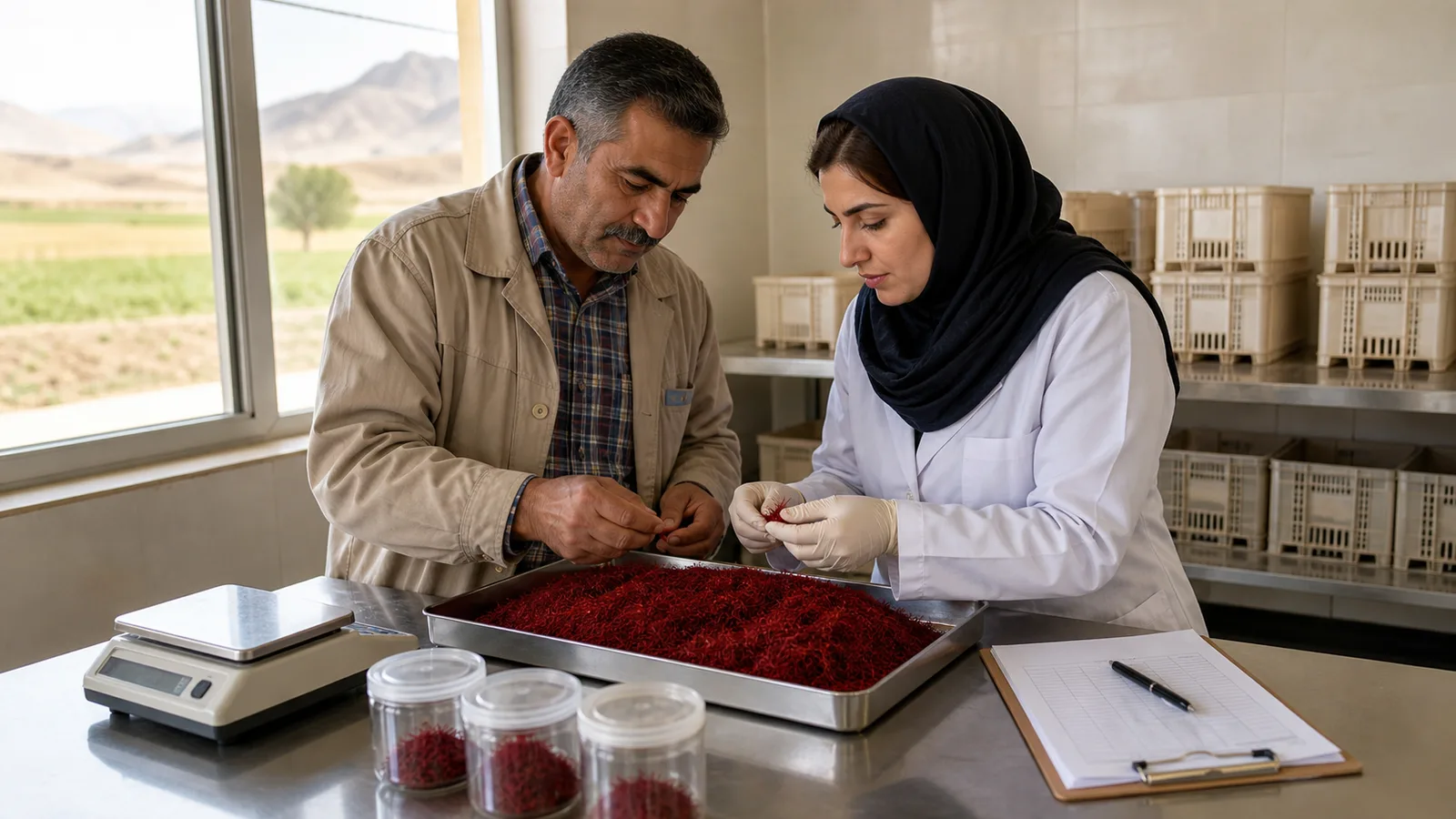
With a warehouse-receipt system, saffron is delivered to an approved facility and assessed against the exchange specification. Once accepted, the stored lot is represented by a receipt. That document can support a sale without moving the physical saffron each time ownership changes.
For a grower, the important benefit is time. Suitable storage and a tradable receipt may make it possible to compare offers after the busiest harvest period instead of selling immediately. Iran’s agricultural news service reported the start of saffron commodity-deposit-certificate trading in 2017, including approved warehouses and defined acceptance procedures.
The receipt does not remove costs or risk. The farmer needs to check testing and warehouse fees, minimum lot rules, storage limits, sale liquidity and how payment is settled. Product that fails the specification may not be admitted, and a later market price can be lower as well as higher.
Standards can make quality visible
Clear specifications are a central part of saffron market development. A contract should identify the accepted form or grade, moisture limits, purity requirements, packaging and delivery location. That makes a transaction more meaningful than a price stated only as “per kilogram.”
Standardisation can reward careful harvesting and drying when those practices produce a compliant lot. It can also reduce disputes between sellers and buyers. Still, an exchange grade is not the whole story. Colouring strength, aroma, harvest age and intended use may matter to a particular buyer, so laboratory results and lot-level documentation remain important.
Price transparency: useful, but not automatic
Published trades can show what a specified lot sold for, how much was traded and when the transaction occurred. This gives farmers a reference before negotiating elsewhere and helps exporters compare physical offers with organised-market data.
A last traded price is not necessarily a national average. Thin trading can make one deal look more representative than it is, while currency movements and delivery terms can create large differences between an Iranian wholesale quote and an overseas retail price. Useful transparency therefore includes volume, grade, date, bids and offers—not just the headline number.
This is also why the goal of making Iran a global saffron price reference depends on consistent reporting and participation, rather than a declaration by one institution.
Futures and options are risk tools, not promised income
The original ministerial account referred to futures and options as ways to support farmers. Properly used, derivatives can help a producer or cooperative manage exposure to price changes. The US Commodity Futures Trading Commission describes price discovery and the transfer of price risk as core economic purposes of futures markets.
That does not make a derivative suitable for every grower. Contract size, margin calls, expiry, delivery grade and the difference between the exchange contract and the farmer’s local cash price all matter. A hedge can reduce one kind of uncertainty while introducing basis, liquidity and operational risk. Anyone considering one should read the live contract specification and obtain qualified financial advice where needed.
For a practical explanation, see our guide to saffron futures contracts and cultivation decisions.
What genuine support for small-scale farmers looks like
An exchange is easier for small producers to use when the surrounding services work. Farmers need nearby accredited collection or warehouse points, understandable grade reports, transparent fees and a way to combine small lots without losing traceability. Training must explain both the benefits and the conditions of each instrument.
Cooperatives can help with aggregation, testing and market access, provided their charges and decision-making are clear to members. Reliable electronic settlement can shorten payment delays. Market data should be available in a form that a grower can actually read, rather than being visible only to professional traders.
Credit linked to a warehouse receipt may improve short-term liquidity in some systems, but it is still a loan. Eligibility, valuation, interest and lender rules must be checked; the receipt itself should never be described as guaranteed financing.
Export competitiveness requires more than exchange trading
Iran’s production scale gives it an important place in international saffron supply. Its export position also depends on consistent testing, clean processing, suitable packaging, traceability, dependable delivery and relationships in destination markets. Organised domestic trading can support those foundations, but it cannot replace them.
Bulk exports may leave branding and retail margins elsewhere in the supply chain. Moving toward higher-value sales requires product presentation and customer service alongside a credible wholesale benchmark. The same batch identity should follow the saffron from accepted warehouse lot to export documents and final pack.
A practical test of market development
The success of a commodity-exchange programme should be measured in outcomes farmers can verify: more comparable bids, clearer grades, reasonable participation costs, timely payment and fewer forced sales under harvest pressure. Trading volume alone is not enough if small growers cannot access the market or understand the terms.
Used carefully, warehouse receipts, published transactions and standard contracts can strengthen Iran’s saffron market. Their value lies in better information and more choices—not a promise that every lot will sell for more. That realistic standard keeps Saffron Market Development focused on the people it is supposed to serve.

![Exporting Saffron to Turkey + Price Guide [Complete 0 to 100]](https://img.rowhanisaffron.com/20260827003933/saffron-export-turkey-quality-inspection.webp)



