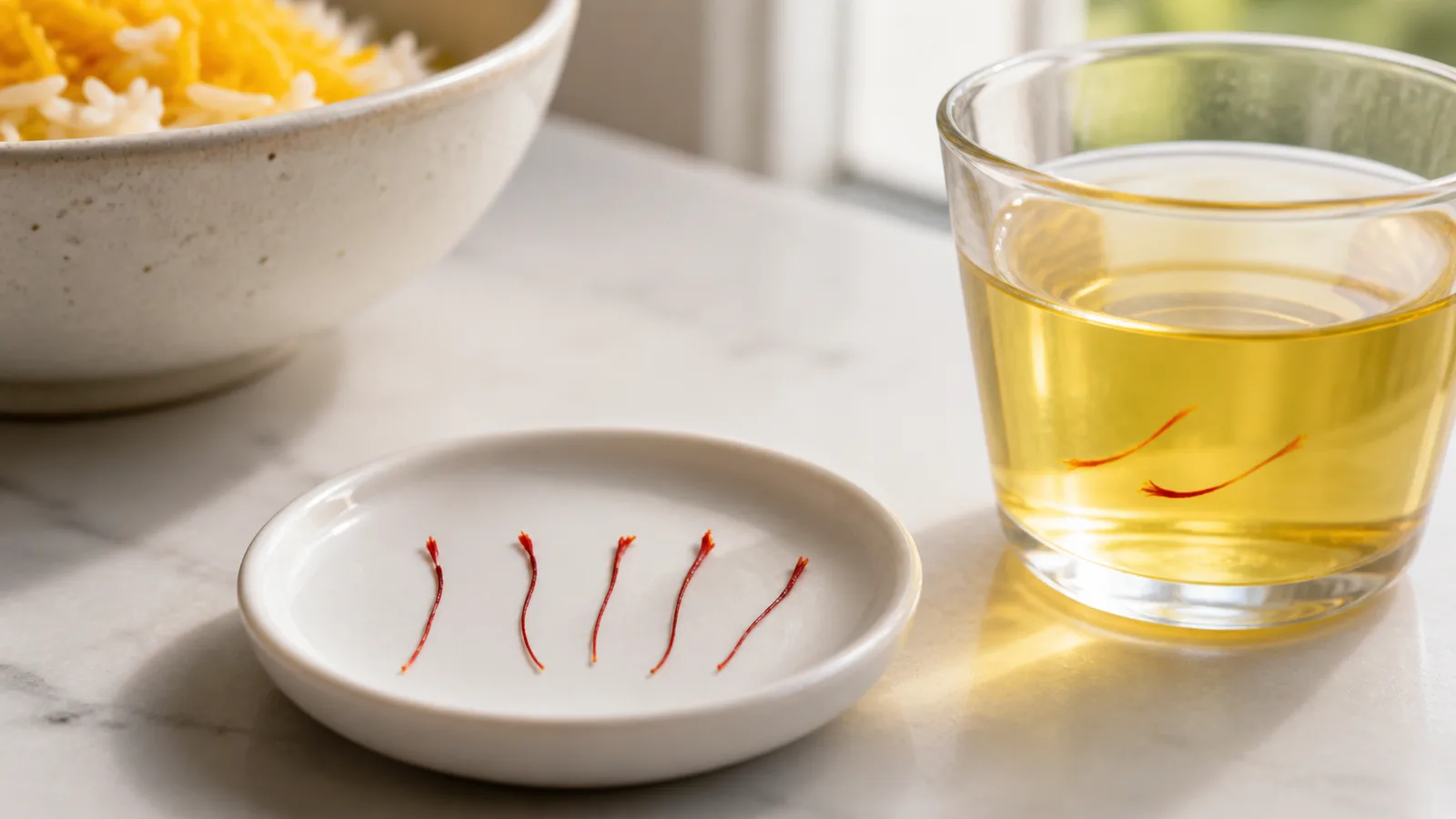


Saffron can be fairly easy to keep alive in suitable soil, yet expensive to produce as a finished spice. The contradiction disappears once growing a few corms is separated from picking thousands of flowers on time, removing three tiny stigmas from each one, drying them correctly, and proving the quality of the final batch.
Why is saffron so expensive if it is easy to grow?
“Easy to grow” usually means that a healthy Crocus sativus corm can survive and flower when it has sun, drainage, and the right seasonal cycle. It does not mean that every corm flowers heavily, that fields are free to establish, or that the spice can be harvested by an ordinary combine.
A home gardener may be pleased with six flowers. A commercial producer has to gather a large, clean crop during a short bloom, then turn the delicate red stigmas into a stable food product. That difference between plant survival and saleable yield is the starting point for understanding saffron price factors.
Each flower gives only three saffron threads
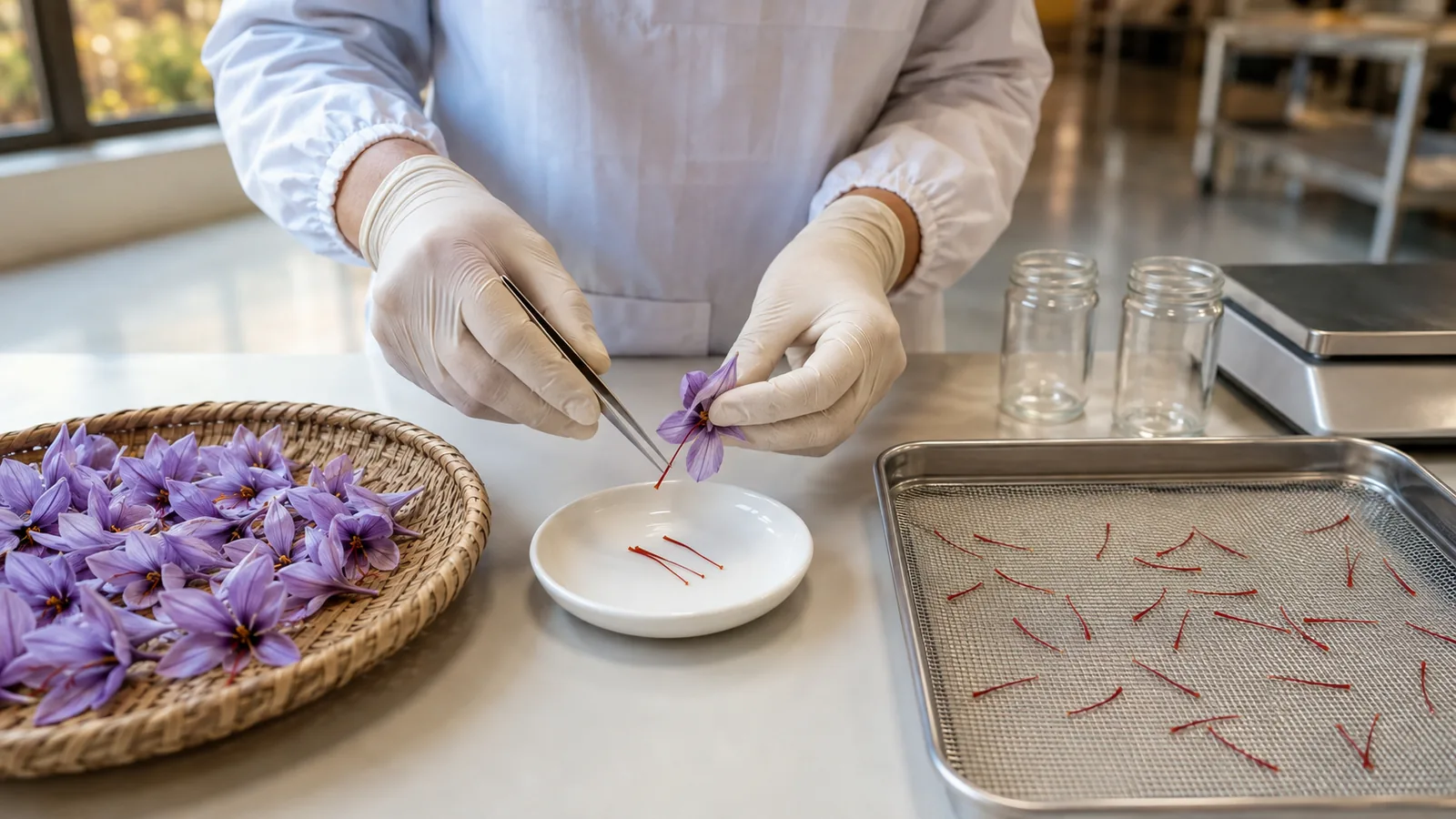
The usable spice is not the whole flower. Each bloom supplies three red stigma branches, while the purple petals and yellow stamens are excluded. Even a productive-looking bed therefore yields very little dried saffron by weight.
A practical planning range is about 150,000 to 200,000 flowers for 1 kg of dried saffron, although published estimates vary with stigma size, grade, moisture, and method. Our evidence review of flowers needed for one kilogram of saffron compares figures from several authoritative sources and explains why there is no universal conversion.
The small yield matters at every scale. Flowers take space and cultivation work, but almost all of their fresh mass never becomes the spice in the packet. Drying removes still more mass from the stigmas before they are ready to store.
The harvest cannot wait
Saffron flowers over a brief autumn period. Pickers have to move through the crop while blooms are clean and in good condition, often returning day after day during the peak. A flower missed at the right stage cannot simply be added to next month’s harvest.
After picking, the stigmas are separated from the flowers. This close work requires care because unwanted floral matter reduces purity and rough handling wastes the most valuable part. The fresh stigmas then need prompt, controlled drying. Too much heat can damage quality; uneven or insufficient drying can leave an unstable or misleadingly heavy product.
The Food and Agriculture Organization’s saffron production manual covers flower harvest, stigma separation, drying, grading, packing, and storage as connected stages. The crop may be straightforward to plant, but the work after flowering is neither automatic nor optional.
Farming still carries cost and risk
A producer needs suitable land or protected growing space, healthy corms, bed preparation, drainage, weed control, water management, tools, labour, and storage. Corms multiply, but that does not make the first planting free. Small or immature corms may not flower, and overcrowded beds eventually need lifting and division.
Yield also changes with corm size, weather, soil, disease, field age, and management. A farm must pay for poor seasons as well as good ones. It may be biologically possible to grow saffron in many places while still being commercially difficult to produce a consistent quantity at the required quality.
Mechanisation can help with soil preparation, planting, transport, and some handling tasks. It does not remove the narrow harvest window or the need to protect fragile stigmas. The relevant question is not whether one machine exists, but whether the full process can deliver clean, traceable saffron without losing more value than it saves.
What does a saffron processing plant cost?
A saffron processing plant can mean anything from a small hygienic drying and packing room to a larger facility that receives flowers from many farms. There is no responsible single price without a country, capacity, building condition, labour model, testing plan, and food-law specification.
A realistic budget has to account for:
- clean receiving and flower-separation areas with food-safe surfaces;
- controlled drying equipment and temperature or moisture monitoring;
- sorting, foreign-matter control, scales, and batch identification;
- food-safe packaging, sealing, labels, and traceability records;
- appropriate sampling and laboratory testing, whether in-house or outsourced;
- dry, dark storage and protection from contamination;
- labour, training, cleaning, utilities, maintenance, permits, and rejected material.
Capacity changes the calculation. Equipment that suits a family crop may become a bottleneck during a large harvest, while an oversized line can sit idle for most of the year. Local wages, electricity, construction, laboratory access, and compliance costs make an old estimate from one region a poor quote for another.
Our article on saffron processing from flower to packed spice explains the operational stages that should be defined before anyone requests equipment prices.
Quality control adds value as well as cost
Two red-looking batches are not necessarily equivalent. Moisture, foreign matter, the proportion of red stigma to pale style, and the compounds associated with colour, aroma, and bitterness all affect commercial quality. Sampling and testing cost money, but they also help a buyer distinguish a documented lot from an unsupported claim.
The current ISO 3632-1:2025 saffron specification covers requirements for dried saffron in filament, cut-filament, and powder forms. ISO also lists ISO 21983 guidance for harvesting, transport, stigma separation, drying, and storage before packing. A standard does not set the market price, but meeting and documenting relevant requirements adds work that an unverified packet may avoid.
Powder needs particular care because a buyer cannot inspect thread shape and unwanted material is harder to see. Whole threads are not automatically perfect, but they make a useful first visual check before laboratory evidence is considered.
Demand and the supply chain affect the final price
Biology and labour create a high production floor; the market then moves around it. Harvest size, stocks, exchange rates, origin, grade, certification, order quantity, packaging, transport, tax, and retailer margins can all change what a buyer pays. Farm-gate, export, wholesale, and retail figures describe different points in the chain.
Why is Iranian saffron so expensive in one shop but less costly in another? The two offers may differ in grade, harvest age, testing, package size, export documentation, currency, and retail margin. Iranian origin alone does not set a fixed price, and the cost of saffron in Iran is not the same as the landed retail price in another country.
Demand matters, but it should not be used as a vague explanation for every price. Saffron prices can rise or fall. A meaningful quote needs a date, currency, net weight, product form, grade or test basis, delivery terms, and tax treatment.
Why growing your own does not make saffron cheap
A gardener can produce a few threads without placing a cash value on personal time. The corms, pot, compost, light, space, and months of care still have a cost, and a small harvest spreads those inputs over very little spice. Home growing is satisfying because it reveals the plant and process, not because one windowsill replaces a commercial supply chain.
The University of Vermont’s high-tunnel saffron newsletter makes the same central distinction: the plant can suit protected production, while the expense still reflects flower harvesting, stigma separation, and drying.
How should a buyer judge whether the price is fair?
Compare offers by net weight and product form first. Then look for a clear origin, lot identity, packing date or harvest context, storage condition, and relevant test evidence. Decorative packaging can raise the price without improving the spice; a plain pack can be good value if the saffron is authentic, fresh, and properly documented.
Low price alone does not prove fraud, and high price does not prove purity. A fuller guide to the cost of saffron and comparing offers covers price per gram, quality, origin, packaging, and unusually cheap lots.
That is why saffron is so expensive: saleable saffron is difficult to produce at scale, not because the crocus is impossible to grow. For available thread formats, visit our saffron shop. For a current trade question with a specified quantity and destination, use the contact page.